Leaves on a StreamEmotional Fitness · ~3 min
About this template · Updated September 2026
Credit first. The personal user manual reached a wide audience through two sources. In a 2013 Corner Office interview in The New York Times, Ivar Kroghrud, a co-founder of the feedback software company QuestBack, described the one-page "user manual" he had written so people could understand how to work with him, and he closed it by asking readers what a revised version should add. Atlassian later turned the idea into a team exercise, My User Manual, in its Team Playbook. This worksheet is independent: Fabulous built it, and neither Atlassian, Mr. Kroghrud, The New York Times nor the separate Manual of Me product made, reviewed or endorsed it.
Every working relationship opens with a stretch of quiet guesswork. A new colleague has to work out whether your short replies mean you are annoyed or just busy, whether a message sent at nine at night will be read at nine at night, and whether you want feedback in the meeting or after it. Most people learn these things the slow way, by getting them wrong. Kroghrud's reasoning was that the learning curve can be shortened: hand people the page on their first day and they skip months of bumping into habits they cannot see yet.
That is all a personal user manual is. Some teams call it a manual of me, a how to work with me document or a personal operating manual. It is short, it is written in the first person, and it covers working together rather than your whole character.
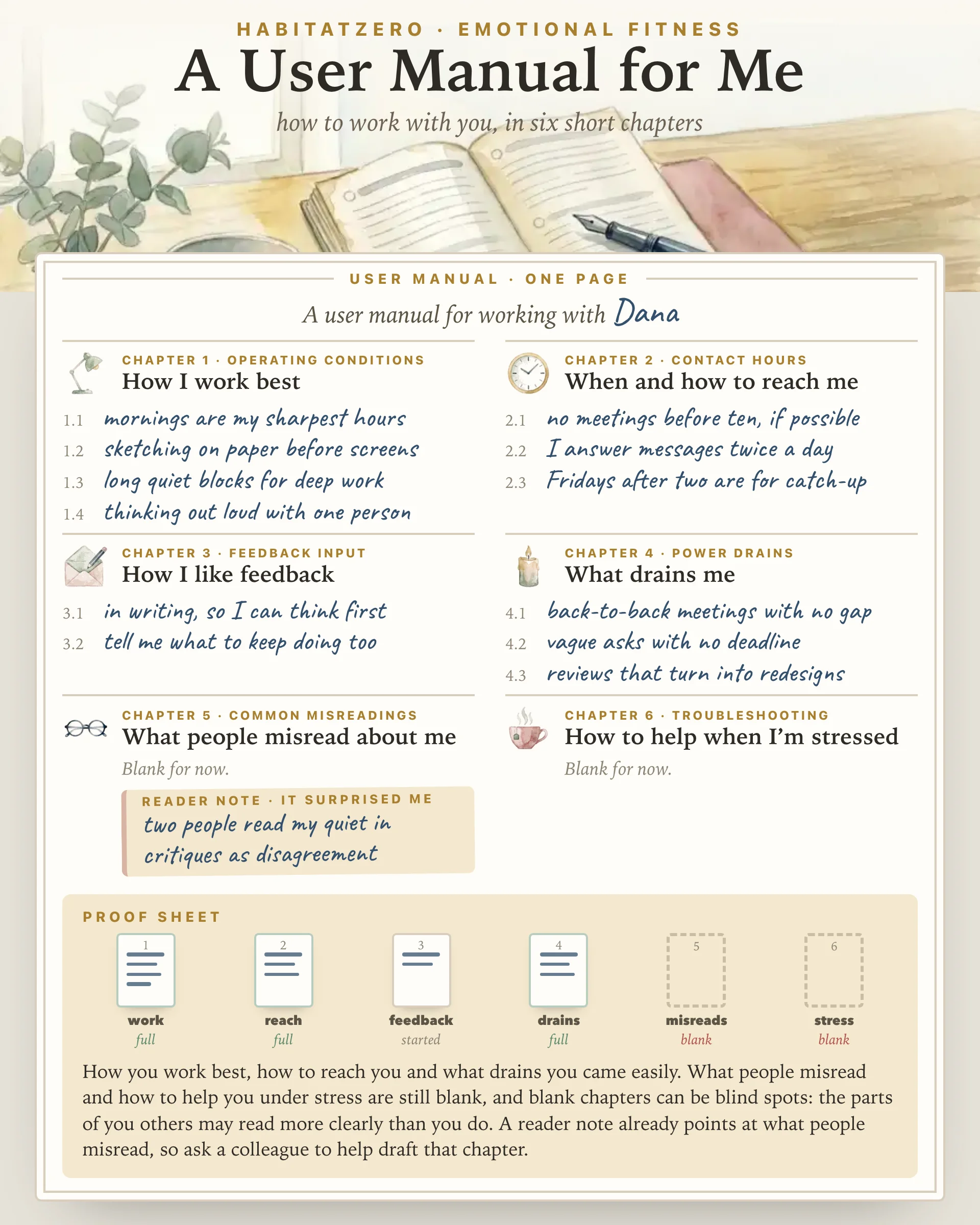
The manual has six chapters: how you work best, when and how to reach you, how you like feedback, what drains you, what people misread about you, and how to help when you are stressed. Open a chapter, tap the suggested lines that are true of you or write your own, and each one lands in handwriting, numbered like a real manual. A chapter holds four lines. The limit is deliberate, because a manual nobody finishes reading helps nobody.
Below the manual sits a proof sheet: six small pages showing which chapters filled up and which stayed blank. The reading underneath names the chapters that came easily and the ones still empty, and it rewrites itself whenever you change a line. Once the manual is out, the reader notes panel logs what a colleague asked or what surprised you, and which chapter it touches. If a note lands on a blank chapter, the reading says so.
Printing gives you one clean page: your name and the chapters you actually wrote. Blank chapters, the proof sheet and your notes never reach the paper. Atlassian's version of the exercise promises that nobody is pressured to share what they are not comfortable sharing, and the print keeps the same rule.
The manual itself has barely been studied, so any promise that it transforms a team runs ahead of the evidence. It rests on nearby research. Personality psychologist Simine Vazire tested who knows what about a person with 165 participants rated by themselves, by friends and by strangers. People were the best judges of their own neuroticism-related traits, the inner and hard-to-see ones, while friends were better judges of intellect-related traits. What drains you and how stress feels from the inside are chapters only you can write, and what people misread about you may be clearer from where your colleagues sit. That is why the proof sheet treats a blank chapter as a question to take to someone else rather than as a failure.
The second strand is psychological safety. Amy Edmondson's study of 51 work teams found that a shared belief that the team was safe for interpersonal risk went with more learning behavior, and learning behavior in turn went with better team performance. A manual does not create that safety on its own. It can shrink one small risk, the risk of saying how you like to be treated, but it works best on a team that already listens.
Two limits are worth keeping in view. A manual describes preferences rather than fixed traits, and it goes stale as your work changes. It is also not a contract: colleagues will not honor every line, and a manual that reads like a list of demands gets quietly ignored.
Be concrete. "I answer messages twice a day" helps a teammate plan their afternoon; "I am responsive" tells them nothing. Write for an ordinary week rather than your best one. Leave out anything you would not want forwarded, since a manual tends to travel. Then hand it over in a conversation instead of only posting a link, and ask one colleague to draft the chapter you left blank.
Reach for it in your first month with a new team, when a new manager arrives, or when one misunderstanding keeps repeating. If the blank chapters intrigue you, The Johari Window is built for mapping what others notice about you that you miss. And once the whole team has shared manuals, Start, Stop, Continue turns that openness into feedback on the work itself.
It is a short page, often called a manual of me or a how to work with me document, that tells colleagues how to get the best from you: when you think most clearly, how to reach you, how you take feedback and what tends to go sideways. It spares people from learning your habits by trial and error.
Most personal user manual examples cover the same ground: your best working conditions, the channels and hours that suit you, how you like feedback, what wears you down, what people tend to misread about you and what helps when you are stretched. A few concrete lines per section tell a teammate far more than a paragraph of adjectives.
An early and much-cited example is a 2013 Corner Office interview in The New York Times, where Ivar Kroghrud, a co-founder of the software firm QuestBack, described the one-page user manual he gave colleagues. Atlassian later built a team exercise around the idea, called My User Manual, in its Team Playbook.
No. Fabulous made this worksheet on its own. Atlassian, Ivar Kroghrud, The New York Times and the separate Manual of Me product had no hand in it and do not endorse it.
The filled-in example on this page is free to look through. Writing your chapters, keeping reader notes and printing your copy happen once you personalize the template in HabitatZero, which costs nothing.
By the team behind Fabulous, the science-based self-care app used by over 30 million people.