
The Overwhelm Recovery ProtocolWellness & Routines · ~5 min
About this template · Updated September 2026
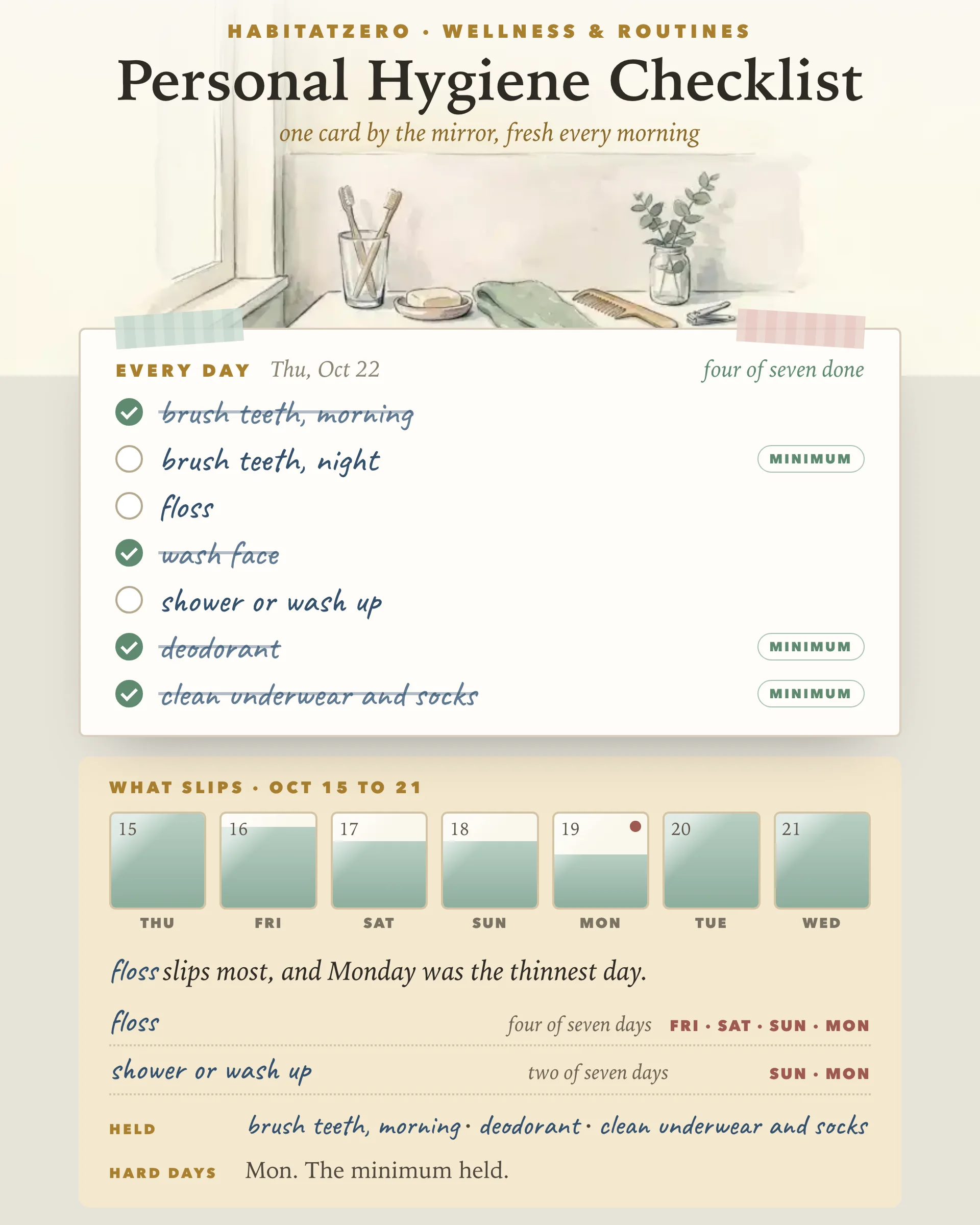
Most people know what personal hygiene involves. The harder part is noticing which pieces quietly drop out of a week, and that is what this checklist shows you. It is a card for the bathroom mirror with daily, weekly and monthly lists. You check lines off as you go, each list starts fresh by itself, and a panel under the card reads the past seven days back to you.
The card starts with lines you can keep, drop or add to. Where a health organization gives a number, the card follows it; where the answer depends on you, it asks you to choose.
Tap a line when it's done and it gets crossed through. The daily list resets on your own calendar date, the weekly list every Monday and the monthly list on the first, so nothing needs clearing by hand. Marks stay with the day they were made: if the card is still open past midnight, your first tap turns it to the new date instead of marking the old one.
A weekly line with a number, like hair, fills a row of dots as the week goes on, and once it has had its planned turns the card says so. Each list has a cap, ten daily lines, six weekly and five monthly, so the card stays readable at a glance. Taking a line off removes its marks too, and every count follows.
The panel under the card looks at the seven days before today. Each day becomes a tile that fills with the share of your daily list you checked, so thin days stand out. Below the tiles, the card names the line that slips most and the exact days it slipped, lists what held every day, and notes any weekly line that fell short last week.
Read it as information about your week, not as a grade. If floss keeps slipping on nights you get home late, the ADA's once a day comes with no hour attached, so the morning counts too. If showers drop out on weekends, pair one with something you already do then. A line that almost never gets checked may belong on another list, or off the card.
Days with no marks at all are left out, not counted as misses, since the card can't know what happened on a day you didn't open it.
Some days the full list is out of reach, whether from illness, grief, exhaustion or a heavy mood. Mark the day as hard and the card keeps your hard-day minimum in full view while everything else goes quiet. Choose up to three lines for that minimum on a steadier day, such as brushing at night, deodorant and clean underwear. When a hard day comes, finishing those three is enough, and later the panel tells you whether the minimum held and what went first.
If basic care has felt out of reach for weeks rather than days, that is worth raising with a doctor or therapist. It says nothing bad about your character, and they can help you figure out what is getting in the way.
Open the card by the sink morning and night, and read the panel once a week. If mornings are where everything slips, the Morning Routine Checklist gives each step its honest minutes and works out when to get up. If you meant bedtime habits, the Sleep Hygiene Quiz scores that other kind of hygiene. For water, movement and time with people, the Self-Care Checklist covers the care that lives outside the bathroom.
Every day: brushing twice, cleaning between your teeth once, washing your face, a shower or wash-up, deodorant, and clean underwear and socks. Every week: hair on your own rhythm, fingernails, sheets and towels. Every month: toenails, your hairbrush and comb, and a look at your toothbrush, which the ADA says to replace every three or four months.
It depends on your hair. The American Academy of Dermatology suggests washing based on how oily it gets: every day can suit straight hair with an oily scalp, while dry, textured, curly or thick hair can go longer, washed when needed and at least every two to three weeks.
The American Dental Association recommends brushing twice a day with a soft-bristled brush and cleaning between your teeth once a day, with floss or another between-teeth cleaner. Once a day comes with no set hour, so if flossing keeps slipping at night, the morning works too.
Mark the day as hard and let a small minimum count, such as brushing at night and a clean shirt. If basic care has felt out of reach for weeks rather than days, mention it to a doctor or therapist. They can help you find out what is getting in the way.
The page shows a filled example you can look through. Checking lines off, the fresh start each morning and the reading of what slips all happen in HabitatZero, which is free.
By the team behind Fabulous, the science-based self-care app used by over 30 million people.


