Leaves on a StreamEmotional Fitness · ~3 min
About this template · Updated July 2026
Most journals watch days. This one watches the person. It runs at the reflective altitude — the height from which you can see a season at a time — and it keeps exactly three things: who you are becoming, a monthly postcard sent backwards, and footprints. That is the whole system. No daily quota, no streak, and no score, because the subject of this journal is not your output. It is the slow, real, hard-to-see fact that you are not quite the person you were in spring.
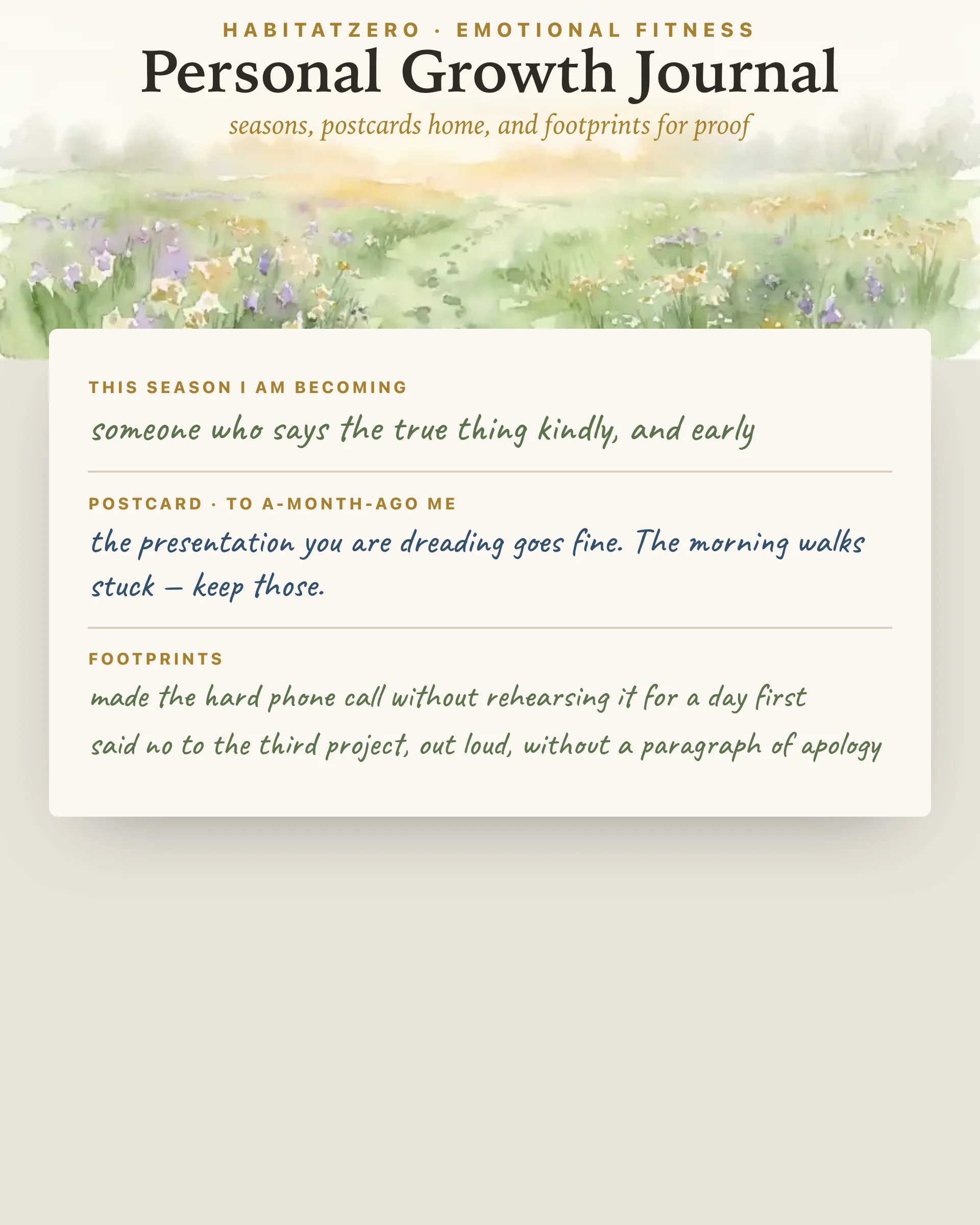
The journal opens with one line: this season I am becoming ___. Written as a person, not a project — "someone who says the true thing kindly, and early," not "improve communication skills." Psychology has a name for the pull this kind of line exerts: possible selves — the vividly imagined versions of who we might become, which research treats as one of the mind's basic motivational instruments. A possible self you can picture recruits behavior in a way a bullet-pointed goal never manages.
The second line keeps the first one honest: what that looks like in the wild, phrased so a bystander could notice it. One brave sentence per meeting. Honesty debts settled inside a week. Becoming is invisible; behavior is not, and the journal insists on knowing what the becoming looks like when it leaves the house.
Once a month, you write a short postcard to the you from a month ago. What changed. What they were wrong to worry about. What to hold onto — the morning walks stuck, keep those. One postcard per month, enforced gently, because a month is about how long change takes to become visible from behind.
Backwards is the important direction. Letters to the future self are wishes; postcards to the past self are measurements — and measurement is exactly where felt growth goes wrong. People reliably misjudge their own change when they go by feel: research on temporal self-appraisal found we tend to retouch our earlier selves downward to make the present feel like progress, improvement or none. The postcard is the antidote, because it forces specifics: you are not asked whether you grew, you are asked what a-month-ago you was worried about — and what actually happened. The corkboard of past postcards becomes the year's story, told by the only narrator who was there the whole time.
Between postcards, the journal collects footprints — one line each, pressed in on the day it happens: made the hard phone call without rehearsing it for a day first. Said no to the third project, out loud, without a paragraph of apology. The bar for a footprint is simple and behavioral: something last season's you would not have done, at any size. Smaller counts more often than people expect.
The footprint list exists for the flat weeks — the stretches where growth feels imaginary and the becoming line reads like fiction. Feelings argue; footprints don't. Scrolling a list of twelve concrete things the old you would have dodged is the fastest available answer to "nothing is changing," and it is an answer written entirely in your own hand.
This page deliberately does not do reps. If what you want is a deliberate-practice log — pick a skill, run the reps, review the tape — the self improvement journal is built for that engine room, and the two pages pair naturally: that one runs the drills, this one checks, monthly and seasonally, who the drills are turning you into. And if the season's becoming needs help getting chosen in the first place, the ACT values worksheet is the compass exercise for picking the direction before this journal starts walking it.
One honest note in closing, because growth journals have a failure mode: they drift into self-scolding. This one is built without a behind — no pace to fall off, no month that fails. A season with three footprints is a season that moved, and a postcard that says "mostly the same, slightly braver" is a postcard worth sending. The journal keeps evidence, never score.
A journal that works at the reflective altitude rather than the daily one. Instead of tracking tasks or habits, it holds three things: a named direction for the season — who you are becoming, written as a person rather than a project — a monthly postcard written back to your past self, and footprints: one-line records of things you did that the earlier you would not have. Direction, story, evidence.
Altitude. A habit tracker watches days; a practice log watches skills; this journal watches the person. It never asks whether you meditated on Tuesday — it asks who this season is turning you into, and then collects the proof at a monthly and seasonal rhythm. The two layers work well together: trackers run the engine, and this journal checks the heading. If a deliberate practice log is what you actually want, the self improvement journal on this site is built for exactly that.
Because the past you is the only one who can confirm growth happened. Letters to the future are wishes; postcards to the past are measurements. Psychologists have found that people routinely misjudge their own change when they rely on feel alone — memory bends to flatter the present. Writing to a-month-ago you, with specifics they were worried about, forces the comparison to be concrete: the presentation went fine, the walks stuck, here is what actually moved.
Anything the earlier you would not have done, at any size — and smaller counts more often than people expect. Made the call without rehearsing it for a day. Said no out loud, once, without apologizing in paragraphs. Asked the question in the meeting. The footprint rule is behavioral on purpose: growth that never shows up in the wild is a mood, not a change, and this list is where the wild gets recorded.
Free, in your browser — this page shows a filled-in preview with a season, a postcard, and two footprints so you can see the three layers working. Inside Fabulous your journal saves privately to your account, which is what makes the postcards honest: next month's you writes with this month's card still pinned up, and the year accumulates instead of evaporating.
By the team behind Fabulous, the science-based self-care app used by over 30 million people.