Leaves on a StreamEmotional Fitness · ~3 min
About this template · Updated August 2026
Self-improvement has a storage problem. The intention lives in your head, the attempts scatter across ordinary days, the lessons evaporate by the weekend — and in December you can't say whether the year moved you an inch. A self improvement journal solves the storage problem, but only if it's built like the right kind of document. Most are built like diaries. This one is built like a practice log.
The distinction has teeth. What separates people who improve from people who merely accumulate hours is a specific style of work: repeated, effortful attempts at the weak point, with attention paid to what each attempt produced. The research tradition that mapped expert skill-building named it deliberate practice, and its core finding is blunt — time served doesn't improve performance; structured reps at the edge of ability do (DOI: 10.1037/0033-295x.100.3.363). A journal for improvement should therefore store exactly three things: the target, the reps, and what the reps changed. That's this whole page.
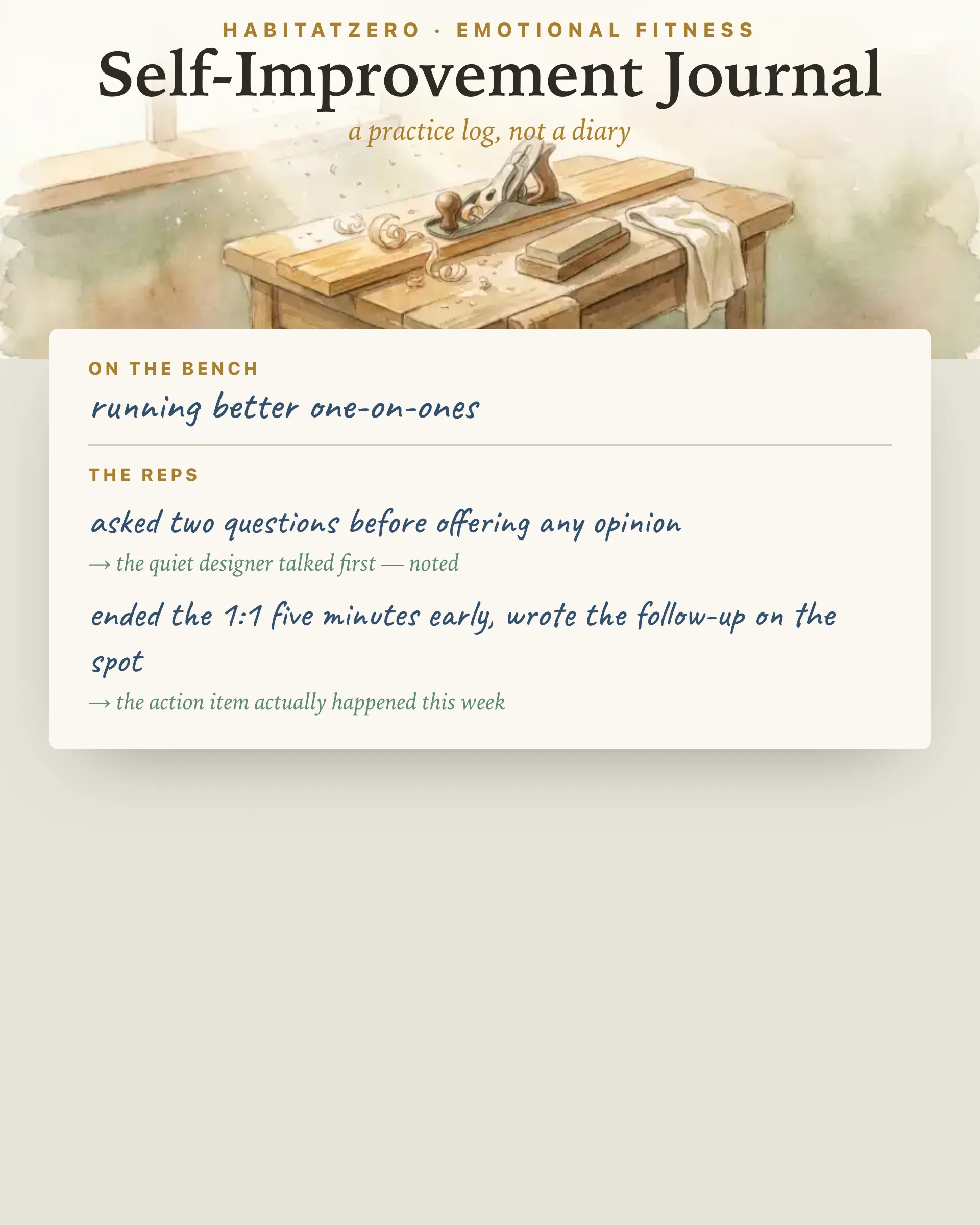
The journal opens with a constraint: name one thing you're improving. Not five. The bench metaphor is literal — a workbench with five half-projects on it produces zero finished chairs, and improvement works the same way, because reps only compound when they keep landing on the same spot.
Under the target goes a second line most self-improvement plans skip: what better looks like, a month from now — phrased as something observable. My reports do most of the talking in our one-on-ones is a test you can pass; be a better manager is a mood. You'll re-read this line often, because on tired weeks it's the difference between a practice and a vague self-criticism.
Each entry is two lines. The rep: the deliberate attempt you made at the hard part — asked two questions before offering any opinion. The change: what it produced or taught — the quiet designer talked first. Deed, then data.
The second line is what turns a log into a feedback loop. Attempts without noticing are just repetition, and repetition entrenches whatever you already do. Twenty dated rep-and-result pairs, all aimed at the same target, read like a lab notebook for the skill — you can see which reps bend the curve and which are comfortable busywork.
Expect the curve to be unglamorous. Field research following people building new behaviors day by day found automaticity arrived after about two months on average, with an enormous honest range around it (DOI: 10.1002/ejsp.674). The journal's card caps at twenty-four reps partly for this reason: that's roughly a season of serious practice, and a finished card — retired, re-readable, complete — is better fuel than an infinite scroll.
One dashed line on the bench stays reserved for the next rep, and the journal nudges you to fill it immediately after logging — while the last attempt is still warm and you can feel exactly where it slipped. A good next rep is small, near, and slightly uncomfortable: Thursday with Amir, open with his agenda item, not mine. Improvement plans fail in the gap between sessions; a queued rep is a plank across the gap.
Pick the thing — the real one, the skill whose absence keeps costing you. Write the month-out test. Queue a rep you can take within two days. Then take it, come back, and log both lines. From there the journal runs on a loop that fits in two minutes: rep, result, next rep. Quiet, dated, and impossible to argue with by December.
A written practice log for getting deliberately better at one chosen thing. Where a diary records what a day felt like, this journal records attempts: the rep you took at the hard part, what it changed, and the next rep queued — closer to how a musician logs practice than how a diarist logs life.
No — the direction of attention is reversed. A diary looks backward at experience; this log looks forward at a target. Every entry is an attempt aimed at the same named thing, which is why twenty entries here compound into visible progress instead of twenty separate moods.
Because reps only compound when they land on the same spot. Improvement spread across five fronts feels busy and measures as noise; the bench holds a single project so that every rep, note, and lesson stacks on the last one. Finish a card, then rack the next project.
A deliberate attempt at the part you are actually bad at, small enough to do soon and specific enough to learn from. Asking two questions before offering an opinion is a rep; being in meetings all week is not. If nothing was tried on purpose, there is nothing to log — which is the log doing its job.
Honest answer: longer than the internet says and shorter than pessimism says. Research tracking real-world habit formation found automaticity took about two months on average, with a wide range on either side. The month-out picture you write at the top is a checkpoint, not a deadline — reps are the metric that never lies.
Neither is required for the log to work, though the log makes both more useful — a page of dated reps and outcomes is exactly the evidence a coach, mentor, or future you needs to see where the practice is bending and where it is stuck.
By the team behind Fabulous, the science-based self-care app used by over 30 million people.