
The Overwhelm Recovery ProtocolWellness & Routines · ~5 min
About this template · Updated November 2026
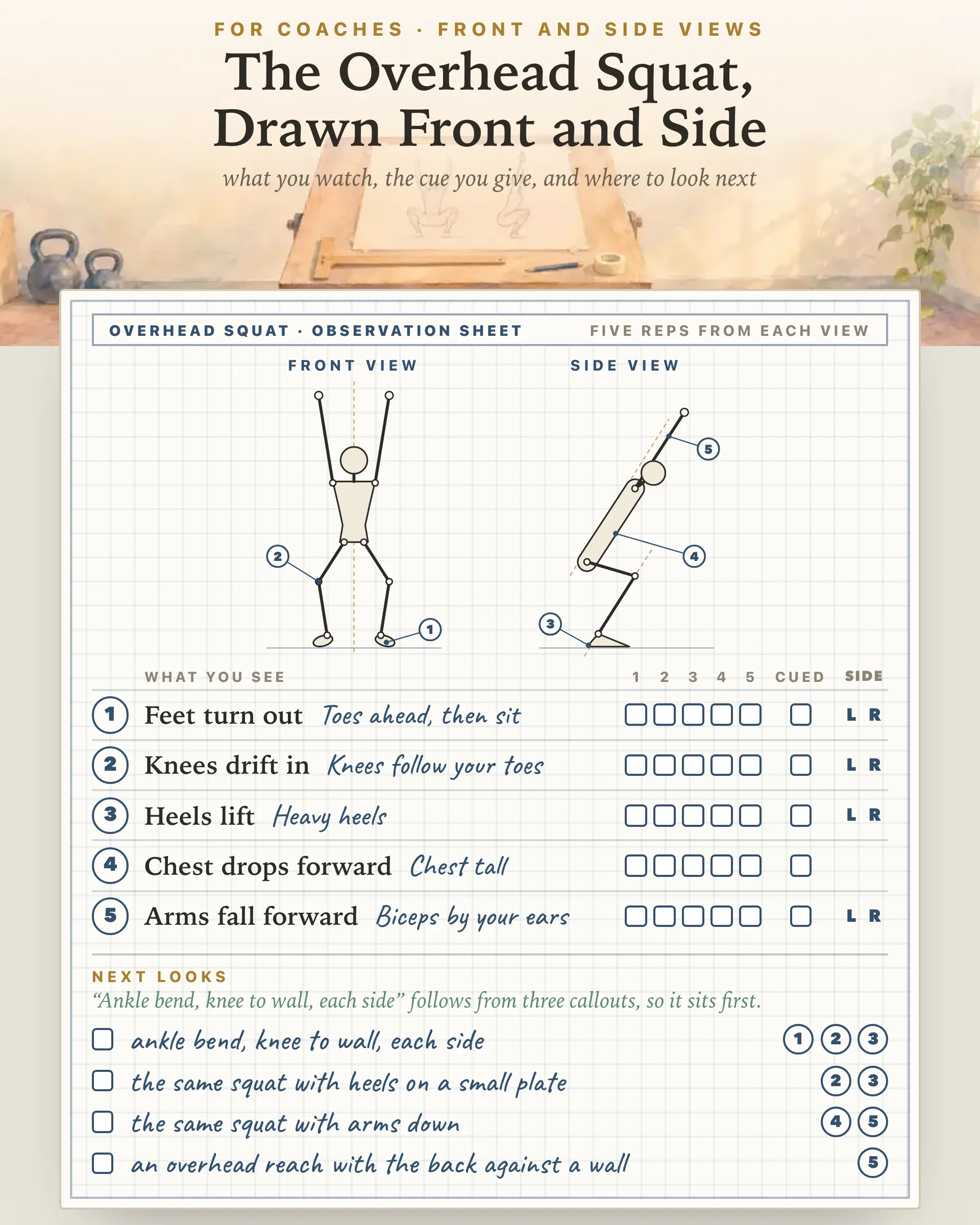
The overhead squat assessment is about as plain as a movement check gets. The person stands with feet about hip width, lifts both arms straight overhead and squats to a comfortable depth several times while you watch, first from the front and then from the side. What makes it useful is watching for the same few things every time and knowing what each one sends you to look at next. This page is where that routine lives: a two-view drawing you mark with numbered callouts, and a blank sheet you print and fill in by hand.
Plenty of education providers teach their own version of this test under their own names. This sheet follows none of them, isn't connected to any, and holds your checkpoints in your words.
From the front, you might watch for:
From the side:
Tap a point on either view and it becomes a numbered callout you can rename the way you say it out loud.
A checkpoint is something you saw on a rep. It isn't a diagnosis, and it doesn't tell you why: the same mark can mean something different in two people. So each callout carries up to two next looks, narrower checks that show you more.
Some of those looks come from lab work. When Padua and colleagues had people whose knees drifted inward squat again with a two-inch lift under their heels, the inward knee motion went away. When Macrum and colleagues set a wedge under the forefoot of thirty healthy adults to limit how far the ankle could bend, knee valgus and medial knee displacement both increased in the squat. That is why the same squat with heels on a small plate, and an ankle bend check with the knee to a wall, are among the suggestions. Both studies describe groups in a lab. Neither tells you what is happening in the person in front of you.
When callouts share a look, the sheet merges them and lists that look first, with the callout numbers beside it.
Under the drawing, each callout gets a row: a box for every rep, one for the cued retest and, where a side matters, an L and an R to circle. Choose three to six reps from each view, write the cue you'll say before the retest and up to four lines you say before the first squat, then print. Every box comes out empty.
The page never asks for a client's name or results and has nowhere to keep them. The marks happen on paper and stay with your own records; Personalize saves only your setup, to a free Salon account.
One reliability study filmed one hundred college students doing the overhead squat and asked three certified athletic trainers to rate each person's knees on two occasions. Agreement between the raters was substantial, with kappa values close to 0.7, and their ratings lined up moderately with motion capture, at a correlation of 0.48. Sensitivity ranged from 0.58 to 0.83. That is encouraging for one checkpoint, the knees, judged on video by trained raters watching young adults. It says nothing about the trunk or the arms, about live watching in a busy gym or about older clients, and the authors themselves advise using the test inside a wider exam.
No mark forecasts an injury, either. In a critical review, Roald Bahr explains why screening tests have not managed to predict sports injuries: none so far has test properties good enough, and no intervention study yet supports screening people for injury risk. Read the sheet as a way to choose what to look at next, never as a risk score.
Pain sits outside the sheet altogether. If a rep hurts, stop there and suggest a doctor or physical therapist.
The overhead squat is a single task seen from two sides. A fuller movement assessment usually adds a step-down, a lunge, a hinge or an overhead reach, along with a talk about what the person wants from training. Let the next looks decide which to add, instead of running every test on everyone.
Set the sheet up before your next first session and print a small stack. If a client wants a squat practice of their own afterward, The 30-Day Squat Challenge gives them a month of sets to log, and for gentle range work between sessions, The Hip Compass is a short routine of six hip exercises. If you are still shaping the business around sessions like this, Your Coaching Business Plan is the place to sketch it.
The person stands with feet about hip width, raises both arms straight overhead and squats to a comfortable depth a few times while you watch, first from the front and then from the side. It shows how they move through one pattern on that day and gives you somewhere to start looking, not a verdict.
From the front, coaches often watch for feet that turn out, knees that cave in and weight that drifts toward one foot. From the side, heels that lift, a chest that drops forward, a low back that arches and arms that fall forward. On this sheet you keep only the ones you use, named in your own words.
No. Knees that drift in can travel with many things, and one rep cannot sort them out. Each mark here points you to a next look, such as the same squat with heels on a small plate. If any rep hurts, stop the squat and suggest a doctor or physical therapist.
It is a single task seen from two sides. A broader movement assessment usually adds others, such as a step-down, a lunge, a hinge or an overhead reach, alongside a talk about goals. The researchers who tested how reliably trainers rate knee position in this squat recommended it as one part of a wider exam.
Onto paper, in the room. This page has no field for a name or a result: it keeps your checkpoints, cues and wording, and prints the sheet with every box empty. Personalize saves that setup to a free Salon account, from the team that makes Fabulous, so you can keep refining it there.
By the team behind Fabulous, the science-based self-care app used by over 30 million people.


