
The Overwhelm Recovery ProtocolWellness & Routines · ~5 min
About this template · Updated November 2026
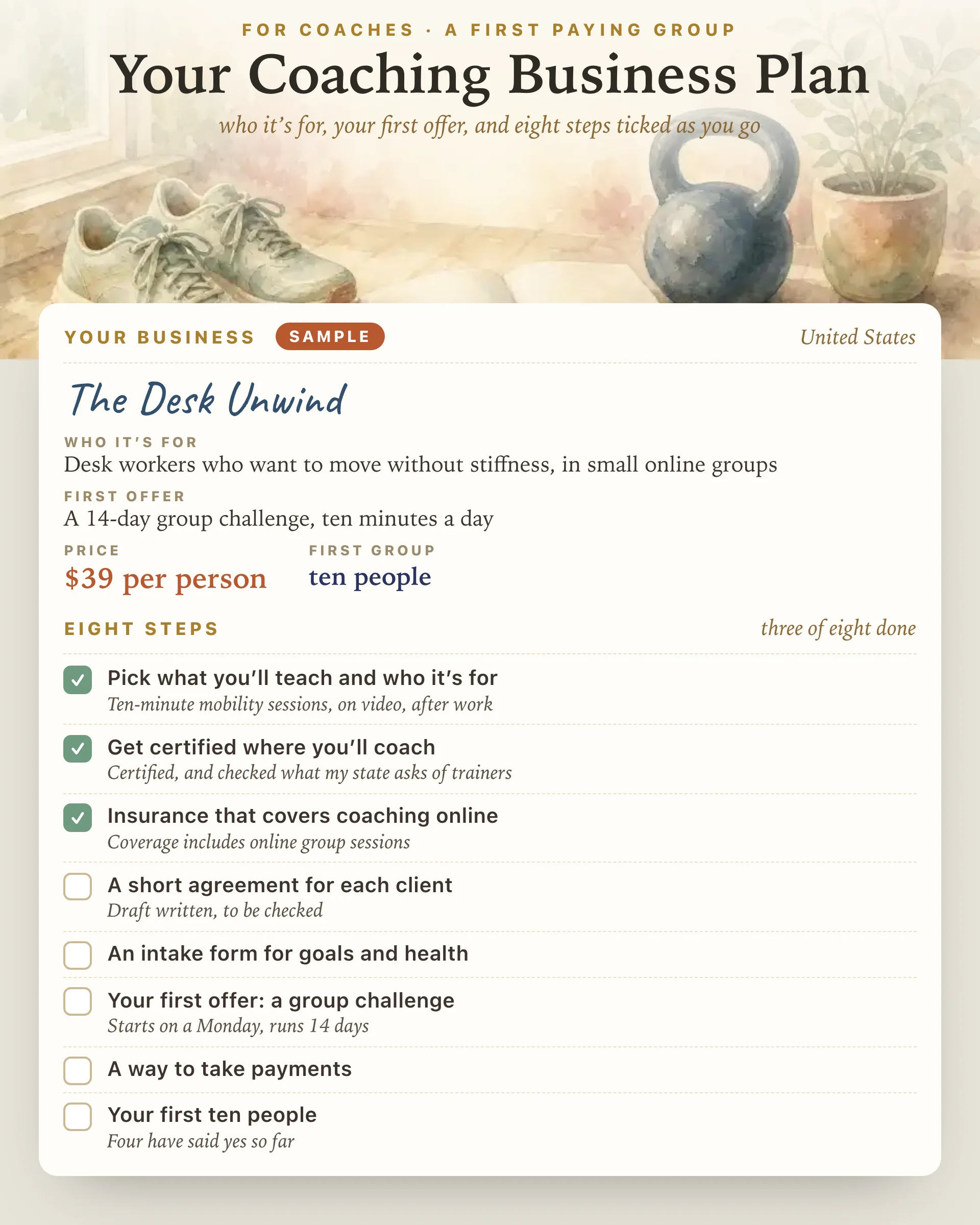
A first paying group needs a shorter plan than most business plan templates ask for. This one fits on a single sheet. The top half says what the business is: its name, who it's for, the first offer, what one person pays for it and how many people you'd like in that first group. The bottom half is eight steps, from choosing what you'll teach to finding your first members, each with a box to tick and a line for a note on what you did.
The top half asks for five things.
Each answer saves as you type, in this browser, so you can close the page and pick up where you stopped.
The steps are listed roughly in the order they lean on each other, but you can tick them in any order.
A tick records that you did a step. The sheet can't look at the work behind it, so a full column of ticks is a record of what you've done, not proof that you meet every rule where you coach.
These are three separate questions, and the plan keeps them apart.
A certification is a credential from an organization that tests what a trainer knows. Accreditation is a check on the certification program itself. In the United States, the National Commission for Certifying Agencies (NCCA) accredits certification programs that meet its standards, in professions from healthcare to automotive repair, and describes those programs as voluntary. An accredited certification is still not a license.
What the law asks of trainers is the third question, and its answer changes from one country to the next and, in the United States, from one state or city to another. It can touch how you register the business, how you handle tax, and whether any rule applies to training people for pay. This page doesn't answer that for you, and it doesn't point you to any particular certification. Choose your country under "Where you coach", then use the note on step two to record what you found and where you found it.
For insurance, ask your insurer a narrow question: does your coverage include online sessions, group sessions, and clients who live in another state or country? Write the answer in the note on step three. The plan names no insurer.
For the agreement, keep it short enough that a client reads it before paying: what you provide, how they cancel and what happens to money already paid. Contract and consumer rules differ by country and state, so check the ones that apply where you and your clients are, or ask a lawyer who practices there.
For the intake form, ask about goals, and about health conditions, injuries and pregnancy, before the first session, so anyone who should speak to a clinician before exercising has the chance to. The completed forms belong in your own records and never on this sheet.
Write the offer the way you'd describe it to someone who asked what you do: how long it runs, how often the group meets, and what each session involves. The price field takes a whole amount up to 99,999 and reads the first amount you write, so typing "$49-$59" saves 49, and a price you haven't typed yet stays blank. Picking another currency changes the sign in front of the amount and leaves the number exactly as you typed it.
The plan shows your price and suggests none of its own. It quotes no going rates, and it doesn't multiply your price by the size of your first group, because that would be a guess about income and this page makes no such guesses.
The group size and the last step are both counts. When people start saying yes, write how many in the note on step eight, never who. The plan asks for counts, never names, and nothing in it asks for an email address or anything from an intake form. The notes are yours to write, so keep clients' names out of them too before you print the plan or share a screenshot with a co-coach.
Nothing in the plan ties it to one kind of training. A yoga teacher, a running coach and a strength coach fill in the same fields, and only the certification step leans toward fitness. As a fitness coaching business plan, it stops at the first group on purpose, so that what you learn running that group can shape the offer after it.
Open it when you decide to run a first paying group, and come back each time you finish a step to tick it. If your first offer is a group challenge, the group fitness challenge planner lays out its days one idea at a time, and when one offer turns into several, three coaching packages puts them side by side.
For a first paying group, five facts and eight steps. The facts are the business name, who it serves, the first offer, its price per person and the size of the first group. The steps run from choosing what you teach through certification, insurance, a client agreement, an intake form, the offer and payments to finding your first people.
Yes. A printed copy shows your answers written out, the steps you ticked and your notes, without the hints or the editing controls. Any kind of coach can use it, though the certification step is written with fitness coaching in mind.
No. A tick only records that you did a step, and the sheet has no way to check the work. Requirements for trainers differ by country and state, so what the law asks where you coach has to be answered there, not on this page.
This page doesn't recommend one. In the United States, the NCCA accredits certification programs that meet its standards, and it describes those certifications as voluntary, which makes them different from a license. What a country, state or city requires by law is a separate question with a local answer.
No. It shows the price you type, in the currency you pick, and proposes none of its own. It never multiplies your price by the size of your group or estimates income, and a price you have not typed yet stays blank instead of reading zero.
Keep those somewhere else. The plan asks for counts, such as how many people have said yes, and never for a name, an email address or an answer from an intake form. Notes are free text, so keep clients' names out of them before you print or share the plan.
Yes, it costs nothing to fill in here, and what you type is kept in this browser. Personalize moves your plan into a free Salon account from the makers of Fabulous, where you can keep it up to date as you tick off steps.
By the team behind Fabulous, the science-based self-care app used by over 30 million people.


