
The Overwhelm Recovery ProtocolWellness & Routines · ~5 min
About this template · Updated November 2026
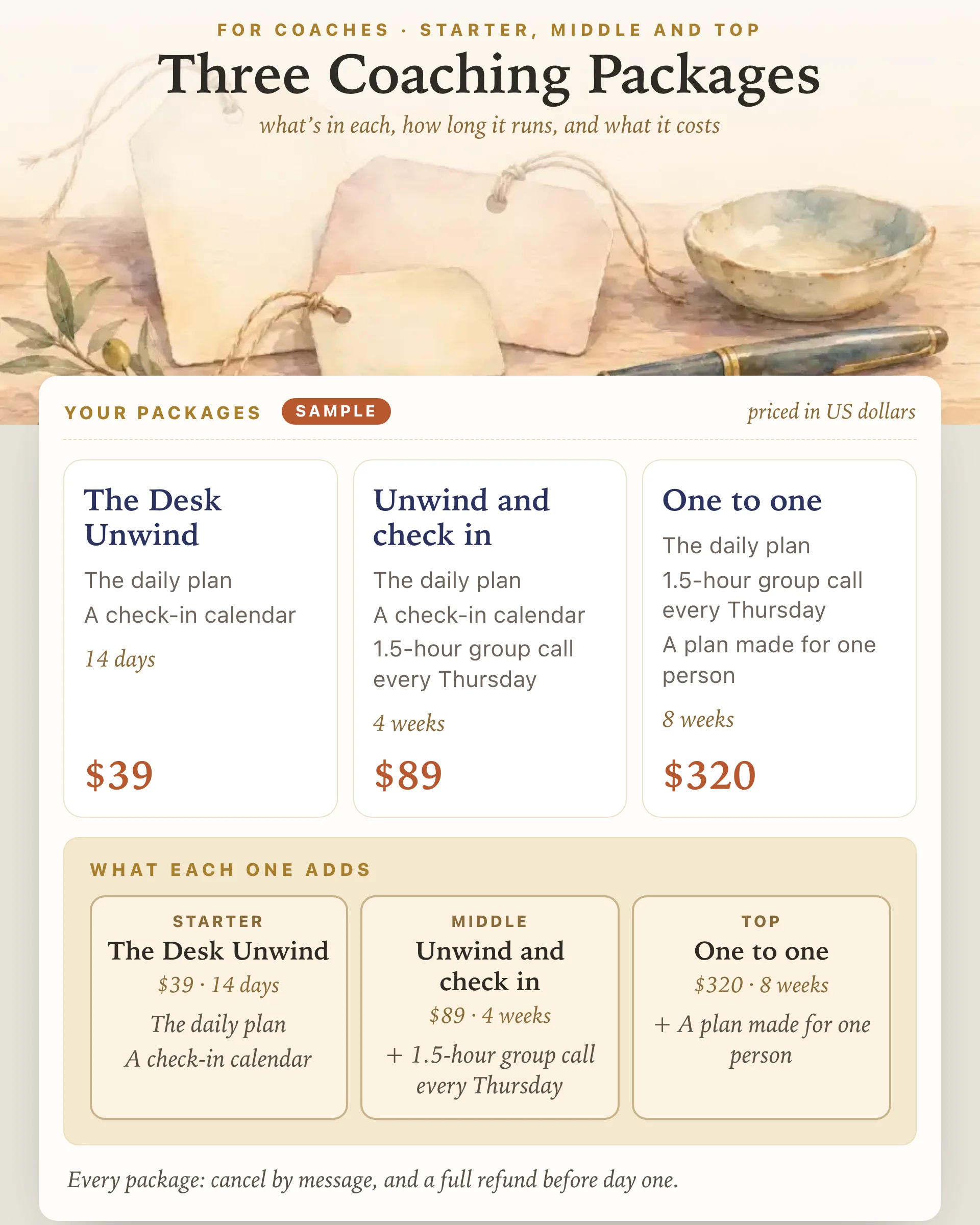
Someone weighing up your coaching wants three answers from each package: what they get, for how long, and for how much. When those answers sit in different places for each package, or come in a different order, the comparison is left to the client. This template lines them up. Name a starter, a middle and a top package, list what each one holds, one thing per line, then add how long it runs and its price in your currency. Underneath, a ladder picks out what each package adds to the ones before it.
Each card asks for four things.
A line under all three cards holds your refund and cancellation terms, so they are written once and read the same for every package.
Repeat on each card whatever carries over from the package before it, so every card reads complete on its own. The ladder below the cards does the subtracting for you. It shows the starter's lines in full, then, for the middle and the top package, only the lines no earlier package lists. Bullets, numbering, capital letters and a closing full stop are ignored when it compares lines, so "- the daily plan." and "The daily plan" count as the same thing.
When a step on the ladder reads "nothing new on the ones before", that package doesn't yet say what it gives that the others don't. Either add the line that sets it apart or let the two packages merge.
The sample on this page is a made-up mobility coach's offer, one way fitness coaching packages can step up:
The same shape fits online coaching packages in other fields. A running coach might start with a run-walk group, add a video review of each runner's form, and finish with a plan written around one person's race. A life coach might move from a single session, to a month of weekly sessions, to three months with messages answered between them.
Three is a habit of the trade more than a finding. The research on offering people more options is less tidy than its reputation. A meta-analysis by Scheibehenne, Greifeneder and Todd pooled 63 conditions from 50 experiments with 5,036 participants and found an average effect of virtually zero: extra options put people off in some studies and helped them in others. A later meta-analysis by Chernev, Böckenholt and Goodman, covering 99 observations and 7,202 participants, found that overload became more likely when the options were complex, when the decision itself was hard, when people were unsure what they wanted, and when they hoped to decide with little effort.
Read together, the two point the same way for a page of packages. The count matters less than how plainly each package differs from its neighbor. Write the three cards in the same order, keep each step to one or two new lines, and the comparison stays easy.
If the point of a package is a routine that sticks, be honest with yourself about the timescale. In a study of 96 volunteers who repeated one daily behavior in the same setting, Lally and colleagues estimated that the time it took to become about as automatic as it would get varied from 18 days to 254, with a median of 66. A fourteen-day package can start a routine, so describe it that way, as a start, and let a longer package be the place where it settles.
The sheet shows the price you type and nothing else. Pick US dollars, euros, British pounds, Canadian dollars or Australian dollars, and every price carries that currency's own sign, such as $1,250, €1,250 or £1,250. Switching the currency relabels the amounts without converting them. Prices are whole amounts up to 99,999: typing 39.99 keeps 39, and a package you haven't priced yet stays blank rather than showing zero.
This page doesn't suggest prices or quote going rates. A rate you find online describes someone else's niche, country and clients, and we have no source we would trust to fit yours.
Write your terms once, in your own words, as a client should read them before paying: how to cancel and what happens to money already paid. The sheet shows the line exactly as you write it under all three packages. It doesn't check your terms against any rule, and consumer rules differ from one country to the next, so check the ones that apply where you and your clients live.
Everything here describes your offer: names, contents, lengths, prices and terms. It never asks for a client's name or details, so you can share a screenshot or print it for a co-coach without anyone's information on it.
Fill it in before you write a sales page, the link in your bio or a reply to someone asking what you offer, so all three packages read the same way wherever they appear. If your starter package is a group challenge, the group fitness challenge planner lays out its days one idea at a time and counts who checks in.
Three facts a client can check at a glance: what they get, how long it runs and what it costs. List what they get as things you deliver, like a weekly call or a plan written for one person, rather than results, so two packages are easy to tell apart.
The sample on this sheet belongs to a made-up mobility coach. Her starter is a 14-day group challenge with a daily plan and a check-in calendar, the middle package runs four weeks and adds a group call every Thursday, and the top one lasts eight weeks with a plan made for one person.
This template holds three, so a starter, a middle and a top package can sit next to each other. Studies of choice overload disagree about whether more options put people off, which makes a clear difference between neighboring packages worth more than any particular count.
No. It shows the prices you type in the currency you pick and never proposes one. Each price is a whole amount up to 99,999, and a package you have not priced yet stays blank rather than showing zero.
Yes. Every line is free text, so a package can be video calls and a training plan, a small group that meets in a park, messages between sessions, or any mix. Write the length the way your clients count it, in days, weeks or sessions.
Your own cancellation and refund terms, written once for all three packages so a client never has to ask. The sheet prints the line exactly as you wrote it and does not check it against any rule.
Yes, and you can fill it in on this page, where your answers stay in your browser. Personalize carries your three packages to a free Salon account, made by the team behind Fabulous, so you can keep shaping them there.
By the team behind Fabulous, the science-based self-care app used by over 30 million people.


