
The Overwhelm Recovery ProtocolWellness & Routines · ~5 min
About this template · Updated September 2026
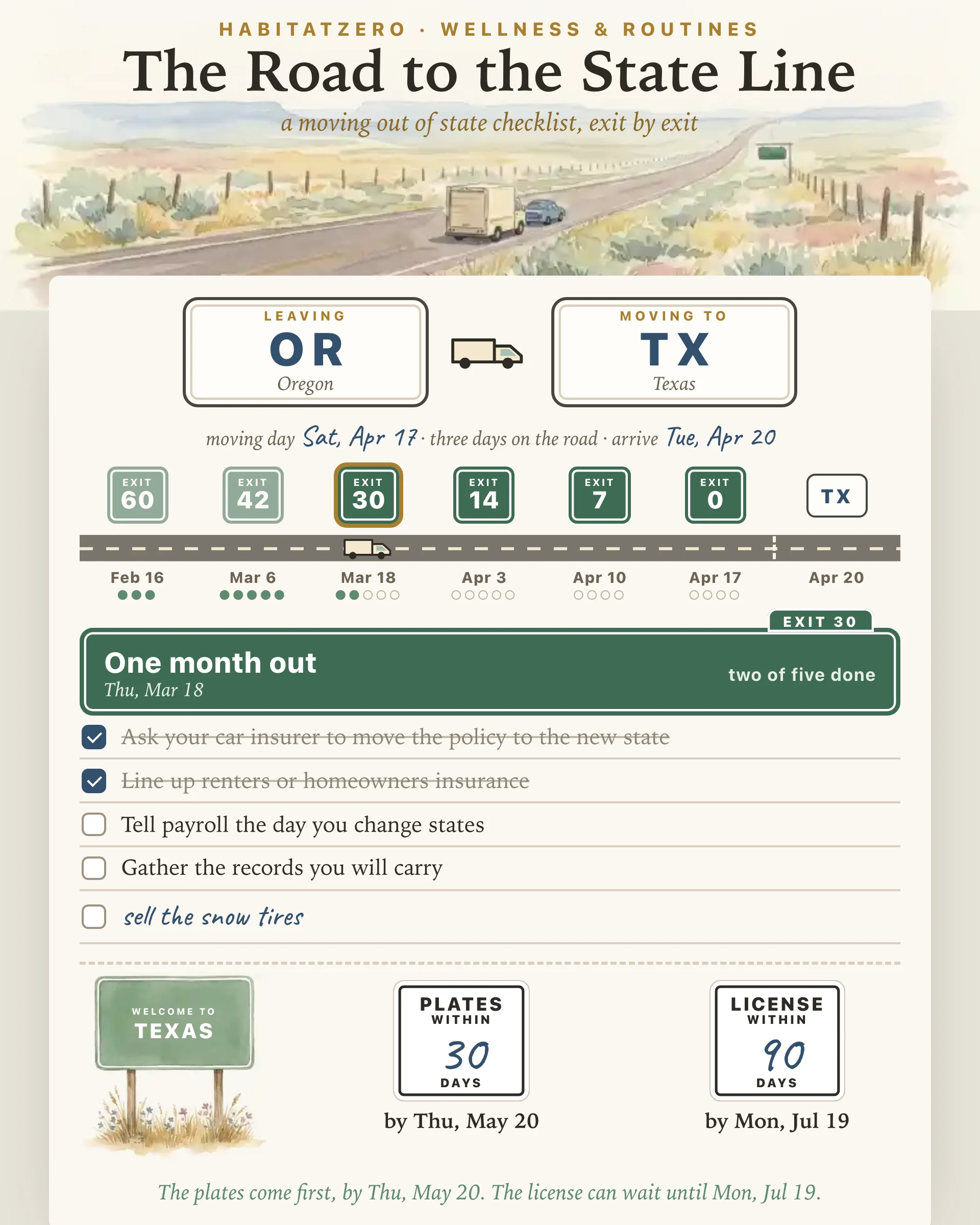
A move across town is a packing problem. A move across a state line is a packing problem with paperwork attached: a mover that answers to federal rules, a driver's license and plates you have to replace on the new state's schedule, a voter registration that stays behind, and a tax year that gets split in two. This moving out of state checklist is built around those extras. It counts the steps back from moving day as exits on a highway, then picks up on the far side of the line with the deadlines your new state sets. It doubles as a cross country moving checklist; only the drive gets longer.
The biggest difference is who carries your things. A company hauling household goods from one state to another has to be registered with the Federal Motor Carrier Safety Administration, and its USDOT number is how you check it. FMCSA's own steps to select a mover are worth reading before you call anyone: get written estimates from several movers, each based on seeing your things in person, look every company up in the agency's mover search for its registration and complaint history, and read the booklet Your Rights and Responsibilities When You Move, which an interstate mover is required to give you.
That booklet explains the choices you will sign. A binding estimate holds the price you pay at delivery. Under a non-binding estimate, the mover can't demand more than the estimate plus ten percent when it unloads; the rest is billed later, and the charges follow the actual weight of what went on the truck. Coverage starts as Full Value Protection. If you waive it in writing, the mover's liability drops to sixty cents a pound per item. Anything worth more than a hundred dollars a pound should be listed on the paperwork, or ride in your own car.
Every state decides how long a new resident has to get its driver's license and register a car, and the answers are far apart. Texas, the state in this page's sample, gives new residents thirty days to register a vehicle and ninety days for a license, and it splits the two jobs between different agencies. Other states set shorter or longer windows, so the page never assumes a number. You look up your new state's rules, starting from USA.gov's directory of state motor vehicle services, and write the days on the signs.
Voting works the same way. Your old registration doesn't travel with you: vote.gov's registration page tells anyone who moved out of state to register with the state they moved to, and warns that deadlines can fall as early as thirty days before Election Day. Mail is the easy part. The Postal Service's change of address page says forwarding can begin within a few business days but advises allowing up to two weeks, and it reminds you that forwarding does not update your license or your voter registration. Taxes come last. For the year you move, each state that taxes income may expect a part-year resident return, so put a question to both state tax agencies well before the filing season.
Pick the two states on the license plates and tap moving day on the calendar. The six exit signs are numbered by the days left, sixty down to zero, and each takes its date from moving day. Tell the page what is making the trip: hired movers, a car, kids in school, pets, a professional license. The road keeps only the steps that fit. A small truck sits at the first exit that still has something open, so you can see at a glance where the move stands.
Set how many days you will spend on the road, then, past the state line, write your new state's license and plate numbers on the white signs. The page adds each number to your arrival day and tells you which deadline comes first. Every stop takes up to four lines of your own, and the printed version lays out every exit in order with its boxes.
What the page cannot know is your state's numbers, whether your employer is withholding for the right state, or how your professional board handles a transfer. Those answers live with the agencies, and the page only turns what you find into dates. It is a planning aid, not legal or tax advice, and it leans on the agencies' rules rather than on research about checklists. Its value is plain: each step that depends on crossing a state line has a date beside it before that date arrives.
Start about two months out, as soon as you know the date, and open the road once a week to clear the next exit. For the packing itself, The Moving Checklist keeps a box log by room and the full change-of-address list. Clearing out before the truck comes pays twice on a long haul, since a non-binding bill follows the weight, so the Decluttering Checklist belongs near the first exit. And if the new place is your first apartment, The First Apartment Checklist sorts what you already own from what you still need to buy.
Everything a local move needs, plus what the state line adds: a mover registered with FMCSA for interstate work, a new driver's license and plates in the new state, a fresh voter registration there, and a part-year tax return in each state that asks for one. The same list works as a cross country moving checklist; only the drive gets longer.
Each state sets its own deadline and the gap between states is wide, so check the new state's DMV site rather than trusting one number from a list. Texas, for example, gives new residents thirty days to register a vehicle and ninety days to get a Texas license.
Look the company up by its USDOT number in FMCSA's mover search, which shows its registration and complaint history, and get written estimates from several movers after they have seen your things. A registered interstate mover also has to hand you the federal booklet Your Rights and Responsibilities When You Move.
If both states tax income, you will usually file a part-year resident return in each one, with the year split at your moving date. States handle the split differently, so ask both state tax agencies before tax season instead of guessing.
No. The page shows a sample road from Oregon to Texas that you can read through. Personalizing it in HabitatZero, which is free, lets you set your own states, dates and DMV numbers and keeps every checkmark between visits.
By the team behind Fabulous, the science-based self-care app used by over 30 million people.


