
The Overwhelm Recovery ProtocolWellness & Routines · ~5 min
About this template · Updated November 2026
Motivational interviewing comes from William R. Miller and Stephen Rollnick, whose book Motivational Interviewing: Helping People Change and Grow reached its fourth edition in 2023. The Motivational Interviewing Network of Trainers, which grew out of their work, keeps a plain overview of the method. This page was made on its own: Miller, Rollnick and the network had no part in it and have not endorsed it. Treat it as a place to practice coaching conversations. It is not therapy, and it can't replace training in the method with feedback from someone qualified to give it.
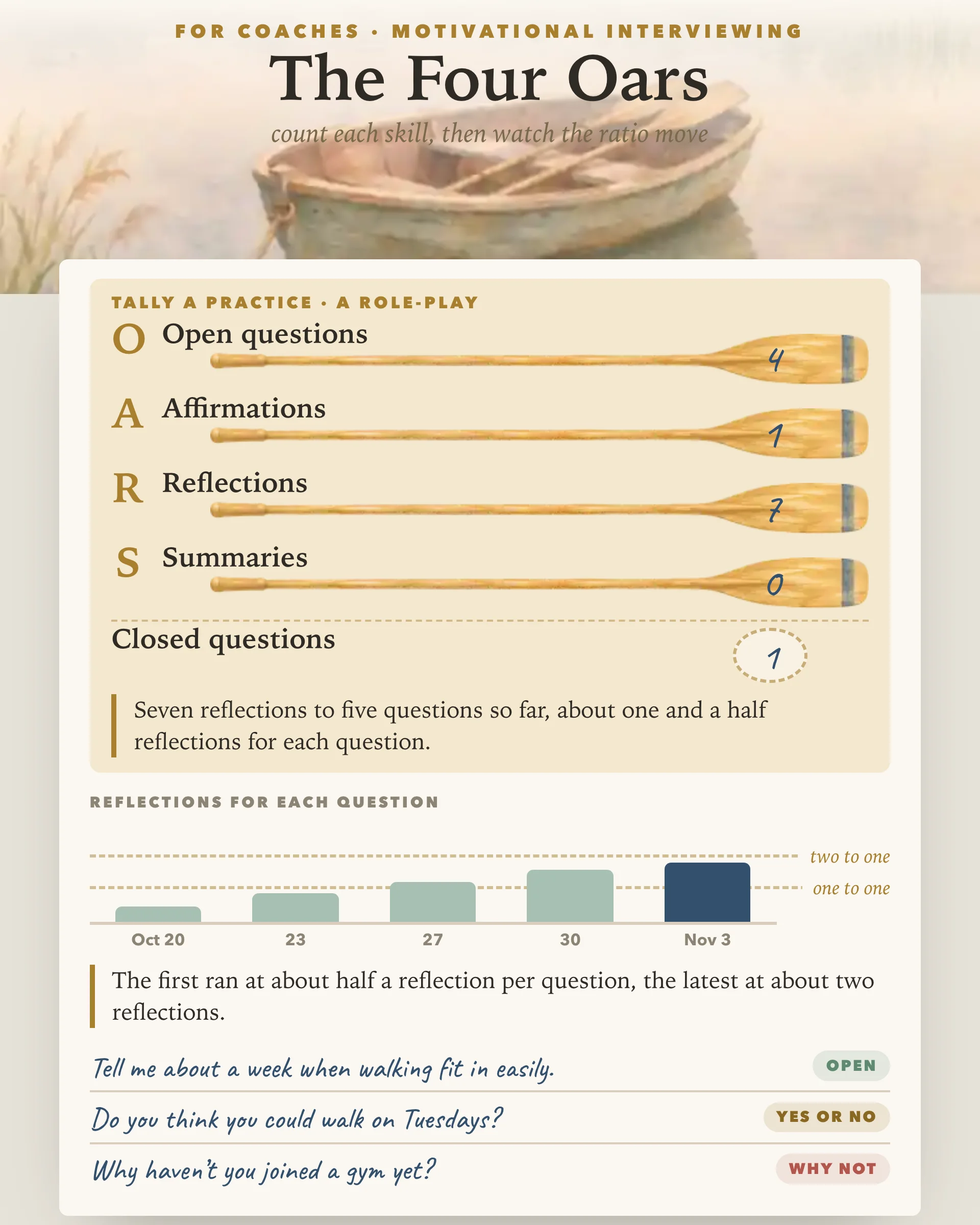
The core skills go by the acronym OARS, and each one hangs here as a painted oar.
Tap an oar's name for examples and the slip to watch for.
Open the sheet before a practice conversation with a colleague, or while you listen back to a recording made with permission. Each time you hear yourself use a skill, tap that oar's blade. Closed questions get a round counter of their own, because the ratio that matters counts every question, open or closed. As you tap, a note reads back your reflections for each question and how many questions were open.
When the conversation ends, log it. The logbook keeps twelve practices and draws a bar for each against dashed lines at one reflection per question and at two. A note compares your first practice with your latest, and the suggestion for next time comes from your own numbers.
The log holds counts and nothing else: no field for a client's name, contact details or anything a client said.
Counting feels mechanical, but your own impression is a poor guide. In a randomized trial with 140 licensed counselors learning the method, Miller and colleagues found that how skillful the counselors believed they were bore no relation to how skillful they were in recorded practice. Workshops raised proficiency, and adding feedback on recorded practice or individual coaching raised it further.
Researchers rate recorded sessions with a coding system called the MITI. Theresa Moyers and colleagues tested its fourth version on 50 recordings of real treatment sessions and found good to excellent agreement between raters on most measures. Its coders count what you count here, and its manual suggests one reflection per question as fair and two as good, thresholds its authors say rest on expert opinion. A count can't hear warmth, curiosity or respect for a person's choice, which the MITI rates separately, so treat your ratio as one view of a practice, never a grade.
The bank holds eight questions. Pick the area you coach in, tap a starter or write your own, and each line gets a reading as you write it. A question that opens with "do you" can be answered in one word, "how many" asks for a fact, and "why haven't you" tends to draw out the case for staying put, so you might turn it into "What would make it worth a try?"
Miller and Rollnick sort what people say in favor of a change into two groups. Desire, ability, reasons and need show someone getting ready: "I'd love to have energy left for the weekend." Commitment, activation and taking steps show them getting moving: "I'm going to walk on Tuesday and Thursday." The other side, sustain talk, is the case for staying the same, and it deserves a reflection rather than an argument. Each tile on the sheet holds an example and one way to answer it.
The method has a reasonable record in health care. A meta-analysis of 48 randomized trials in medical settings, covering 9,618 participants, found a modest advantage for motivational interviewing over comparison approaches, with promising results for body weight, sedentary behavior, alcohol and tobacco use, and confidence in change. It showed little effect on eating disorders, self-care behaviors or some medical measures such as heart rate. Those trials tested trained practitioners, not a worksheet, and nothing here promises that the people you coach will change.
Use the sheet for deliberate practice: a weekly role-play with a colleague, or one recording a week played back with the counters open. For tools to use alongside your sessions, the Readiness Ruler turns importance and confidence into two scales, the Values Card Sort brings out what matters to someone, and The Spiral Path maps where a person stands with a change.
Open questions, affirmations, reflections and summaries, often remembered as OARS. Around them sit listening for change talk and offering information only with permission. This sheet counts the four skills in one practice conversation and reads back how they balance.
Ones that leave room for a story, usually opening with what or how. What would you like to be different a month from now? What has helped before, even for a little while? A question that opens with do you can be answered in one word, and why haven't you tends to bring out reasons not to change.
Anything a person says in favor of changing. Miller and Rollnick group it as desire, ability, reasons and need, which show someone getting ready, and commitment, activation and taking steps, which show them getting moving. Sustain talk is the other side: the case for staying the same.
The manual for the MITI, the coding system researchers use to rate this kind of practice, suggests one reflection per question as fair and two as good. Its authors say those numbers rest on expert opinion, so watch your own ratio across several practices rather than treating it as a pass mark.
No. It is an independent practice sheet that William R. Miller, Stephen Rollnick and the Motivational Interviewing Network of Trainers neither made nor endorsed. It is not therapy either, and it cannot stand in for a course with feedback from a qualified trainer.
Yes. You can tally, log and keep your question bank right here, with your answers held in this browser. Personalize carries the whole sheet to a free Salon account, made by the team behind Fabulous, so your logbook keeps growing there.
By the team behind Fabulous, the science-based self-care app used by over 30 million people.


