Wind-Down Routine BuilderSleep & Evenings · ~4 min
About this template · Updated September 2026
The routine now known as the military sleep method is usually traced to Bud Winter, the San Jose State sprint coach enshrined in USA Track & Field's Hall of Fame. During World War II he taught relaxation to Navy pilots in training, and in 1981 he set the method down in his book Relax and Win: Championship Performance. This worksheet is our own practice tool: it has no connection to Winter's estate, his publishers or USATF, and none of them has endorsed it.
The method fits on an index card: let the body go slack from the top down, hold one quiet picture in your mind, and repeat the sequence nightly until it runs on its own.
When thoughts keep crowding back, Winter's fallback is to repeat don't think, don't think slowly for about ten seconds and then return to the picture.
The famous promise is that Winter's cadets, after roughly six weeks of practice, could fall asleep within two minutes, even sitting up. Read that as a coach's account of his own program rather than a finding. No one has tested this exact routine in a controlled trial, a point Cleveland Clinic's sleep psychologist makes plainly, and she adds that twenty or thirty minutes to fall asleep is ordinary for most people and nothing to fix.
The ingredients stand on firmer ground than the recipe. Relaxation training that eases muscle tension and quiets a busy mind, guided imagery included, is one of the behavioral treatments the American Academy of Sleep Medicine suggests for chronic insomnia. Its 2021 guideline rates that suggestion as conditional, though, and saves its strong recommendation for cognitive behavioral therapy for insomnia, or CBT-I.
The picture step has its own precedent. In a 2002 Oxford study, people with insomnia who were coached to hold an absorbing image at bedtime fell asleep sooner, and reported fewer unwanted thoughts, than people given no instructions at all. The researchers credited the image with taking up enough room in the mind to keep worries from moving back in.
Fairly read, the military method packs sensible relaxation habits into an order you can remember. It may bring some nights on faster. It cannot overrule a body that is not sleepy yet, and chasing a two-minute target can leave you more alert, not less.
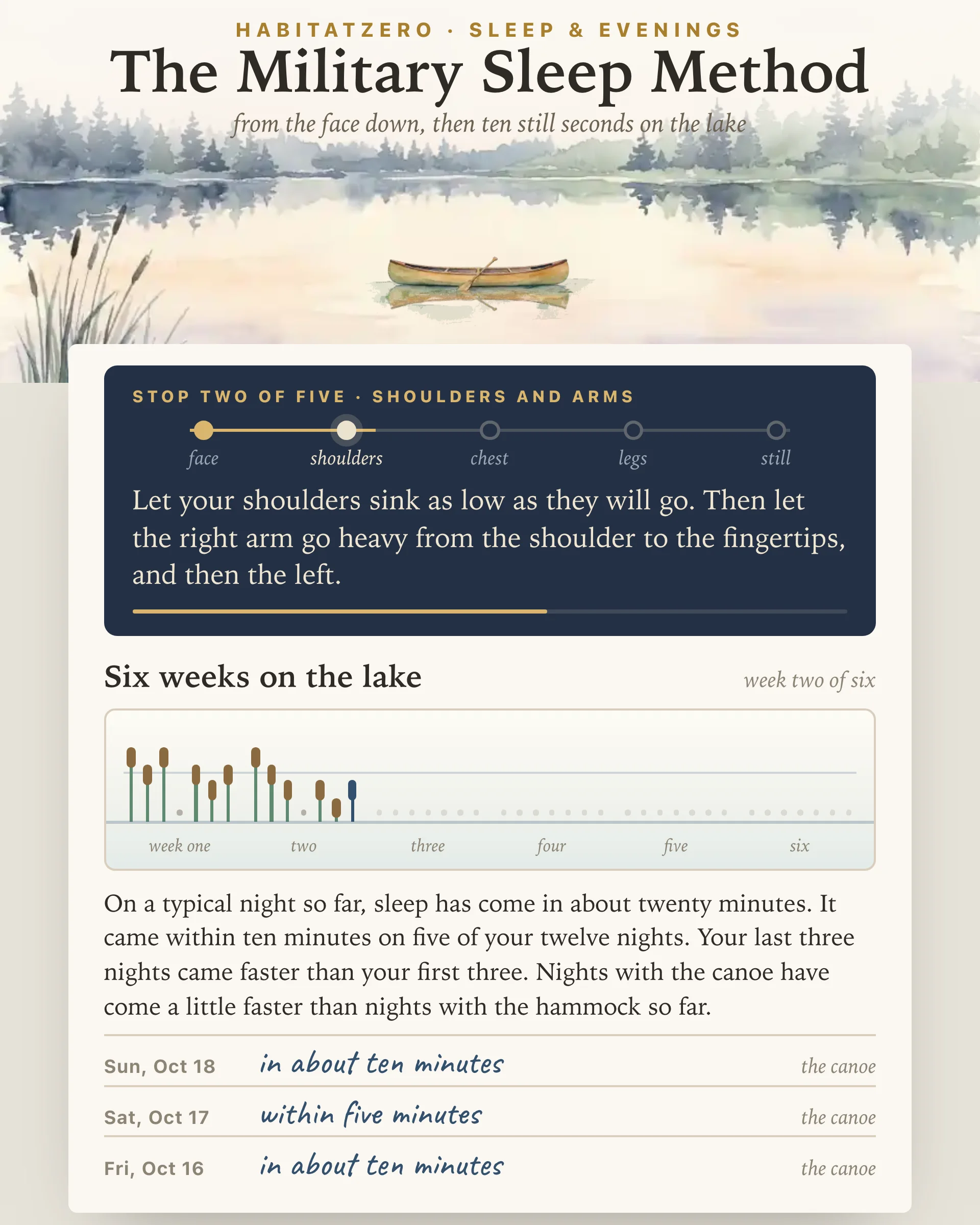
Press push off and the page guides you through the five stops in silence: about twenty-five seconds for the face, thirty for the shoulders and arms, twenty for the chest, twenty-five for the legs and ten for the picture, a little under two minutes in all. A painted canoe drifts across the lake as the screen darkens stop by stop. You can hold a stop, skip ahead or end the run at any point; when it finishes, only the fallback words remain on a dark page.
You choose the picture: the canoe, the hammock, or a place you describe yourself in a few words, like a porch swing or a dock at dusk.
In the morning, one tap records roughly how long sleep took. Each logged night grows a reed on a six-week strip of lake, taller when sleep was slow, and a short reading underneath puts the pattern into words: your typical night, whether recent nights are quicker than your first few, and which picture seems to suit you. The log holds six weeks, the stretch Winter's cadets trained for, and then asks you to begin a fresh six. Morning estimates are rough by nature, so trust the trend over any single night.
Reach for it on nights when your body is tired but your head keeps working. Lean on the page for the first week or so, then run the stops in the dark from memory and open the page only to log the morning. If tomorrow's list is what keeps you up, empty it first with a Bedtime Brain Dump. For a longer body practice, Progressive Muscle Relaxation tenses and releases each muscle group in turn. To put the whole night on record, bedtime and wake time included, pair it with a Sleep Log.
A relaxation routine is not a treatment for insomnia. If falling or staying asleep has been hard on most nights for several weeks, or tiredness is spilling into your days, talk with a doctor. CBT-I is where sleep specialists usually start, and a few weeks of reeds give that conversation something concrete.
It is a short relaxation routine for falling asleep: you let the face, shoulders, arms, chest and legs go slack in that order, then hold one calm picture in your mind for ten seconds. People also call it the army sleep method or the military sleep technique, and it is usually traced to track coach Bud Winter's 1981 book Relax and Win.
Relax the forehead, eyes, jaw and tongue. Drop the shoulders and let each arm go heavy. Breathe out slowly so the chest settles. Let each leg go heavy from thigh to foot. Then picture a canoe on a calm lake or a black velvet hammock in a dark room for ten seconds, and if thoughts return, repeat don't think slowly for another ten.
The two-minute figure comes from Winter's account of Navy cadets after six weeks of practice, not from a study, and no trial has tested this exact routine. Its ingredients, muscle relaxation, slow breathing and a held image, do have research behind them for sleep, so it may bring some nights on sooner. Twenty or thirty minutes to drop off is still ordinary for most adults.
The story told about it is six weeks of nightly practice. That is why the log on this page runs for six weeks: you can watch your own nights change, or not change, instead of taking the promise on trust.
No account is needed to read the five stops or look over the sample lake on this page. To run the silent guide at your bedside and keep six weeks of your own nights, open the worksheet in HabitatZero, which is free.
By the team behind Fabulous, the science-based self-care app used by over 30 million people.