The Overwhelm Recovery ProtocolWellness & Routines · ~5 min
About this template · Updated July 2026
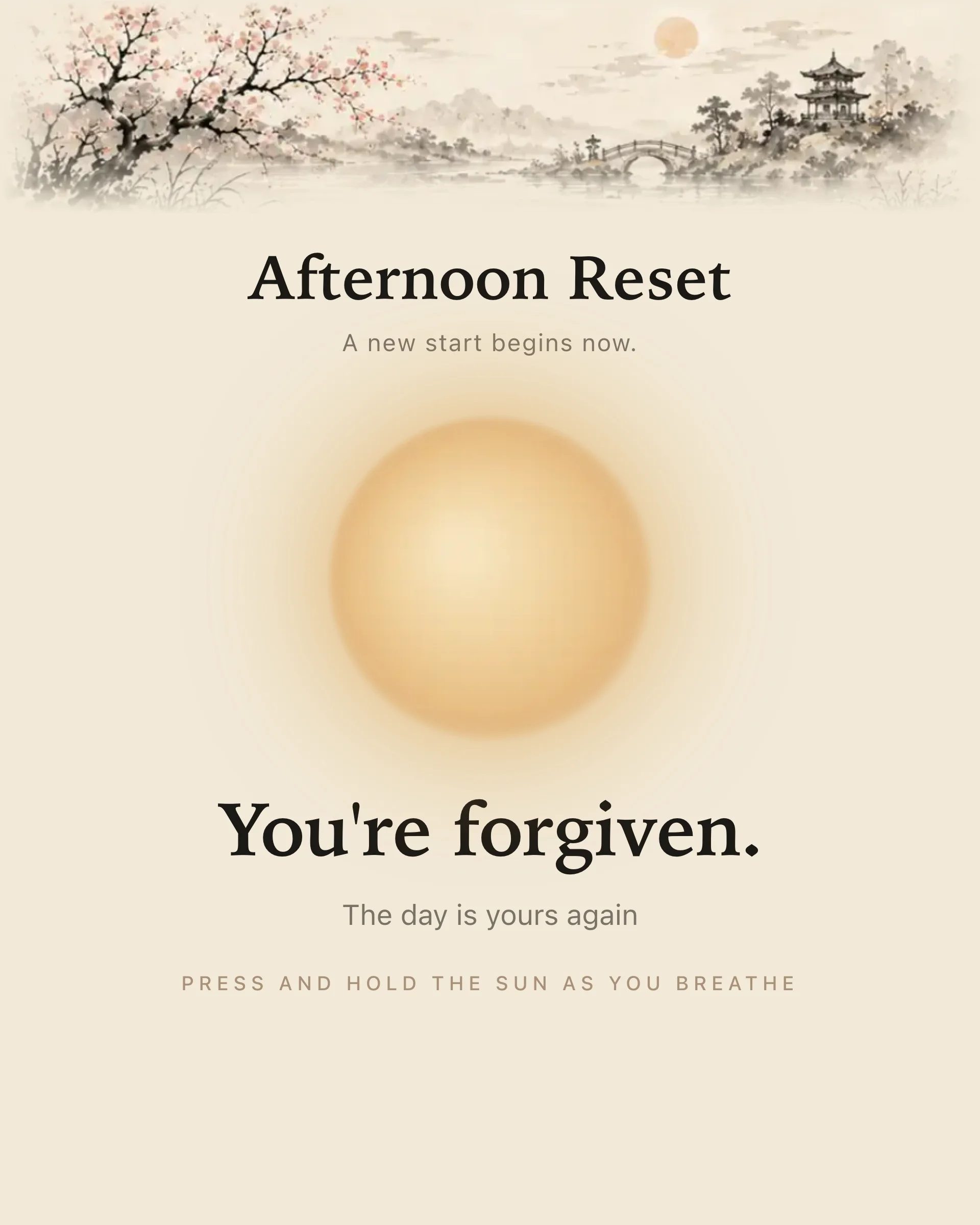
There's a particular arithmetic to a bad morning: the deadline slips at eleven, and by two o'clock the whole day has been quietly written off. Not because the afternoon was damaged — it hadn't happened yet — but because the morning came along for the ride. This sheet is a two-minute mental reset built to break exactly that carry-over. Two steps: name what's weighing on you, then hold the sun through three slow breaths. It ends with two words most productivity tools would never dare print: you're forgiven.
The reset starts with a plain question — what's weighing on you? — and a box to answer it in. Write it the way you'd say it to yourself: I let the deadline slip. I couldn't focus and wasted the morning. The point isn't eloquence. An unnamed weight behaves like background noise, coloring everything without ever presenting itself for inspection. Named, it becomes one specific thing that happened, with edges — and a thing with edges can be set down.
What you write here is deliberately ephemeral. It isn't saved, scored, or shown to anyone; when you start over, it's gone. That's not a missing feature. Some sentences do their work in the writing, not the keeping — and knowing the box is private in the fullest sense makes it easier to be honest in it.
Step two asks for something small and oddly physical: press and hold the sun on screen while you take three slow breaths. The sun warms and brightens as you hold; let go early and it starts over. Ten seconds of continuous attention, which turns out to be the mechanism — while you're holding and breathing, you are not re-running the morning. The hold gives your hands and your attention one simple job, and slow breathing meanwhile does what slow breathing does: it downshifts a nervous system that has been idling high since eleven o'clock.
Then the screen says it plainly. You're forgiven. The day is yours again.
It sounds soft. The evidence says otherwise. In a study of university students memorably titled "I forgive myself, now I can study," students who forgave themselves for procrastinating before one exam procrastinated less before the next one — while the self-punishers repeated the cycle. The finding generalizes beyond exams: rumination and self-blame consume precisely the attention and mood you need to do better in the next hour. Self-forgiveness isn't letting yourself off the hook. It's refusing to spend the afternoon paying interest on the morning.
That's the honest logic of the ritual's ending. The forgiveness on this sheet isn't a verdict about whether the morning was fine — maybe it wasn't. It's a decision about what the afternoon gets to be.
Most brain breaks aim at focus fatigue — stand up, stretch, look out a window. This one aims at the emotional kind, where the problem isn't tiredness but the slipped deadline still sitting on your chest. It earns the two minutes it asks for, and it's built to be repeatable: some weeks need a reset on Tuesday and another on Thursday, and the sheet doesn't keep score.
If the weight you keep naming is the same one every afternoon, that's information worth keeping rather than releasing — the worry journal is built for exactly that, and the thought record journal goes a step further and cross-examines the thought. And if the afternoons feel heavy more days than not, lately and persistently, that's a conversation for a professional rather than a worksheet — this page is a fresh start, not treatment.
For everything else — the ordinary sideways morning, the meeting that went badly, the focus that never arrived — the reset is here. Name it. Three breaths. The day is yours again.
A short, deliberate break that separates a bad stretch of the day from the rest of it. This one takes about two minutes and has two moves: name what's weighing on you in writing, then hold a slow three-breath pause. The goal isn't to fix the morning — it's to stop the morning from running the afternoon.
Because the alternative — beating yourself up — reliably backfires. In a study of students who procrastinated on exam prep, the ones who forgave themselves for it procrastinated less the next time; the self-punishers repeated the pattern. Rumination about a slip consumes exactly the attention you need to recover from it. The ritual's closing line is doing real work.
Nothing — and that's deliberate. The text isn't saved, synced, or sent anywhere; it exists so the weight gets named, and it's gone when you start over. Some things help more written than kept. If you want a record of recurring worries, a worry journal is the right tool; this sheet is for setting something down and walking away.
Yes — that's a fair name for it. A brain break is a short pause that lets your attention recover; most versions aim at focus fatigue. This one aims at the emotional variety: the afternoon where the problem isn't tiredness but the morning still sitting on your chest. Two minutes, three breaths, and the reset button actually gets pressed.
Yes. It runs in your browser at no cost — nothing to install, no account to make. It works on a phone or a laptop, takes about two minutes, and you can use it as many afternoons as the week requires. Inside Fabulous the sheet remembers where you left off; what you write in step one stays unsaved by design.
By the team behind Fabulous, the science-based self-care app used by over 30 million people.