
Leaves on a StreamEmotional Fitness · ~3 min
About this template · Updated September 2026
Search for mental health exercises and you get two different lists. One is about the mind: breathing drills, grounding, journaling prompts. The other is about the body: walks, yoga, a bike ride, anything that gets you moving and tends to leave you feeling better. This page is built for the second list. If you came for the first, The Mindfulness Tea Chest holds short practices you can do sitting still.
The trouble with the second list is that it is always somebody else's list. A ranking of the best exercise for mental health tells you what helped people on average in a trial. It cannot tell you whether dancing in your kitchen beats a lap of the park for you, or whether twenty minutes does as much as an hour. You find that out the way a scientist would: try something, measure before and after, and compare.
A 2023 umbrella review pooled nearly a hundred systematic reviews covering more than a thousand trials and found that physical activity had medium-sized effects on depression, anxiety and psychological distress across a wide range of adults, from the general population to people living with chronic illness. Harder sessions tended to help more than gentle ones.
On which kind of movement, a 2024 network meta-analysis of more than two hundred trials in people with depression found moderate drops in symptoms with walking or jogging, yoga and strength training, and yoga and strength training were the best tolerated. The authors were candid about the limits: only one of those trials met the strictest standard for low risk of bias, so their confidence was low for walking or jogging and very low for the rest.
The honest summary: movement helps a lot of people feel better, it works alongside treatment rather than in place of it, and no study can name your best exercise for you.
There is a reason to rate your mood as you leave, not only when you get back. Across four studies, people underestimated how much they would enjoy exercising, largely because they pictured the first uncomfortable minutes and gave them too much weight. That forecast is the voice that talks you out of the walk on a heavy afternoon.
A postcard written on the way home answers it. Over a few weeks the box fills with evidence in your own hand: left low and tired, home good and lively. The next time the couch sounds like the sensible choice, that evidence is one tap away.
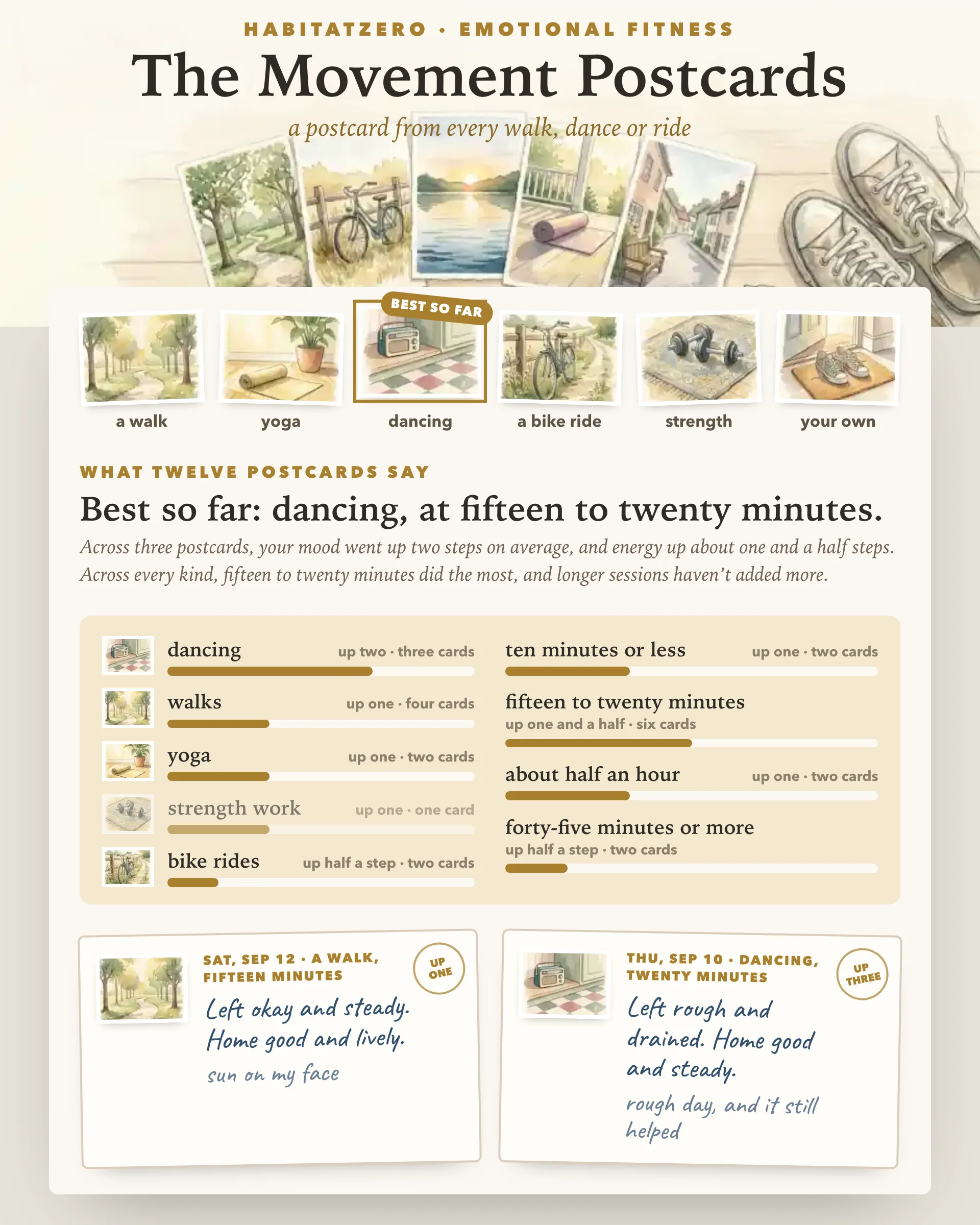
Pick a card from the rack: a walk, yoga, dancing, a bike ride, strength work, or a kind of your own, such as swimming or yard work. Before you start, tap one word for your mood and one for your energy, then set off. The card keeps the time, so when you come back it can suggest roughly how long you were out. Rate your mood and energy again, choose the length, add a line for the back if something stood out, and post it.
If plans change halfway and the walk turns into a bike ride, swap the picture. The ratings you already made stay, because they describe you rather than the plan. Forgot to rate before you went? Mark the card as already back and fill in both halves from memory, for today or yesterday.
Once two kinds of movement each have two postcards, the box starts comparing. It names the kind that raised your mood most on average and the length where that happened, marks that card on the rack as best so far, and lays every kind and every length side by side. A kind with a single postcard is shown but not ranked, and when two kinds sit within a quarter of a step of each other, the page calls it a tie.
Mood moves for plenty of reasons. A walk on a sunny Saturday with a friend is not a fair match for a treadmill session after a bad night's sleep. Treat the box as a running conversation rather than a verdict: try each kind a few times, change the length now and then, and use the line on the back to note what else was going on. The box holds forty postcards, enough for several weeks, and old ones can go whenever you want a fresh start.
Check with your doctor before you start something new if you have a heart condition, chest pain, dizziness when you exert yourself, or another health concern. If low mood sticks around most of the day, nearly every day, for two weeks or more, that matches how the National Institute of Mental Health describes depression, and a doctor or therapist is the right next step. If your low mood ever turns into thoughts of not wanting to be here, call or text 988 in the US, or your local emergency number, today.
The postcards pair well with a daily Mood Tracker, which shows the days in between sessions, and with The Balloon Field, a behavioral activation planner for when low mood makes everything feel pointless. Start with whichever kind of movement feels most possible today. A ten-minute postcard still counts.
The phrase covers two kinds of practice: movement done partly for your mood, such as walking, yoga or dancing, and mental drills like slow breathing or grounding. This page is built for the first kind and helps you find which movement leaves you feeling better.
No single activity wins for everyone. Trials in people with depression found walking or jogging, yoga and strength training all helped, and the one you will keep doing matters more than any ranking. A few weeks of before and after ratings shows which one does the most for you.
There is no fixed number, and it differs from person to person. The postcard box sorts your sessions by length, so you can see whether ten minutes of movement does as much for your mood as half an hour.
Movement helps many people and sits well alongside treatment, but it is not a stand-in for care when low mood or worry keeps returning. If low mood hangs on most days for two weeks or longer, talk with a doctor or therapist about it.
The filled box on this page holds three sample weeks of walks, dances and rides. To write your own postcards and watch the box compare them, open the worksheet in HabitatZero, where it is free to use.
By the team behind Fabulous, the science-based self-care app used by over 30 million people.


