
The Overwhelm Recovery ProtocolWellness & Routines · ~5 min
About this template · Updated September 2026
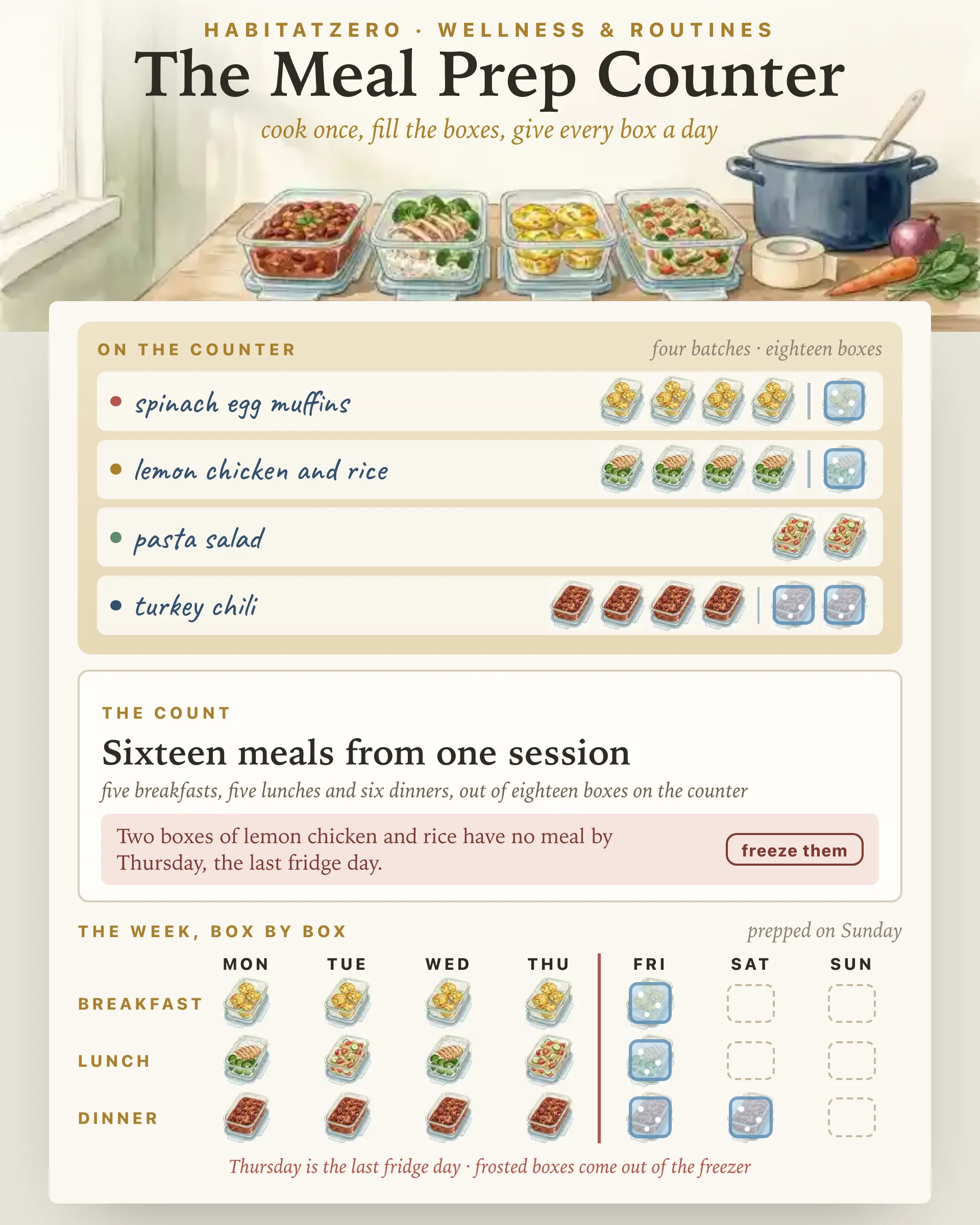
Plenty of meal prep plans break on the same day. You cook on Sunday, stack seven lunches in the fridge, and by Friday you are sniffing a container and wondering. Nothing went wrong in the cooking. The plan simply promised the week more fridge time than cooked food has.
This meal prep template is built around that limit. Before you shop, it lays every box you plan to cook over the days after prep day, counts how many meals the session really covers, and names the boxes that would spoil before anyone eats them.
The FoodSafety.gov cold storage chart gives one answer for nearly every dish on this counter. Cooked meat and poultry, soups and stews, baked egg casseroles, and egg, chicken, tuna or macaroni salads all keep three to four days in a refrigerator at 40°F or below. So a Sunday session can carry you through Thursday from the fridge, and no further.
The freezer is where the rest of the week lives. The same chart notes that food held at 0°F stays safe indefinitely; its freezer months, such as two to three for soups and two to six for cooked meat, are about flavor and texture. The salads are the exception: they do not freeze well, so every salad box has to be eaten within its four days.
Start with a batch. Tap a recipe such as lentil soup or spinach egg muffins, or write in your own, and it lands on the counter as a row of painted boxes under a strip of masking tape with its name. Each batch belongs to breakfast, lunch or dinner and carries a kind of dish, and the kind decides how long it keeps and whether it can go in the freezer.
Tap a box to send it to the freezer, where it turns frosty, and tap it again to bring it back. The plus and minus buttons change how many boxes the batch fills, up to eight, and the counter holds six batches.
Below the counter, the week does the arithmetic. Fridge boxes take the first four days after prep day, rotating between the batches for each meal so Tuesday is not a copy of Monday. Frozen boxes fill the days after that, each with a note about which night to move it into the fridge. Anything left over shows up in the count. A fridge box with no meal before its last day is marked as waste, with a button that sends it to the freezer, or, for a salad, trims the batch. A frozen box with no meal this week simply waits for a later one.
The shopping list writes itself from the ingredients in each recipe, merges the duplicates, and lets you tap off what is already in the kitchen.
Cooking at home more is linked with eating better, though the link is not proof. In a survey of 1,319 adults, people who spent more time on home food preparation ate vegetables, salads and fruit more often, and those who spent under an hour a day spent more on food away from home. It was a snapshot, so it cannot show that cooking caused the difference.
On waste, the evidence points at planning. In a series of three studies on household food practices, a field experiment with 210 people suggested that teaching the skills of planning food preparation cut the amount of food thrown away at home. That is one study with a modest sample, and this page does not weigh your trash. What it can do is catch one very ordinary planning slip, more fridge portions than fridge days, while it is still a plan.
The U.S. Department of Agriculture's guidance on leftovers fills in the rest of prep day:
Write the day on each lid while you pack, and the week on the counter becomes the week in your fridge.
Fill it in the day before you shop, when you know what you feel like cooking. Check the count again on prep day, while the boxes cool, so the extras go straight into the freezer instead of the back of the fridge. For the nights you cook fresh, the Meal Planner keeps the rest of the week in one place, and The Aisle-by-Aisle Grocery List sorts the shopping by store aisle. If a weekday evening needs almost no decisions at all, The Fridge Door Meal Plan is built for exactly that.
Each recipe you plan to cook, how many portions it makes, where every container will live, and how long it keeps there. The most useful ones also turn the recipes into a shopping list and lay the containers over the days you will actually eat them.
The FoodSafety.gov storage chart gives three to four days at 40°F or below for cooked meat and poultry, soups and stews, egg casseroles, and egg, chicken, tuna or macaroni salads. Food held frozen at 0°F stays safe indefinitely, and the freezer months on that chart describe flavor and texture rather than safety.
Yes. In the app, printing a finished plan puts the counter, the week and the shopping list on paper you can keep by the stove. With nothing on the counter yet, the same button prints a blank version with recipe lines, a seven-day grid split after day four, and space for groceries.
Yes, as long as only four of them rely on the fridge. Freeze the Friday and weekend portions on prep day, then move each one to the refrigerator the night before, or reheat it straight from frozen when the night got away from you.
The sample counter on this page is there to explore. To plan your own sessions, keep your recipes and freezer boxes from one weekend to the next, and print the plan, open the template in HabitatZero, which costs nothing to use.
By the team behind Fabulous, the science-based self-care app used by over 30 million people.


