The Overwhelm Recovery ProtocolWellness & Routines · ~5 min
About this template · Updated September 2026
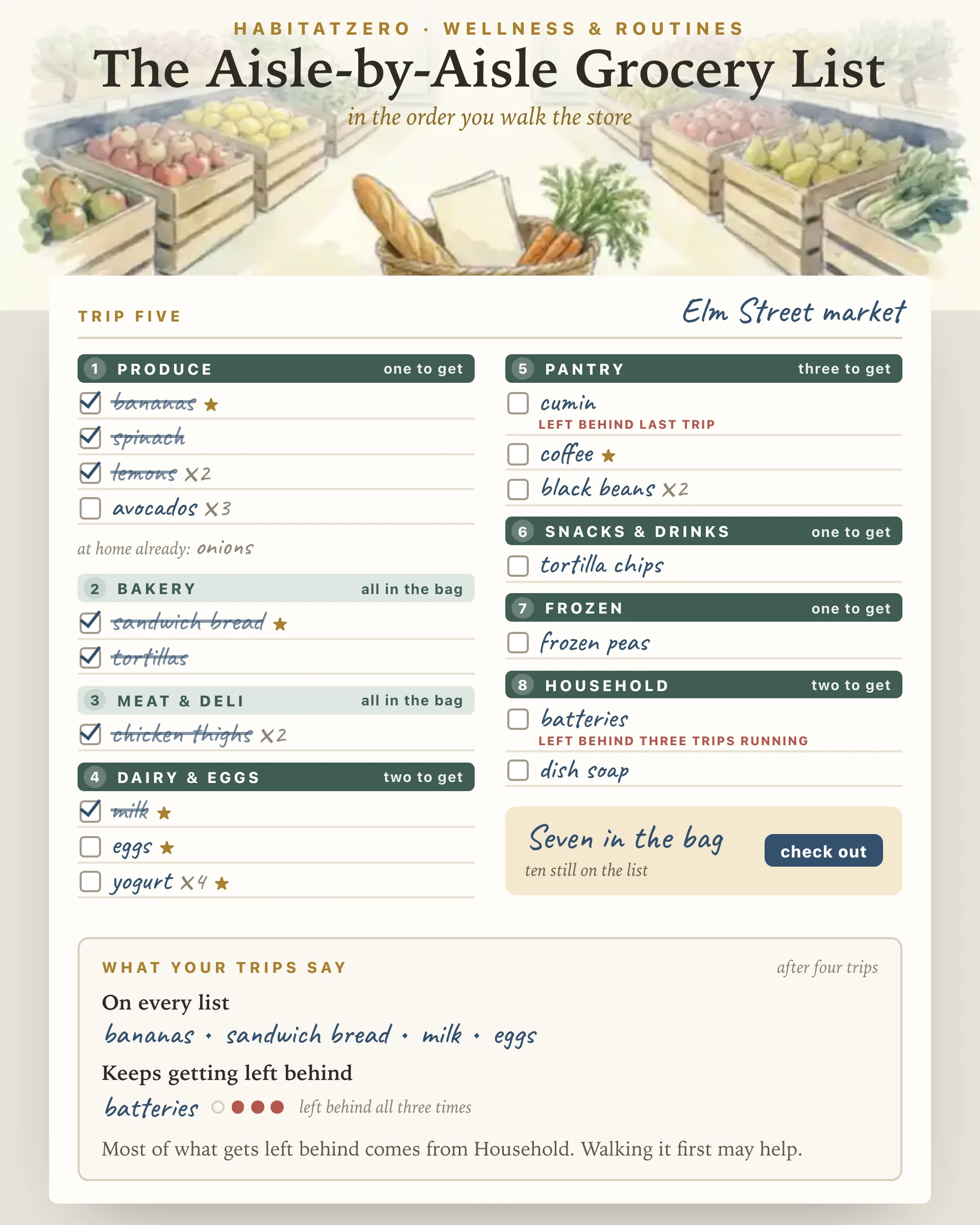
You know the trip. You reach the register feeling organized, and somewhere between the parking lot and your front door you remember the batteries. Or you cross the store twice because the list said coffee, bananas, dish soap, eggs, and you followed it. This page fixes the order first, then keeps an eye on the things that slip.
Most lists get written in the order things run out. The store is laid out another way. Writing each item under the aisle where it lives turns the list into a route: you pass each section once, and nobody sends you back across the store for the eggs.
The route matters more than it looks. When Hui and colleagues followed shoppers through a grocery store with radio frequency tracking, the typical path covered less than half of the floor. The authors start from a known habit: shoppers lean on the products around them as memory cues. One practical reading: if the shelves jog your memory, the sections you skip cannot. A list sorted by aisle tells you which sections this trip needs before you start walking. The same study found that longer paths through the store led to more unplanned spending, so a tidy route helps twice.
Lists do their job. Block and Morwitz compared shoppers' written lists with what they actually bought over two months of grocery trips, and more than four in five of the items written down ended up in the cart. The list was a dependable memory outside the head. It also held only about two in five of what people bought. The rest was decided in the store, and the things that made it onto paper tended to have a reason to be remembered, such as being used often or carrying a coupon.
That gap is what this template works on. Your regulars should not depend on you remembering to write them down, and the items that keep slipping deserve more attention, not less.
Each aisle sign opens with common items for that part of the store. Tap one and it lands on the list in handwriting, or write your own on the line underneath. Open any item to set how many you need, to star it, or to take it off with a second tap.
Stars carry the week-to-week part. A starred staple comes back after every trip, unchecked and waiting. If you still have plenty at home, say so and it sits the trip out on a line of its own.
In the store, tap items as they go in the cart. The sign above each aisle counts what is still to get and fades once the aisle is done. When you finish, press check out. One-offs you bought leave the list, staples reset for next week, and anything still unchecked stays on with a note that it was left behind last time.
The list holds forty lines, because forty is what fits on one printed page. The print button lays it out in two columns with an empty box beside each item and a few spare lines under every sign for whatever comes up midweek. Print it before adding anything and you have a blank checklist sorted by aisle.
From the second checkout on, a card under the list reads your record back to you. It names what has been on every list, the regulars you can stop thinking about. It names what keeps getting left behind, with a row of dots for recent trips. If most of the misses come from one aisle, it offers to move that aisle to the front of your route, since a section you rush past at the end is the easiest one to skip. And if a one-off keeps coming along, it offers to make it a staple.
None of this is a grade. Something can stay on the shelf because it was sold out or the price jumped. The card shows the pattern so you can decide what, if anything, to change.
The research here is about how people shop, not about what this page will do for you. A survey of nearly 1,400 shoppers in two Pittsburgh neighborhoods with limited access to fresh food, by Dubowitz and colleagues, found that people who consistently shopped with a list had healthier diets on a standard index. It was a single snapshot, so it cannot show that the list caused the difference; people who plan their shopping may differ in other ways too. No study has tested the reading on this page; treat it as a mirror of your own trips.
Set it up once at home, starring what you buy most weeks. Before every trip, skip the staples you still have; in the store, check things off aisle by aisle; check out when you get home. If dinners are the hard part, decide the week first on the Meal Planner and carry its ingredients over here, or keep a few repeating dinners on The Fridge Door Meal Plan. If you plan food and exercise together, the Meal and Movement Planner keeps both halves of the week on one page.
Begin with what you buy nearly every week, such as milk, eggs, bread, fruit, coffee and a few household basics. Star those as staples. Everything else goes on as a one-off for the week it is needed, which keeps the checklist short enough to read while you push the cart.
Group each item under the section of your own store where it lives, then put the sections in the order you walk them, often produce first and frozen close to the end. This template starts from a common layout, and the arrow on each aisle sign moves that aisle earlier until it matches your store.
Yes. The print button turns the list into one two-column page with an empty box beside every item and spare lines under each aisle. Pick Save as PDF in the print dialog if you would rather carry it on your phone.
Print the page before adding anything and you get a blank checklist sorted by aisle, with boxes and ruled lines under every sign. Fill it in with a pen at the kitchen counter and cross things off in the store.
This page shows the list working with sample trips. Personalize it in HabitatZero, which is free, and your staples, store order and trip record carry over from one week of groceries to the next.
By the team behind Fabulous, the science-based self-care app used by over 30 million people.