
The Overwhelm Recovery ProtocolWellness & Routines · ~5 min
About this template · Updated September 2026
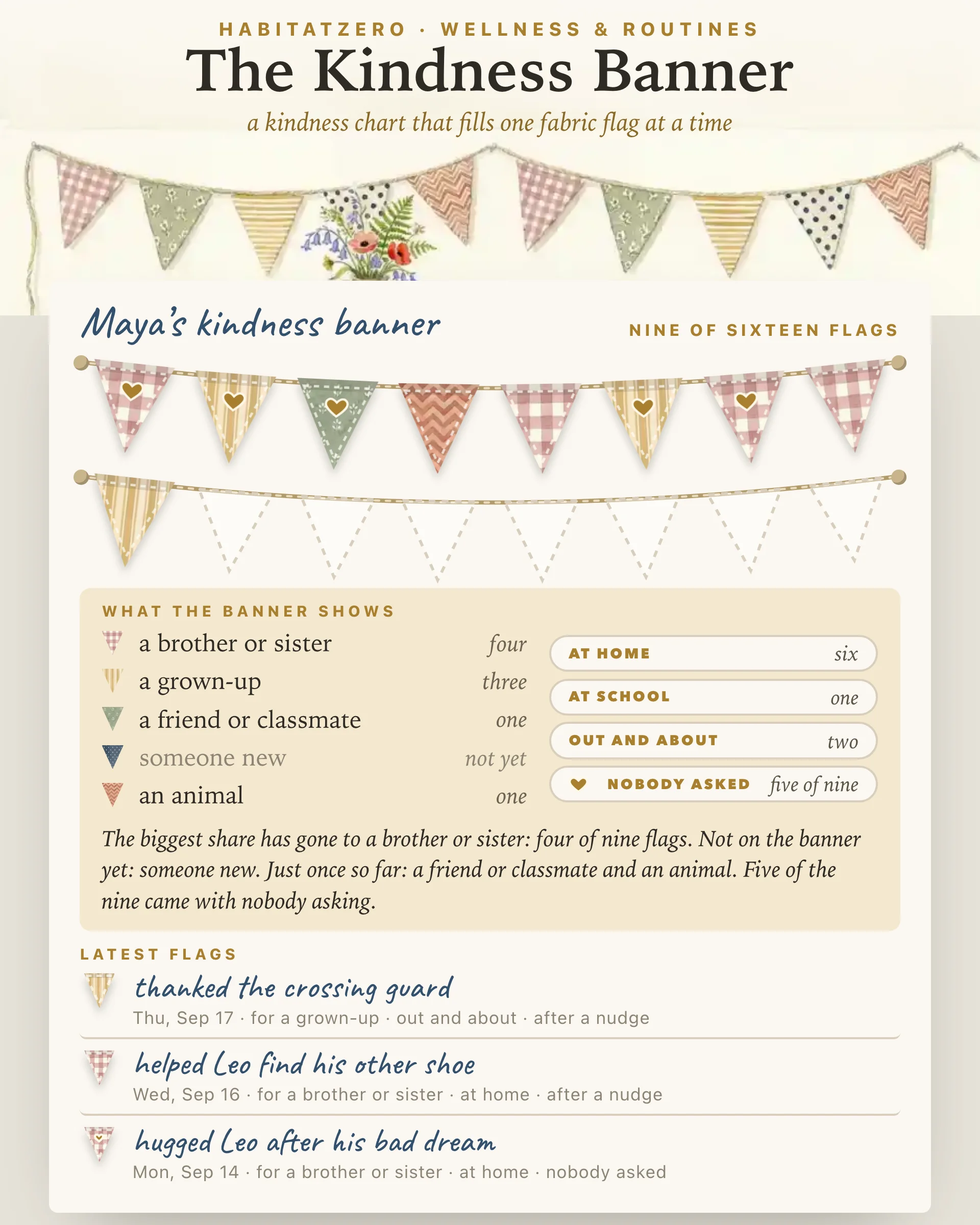
Most kindness charts are sticker charts in a softer color: a grid, a sticker per good deed, a prize waiting at the bottom. This one is built differently on purpose. You catch your child being kind, write down what they did in a few words, and hang a fabric flag for it on a banner. Sixteen flags fill the banner, and then your child picks how the family celebrates. No flag earns anything on its own.
Children start helping early, and nobody has to pay them to do it. In one experiment, 20-month-olds who received a material reward for helping went on to help less than toddlers who had been praised or given nothing at all. A later study tracked two-year-olds' pupils and found that they reacted alike whether they helped someone themselves or watched another person do the helping. What seemed to matter to them was that the person got helped, not who got the credit.
Taken together, those findings suggest that kindness in young children runs on a motive of its own, and that a price tag can crowd it out. That is why this banner pays nothing per act, and why its ending is something your family does together, like a living room picnic or a bike ride, rather than something bought. If a toy gets suggested, the page steers back to shared plans and says why.
Keep the limits in view. Both studies were short lab sessions with toddlers, and neither looked at older children or at a shared family treat at the end of a few weeks. The research points in a direction. It does not hand you a rule.
Put your child's first name above the twine. When you see something kind, write it the way you would tell it at dinner: "waited for Leo to catch up" or "gave Ava the blue marker." Then tag it with three taps:
Flags go up left to right, each with its date. Tagged one wrong? Fix it and the flag changes fabric in place, or take it down with two taps. When all sixteen hang, the catch card steps aside and your child chooses the celebration. After the celebration, start the next banner.
From about four flags on, the banner starts saying what it sees: which kind of person gets most of your child's kindness, which kinds have not appeared, and how many flags came with nobody asking.
Expect it to be lopsided. Kindness is not one single skill. When researchers gave toddlers chances to help, share and comfort, how often a child did one did not predict the others. A child who comforts a crying friend may still guard every cracker from a younger brother. A banner lets you see that split instead of blending it into one total.
Treat an empty row as a prompt to notice, not a gap to fix. If someone new stays blank, you do not need to assign a good deed. Watch for the small version, like making room at the lunch table for a kid sitting alone, and hang the flag when it comes.
Two cautions come with any reading. You mostly see home, so school kindness reaches the banner only when a teacher or your child mentions it; asking at pickup helps. And a banner records what you noticed, which blends your child's habits with your own attention.
Hang flags for small things. Filling the dog's water bowl without being told is the real thing, and the banner treats it the same as a grand gesture.
Say what you saw, briefly and soon: "You waited for Leo even though you wanted to run ahead." Then let the moment go. Skip the speech about what a kind person they are, and never bargain with a flag, as in "share and you get one." Kindness that came after a nudge still counts and still hangs; it simply goes up without the heart.
A kindness banner suits a stretch when you want more warmth in the house: a new baby, a rough patch between brothers and sisters, the first weeks at a new school. It is not the tool for a routine you need to build quickly, like getting dressed before the bus. For that, The Token Board ties a named behavior to a reward you agree on ahead of time, and The Weekly Behavior Chart follows a few specific behaviors across the week. If your family would rather plan kind acts together than catch them as they happen, Kindness Bingo gives you a card to color in.
Print the banner when it fills. Sixteen flags make a small record of weeks when your child was generous in ways that would otherwise be easy to forget.
It is a running record of the kind things a child really does, kept by the grown-ups who notice them. Here each act becomes a fabric flag on a banner, so after a few weeks you can see who gets your child's kindness and how much of it arrives without a reminder.
Keep them social. In one experiment, toddlers who got a material reward for helping went on to help less than toddlers who had been praised or given nothing. This banner pays nothing per flag and ends in a family celebration your child picks, never a purchase.
Small, real moments: sharing a snack, waiting for a sibling, comforting a friend, filling the dog's bowl. Log the nudged ones too: they hang like any other flag, and only the unasked ones get a gold heart.
Yes. The print button gives a clean page with the banner, the pattern, the chosen celebration and every flag's words and date, with the buttons left off. A copy taped low on the fridge keeps the banner in your child's sight between catches.
This page shows an empty banner and a half-filled sample. To hang your own flags with their dates, read your child's pattern and save the celebration they pick, personalize the banner in HabitatZero, which costs nothing.
By the team behind Fabulous, the science-based self-care app used by over 30 million people.


