The Overwhelm Recovery ProtocolWellness & Routines · ~5 min
About this template · Updated September 2026
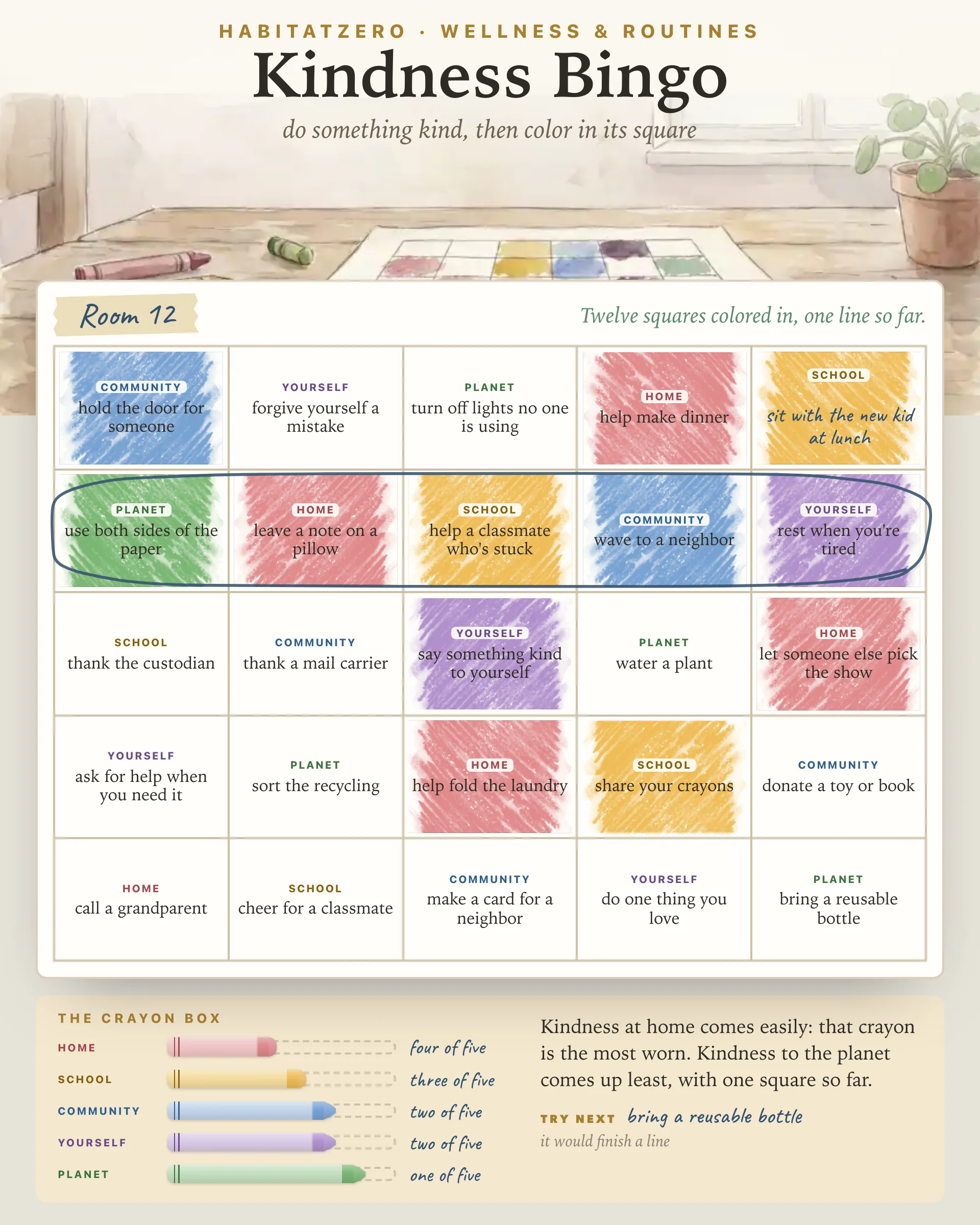
A kindness bingo card makes kindness something a child can point at. Twenty-five small acts sit in a five-by-five grid, and a square gets colored in only after its act has really happened: a door held open, a note left on a pillow, a classmate helped through a hard problem. Color a whole row, column or diagonal and you have a line. Color all twenty-five and you have a blackout. The card works taped to a classroom wall, stuck on the fridge, or folded into a backpack.
This version keeps track of something a printed sheet can't: which kinds of kindness your class or family reaches for easily, and which ones quietly get left out.
Start by naming the card on its strip of tape, whether it belongs to one child, a class, or the whole household, and keep it where everyone passes. When someone does one of the acts, they tap its square and it fills with that kind's crayon. Tapping a colored square once asks before anything is erased, so a stray finger can't wipe out a good day.
Nobody calls numbers and nobody races. Kids choose the squares that suit their day. Some teachers color one square together each afternoon; some families do it over dinner, with the youngest doing the tapping.
If a square doesn't fit your group, trade it for another idea of the same kind or a few words of your own.
Every square belongs to one of five kinds: kindness at home, at school, in the community, to yourself, and to the planet. The grid is arranged so that every row, every column and both diagonals hold exactly one square of each kind, and the middle square is kindness to yourself.
That arrangement is the quiet rule of the game. No line can be finished with only the easy kind. A class that loves helping each other but never gets around to the planet squares won't close a single line until somebody turns off a light nobody needs or brings a reusable bottle.
Under the card sits a box of five crayons, one for each kind. Every colored square wears its crayon down a little, so after a week or two the box tells the story at a glance. A crayon worn to a stub marks a kind of kindness that comes easily. A crayon still sharp and long marks one that keeps getting skipped.
The page puts that pattern into plain words and suggests a square to try next, taken from the kind that lags behind and, when it can, one that would finish a line. That's the conversation worth having with kids. The question isn't who was kindest this week. It's which kind of kindness all of you keep forgetting.
At about one square a day, twenty-five squares last a month with a few rest days, which turns the card into a thirty-day kindness challenge with the blackout as its finish line. After that, start a fresh card: the colors clear, while the name on the tape and any squares you rewrote stay put for next month.
The evidence is real but modest. A 2018 meta-analysis pooled twenty-seven experiments with just over four thousand participants and found that doing kind acts gives the person doing them a small-to-medium boost in well-being. The effect held across ages, and the authors are candid about the limits of the studies behind it.
Closer to a classroom, researchers in nineteen Vancouver classrooms asked nine- to eleven-year-olds to do three kind acts a week for four weeks, while a comparison group kept track of three places they visited each week. Both groups ended up happier, but the kindness group gained more peer acceptance: more classmates circled their names as someone they'd like to spend time with.
Kindness to yourself earns its square too. In a seven-day experiment with nearly seven hundred people, kind acts for people close to them, for people they barely knew, and for themselves raised happiness about equally, and people who did more kind acts tended to gain more.
None of this means a bingo card will change a child's character or rescue a hard year. It's a small nudge, repeated. Keep the talk on the acts themselves, and don't turn the card into a scoreboard of which kid did the most.
Once the card is yours, it prints on one page: blank, for coloring with real crayons, or colored in at the end of the month for the fridge. Each square names its kind in small letters, so a black and white printer loses nothing.
If the kids like a game about feelings too, Feelings Bingo pairs well with this card. For a slow weekend, The Gratitude Scavenger Hunt sends the whole family looking for good things close to home. And if the square for kindness to yourself keeps staying white, The Loving-Kindness Circle is a short guided practice that begins with you.
Every square names one small kind act. Once someone has really done it, color that square in. Five colored squares across, down or corner to corner count as a line, and coloring all twenty-five is a blackout. Nobody calls numbers and nobody races, so each kid picks whatever square fits the day.
Pick acts a child can finish before bedtime: holding a door, leaving a note on a pillow, thanking the custodian, sorting the recycling, forgiving yourself for a mistake. This card spreads them across five kinds, at home, at school, in the community, toward yourself and toward the planet, so one favorite kind cannot fill the whole grid.
It can. At roughly one square a day, twenty-five squares carry a class or a family through a month with a few rest days, and the blackout becomes the finish line. When the card is full, starting fresh wipes the colors but keeps the name and any squares you rewrote.
The starting squares are written for children, yet each one can be rewritten in a few words, so the same card suits a staff room, a youth group or a house full of adults. Grown-ups tend to find the crayon box just as revealing, since everybody has a kind of kindness they skip.
This page shows the empty card and a colored-in sample you can look over. To put a name on your own card, trade squares, color them in through the month and print it, personalize it in HabitatZero, which costs nothing.
By the team behind Fabulous, the science-based self-care app used by over 30 million people.