The Overwhelm Recovery ProtocolWellness & Routines · ~5 min
About this template · Updated September 2026
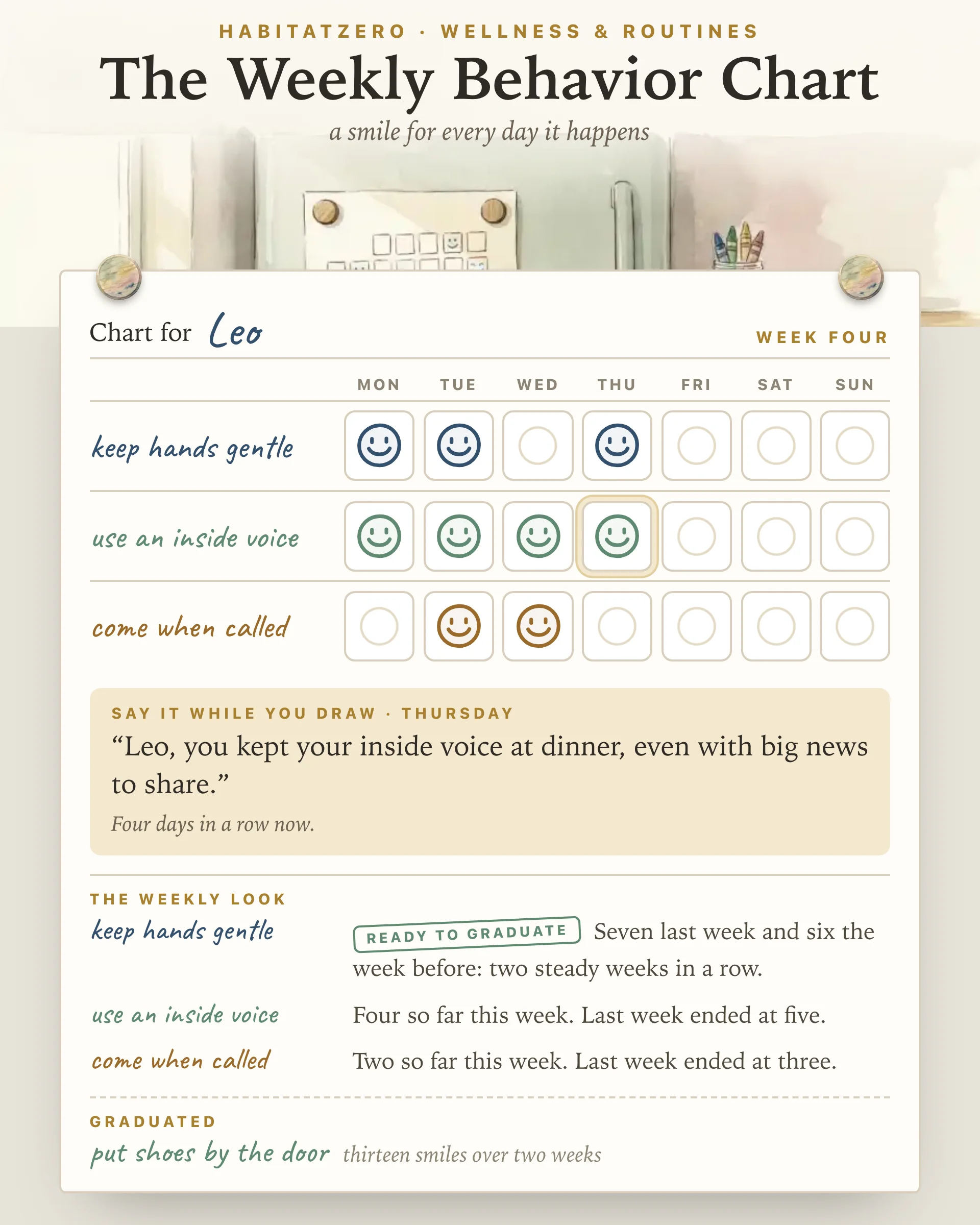
A behavior chart is about as plain as parenting tools get: a sheet on the fridge, a few behaviors down the side, the days of the week across the top, and a mark for each day it went right. It works best when it stays small, stays positive and ends on purpose. Here you name two or three behaviors as things to do, you and your child draw a smile on each day they happen, the chart hands you the words to say while you draw, and each week it shows which behaviors are steady enough to leave.
Most charts start from the trouble: hitting, yelling, the fifteen-minute bedtime stall. That is the right place to start and the wrong thing to write down. "No hitting" gives a child nothing to aim at, and it gives you nothing to draw a smile for, because an absence is hard to notice.
So the chart opens by asking what has been hard lately. Tap hitting and it offers keep hands gentle or use words when you're mad; tap bedtime stalling and you get in bed when the song ends or stay in bed after lights out. Type your own starting with no, don't or stop, and the chart turns it down, says why, and points you to a version worded as something to do.
Pick a time you can keep, such as right before bed, and sit down together to tap the box for each behavior that happened today. A smile draws itself in that row's crayon color, and a card opens with a line to read out loud, such as "Leo, you kept your inside voice at dinner, even with big news to share." If that line doesn't fit the day, ask for another way to say it.
The line matters more than the smile. The CDC's parenting guidance separates labeled praise from unlabeled praise: "I saw that you put your toys away" tells a child exactly what to repeat, while "great job" only tells them you approve. Every line here names the behavior, and a small note adds what the chart has noticed, like three days in a row.
There is no red column, no frowning face and no way to take a smile back as a penalty. The only smile you can clear is your most recent one, for the evening a finger lands in the wrong box. A blank box means not yet.
That choice is about more than kindness. The American Academy of Pediatrics policy statement on discipline says that yelling at or shaming children is minimally effective in the moment and not effective over time. A chart that paints a child's hard days red works a lot like shaming, and it soon becomes a record nobody wants to look at.
When the week ends, start the next one. Each behavior's smiles move into the weekly look, which reads them back in plain words: four so far this week, last week ended at five. When a behavior earns six or seven smiles two weeks running, the chart stamps it ready to graduate. Graduate it and it moves to a short list of graduates with its total smiles, and its row opens for the next thing.
Two steady weeks is this page's rule of thumb, not a number from research. It puts into practice the CDC's suggestion to change the chart as your child grows by moving on to a different behavior. The reading works in the other direction too: two quiet weeks in a row suggest the step is too big, so try it for one moment of the day instead of all day.
A chart makes praise regular. It does not make praise magic. A systematic review of praise and child compliance covering forty-one studies of children aged one and a half to eleven found mixed results for praise on its own, while reprimands more consistently led to compliance. That is about following instructions in the moment, not building habits over weeks, but it is a fair warning: a chart works alongside clear, calm limits, not in place of them.
If behavior is dangerous, getting worse, or part of a diagnosis, bring it to your pediatrician. For children under six with ADHD, the CDC describes parent training in behavior management as the recommended first choice of treatment, and a therapist can fit a chart into that larger plan.
Reach for it when two or three things keep going sideways, and print the fridge copy so the chart lives where everyone can see it. A teacher can keep one for a single student the same way, marking it at the end of the school day. For one routine with a reward your child picked, the Token Board moves faster. For a single job your child resists, a First-Then Board fits the moment better. And for dishes and laundry, use the Chore Chart: a behavior chart is about how your child acts, not which jobs get done.
It is a simple grid kept on the fridge or a classroom wall, with a few behaviors down the side, the days of the week across the top, and a mark in each box on a day the behavior happened. It makes an expectation visible to a child and gives the adult a daily reason to notice what went right. This one marks each day with a drawn smile and gives you a line of specific praise to say while you draw it.
Choose two or three, each worded as something your child can do, such as keep hands gentle, use an inside voice, or come when called. A rule phrased as a stop, like no hitting, gives a child nothing to aim at and gives you nothing to draw a smile for. Pick behaviors your child already manages on a good day, so the chart catches progress instead of asking for a skill that is not there yet.
A chart can help as one piece of a bigger plan. For children under six with ADHD, the CDC calls parent training in behavior management the recommended first choice of treatment, and that training teaches parents to use positive reinforcement, structure and consistency, which is the same ground a chart covers. Keep the chart small, with one or two rows marked the same day, and ask your pediatrician about a full plan.
Usually the chart asks for too much at once, the marks arrive long after the moment, or it slowly becomes a record of bad days that nobody wants to look at. This chart holds three behaviors at most, gets marked the same day, never takes a smile back as a penalty, and shows you when a behavior is steady enough to leave, so it ends on a success instead of fading out.
Yes. The filled-in example on this page shows how a finished week looks. To put your own child’s name and behaviors on it, mark the days, and print a fridge copy with a praise line under every row, open the chart in HabitatZero, which costs nothing to use.
By the team behind Fabulous, the science-based self-care app used by over 30 million people.