Leaves on a StreamEmotional Fitness · ~3 min
About this template · Updated September 2026
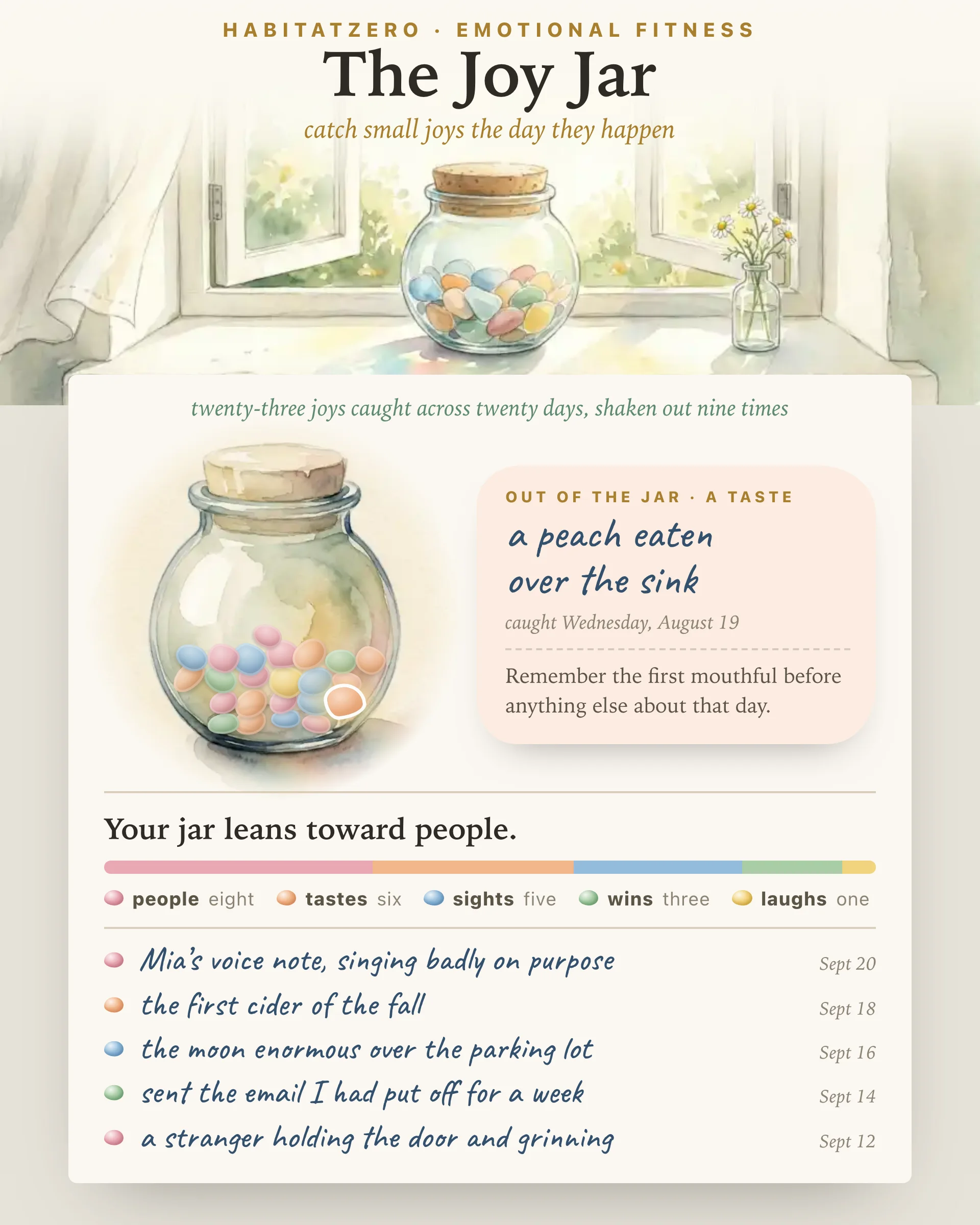
A joy jar is about the smallest practice there is. Something good happens, you write it down in a line, and it goes into a jar. Weeks later, on a day that has gone gray, you tip one back out and stand inside that moment again for a few seconds. People have kept real jars like this for years, under names like happiness jar or happy jar. This one is glass on a screen, and it keeps track of a few things a real jar cannot.
Psychologists have a word for what the jar asks of you: savoring. Fred Bryant and Joseph Veroff describe savoring as managing the emotional impact of a good event through how you think and act in response. It starts with noticing: a good moment you never notice is gone by dinner.
In a thirty-day diary study, 101 people reported each day's good events, how they responded, and how happy they felt. Savoring turned out to be part of the route from a good event to a good mood, and the more someone savored in a given moment, the further the same good event lifted them. So the page asks for the joy on the day it happens, while the detail is still in it: the peach eaten over the sink, not a good weekend.
Pick what kind of joy it was: a sight, a taste, a person, a win or a laugh. Write one line, or borrow a prompt and change a word until it sounds like you. Press drop it in and the joy falls onto the pile as a pebble of sea glass in its kind's color, dated automatically. The jar holds fifty. Once it is full, an old joy has to go before a new one fits, which is its own small act of rereading.
On a low day, shake the jar and one joy comes back out with the day you caught it. The shake draws from the third of the jar you have gone longest without seeing, counting the day each joy was caught and the last time it came out, so the ones at the bottom get their turn. Under each joy sits a cue for replaying it, matched to its kind. Sights ask where the light was coming from. People ask you to tell them. Wins ask you to be pleased for ten slow seconds.
From five joys on, the jar also reads what it holds. It names the kind you catch most and points out the kind that keeps slipping past you. A jar full of people and short on laughs gives you something to listen for this week.
Returning to good memories on purpose has been tested directly. In a week-long experiment, Bryant, Colette Smart and Scott King had students spend ten minutes twice a day either reminiscing about pleasant memories or thinking about current concerns. Both reminiscing groups reported bigger increases in how much of the week they felt happy than the comparison group did, and the students who replayed memories as mental images gained more than those who leafed through keepsakes. A jar is a keepsake, so the cue under each joy is there to turn reading into replaying.
Different ways of savoring seem to feed different things. A survey of 282 people led by Jordi Quoidbach found that staying present in a good moment and dwelling on it afterward went with more positive emotion, while telling other people about it went with greater life satisfaction. People who used a mix of strategies were happier overall than those who leaned on one or two, which is why the cues change with the kind of joy.
The rotation has a reason too. Pleasures dull with repetition, and in a study that asked people to give up chocolate for a week, those who abstained savored their next piece more than people told to eat as much of it as they could or left to carry on as usual. The jar borrows the idea, not the result: a joy unseen for a month tends to land harder than one you read yesterday.
None of these studies tested a jar. The reminiscence experiment used students, and the diary and survey findings are associations drawn from self-reports. Savoring is a way to get more out of good days, not a treatment for hard ones. If the low days have outnumbered the others for weeks, that is worth raising with a doctor or a therapist.
Catch a joy at the end of the day, or the moment it happens. One a day is plenty. Shake the jar on a flat evening or a Sunday that has gone too quiet.
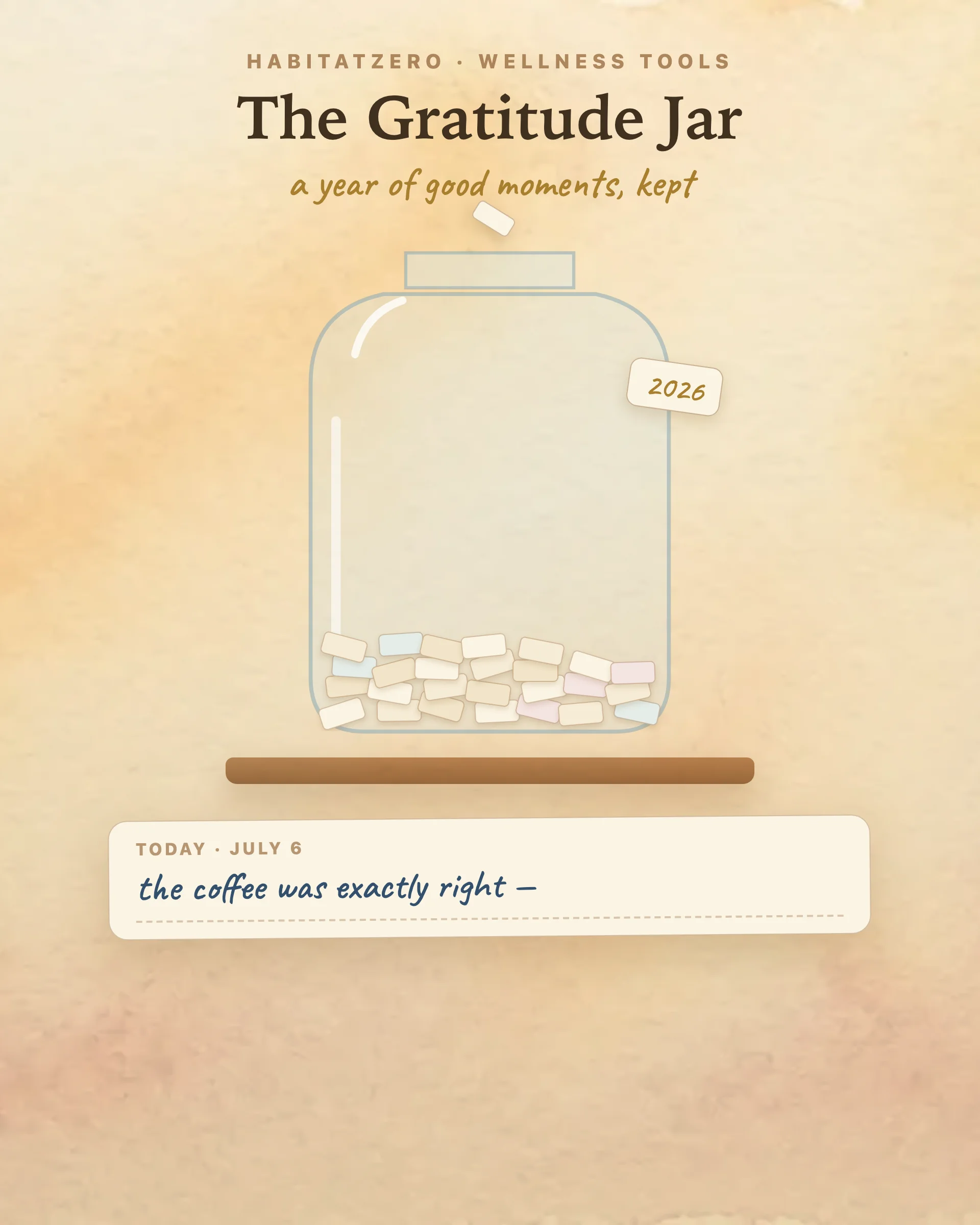
If what you want to keep is thanks rather than delight, The Gratitude Jar is made for that, filling slip by slip across a whole year. For a daily look back that makes room for the hard parts, Rose, Bud, Thorn names a highlight, a difficulty and something just starting. And when a low day needs something to do more than something to remember, The Dopamine Menu hands you an activity you chose on a better day.
It is a jar you fill with small good moments, one short note at a time, so that on a flat day you can pull one out and stand in it again for a few seconds. The skill underneath it is what psychologists call savoring: noticing a good moment while it is happening, then going back to it later on purpose.
Anything from today that made you glad to be there: light on a wall, a first bite, a friend's voice note, a job finally finished, a joke that landed. Specific beats grand, so write the peach eaten over the sink rather than a nice summer. If nothing comes, each kind of joy on this page offers three prompts to borrow and reword.
They are three names for one idea: a container of happy moments that you add to over time and draw from when you need a lift. Some people fill theirs with notes from friends or favorite quotes. This one holds your own moments, each dated and sorted into five kinds, so it can also show you what tends to make your days good.
Going back to good memories on purpose has held up in experiments. In one, students who reminisced about pleasant memories for ten minutes twice a day for a week felt happy more of the time than students who thought about current worries, and vivid mental replays did better than looking at keepsakes. It is a way to lift a mood, not a treatment, so a jar cannot replace help when a low patch drags on.
On this page you can look through a jar someone has half filled, with one joy already shaken out. A jar of your own, one that keeps every joy between visits and can be shaken on any day, begins when you personalize the page in HabitatZero at no cost.
By the team behind Fabulous, the science-based self-care app used by over 30 million people.