Reading JournalStudy & Learning · ~4 min
About this template · Updated September 2026
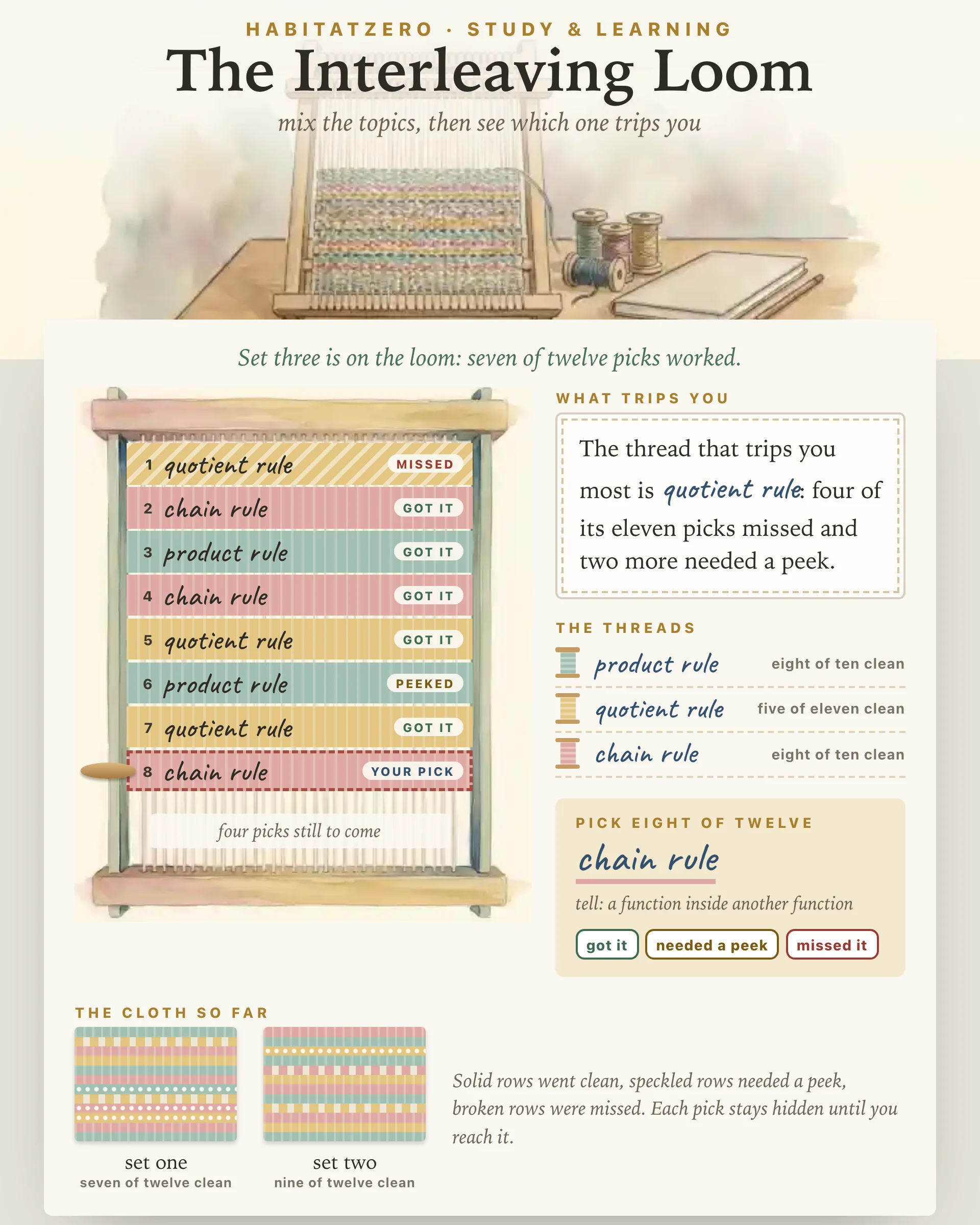
Most practice sets come in blocks. Ten chain rule problems, then ten on the quotient rule, then a page of product rule questions. By the third problem in a block you already know which method to reach for, because the heading told you. Your test will not tell you. There, a quotient rule problem turns up right after a chain rule one with nothing announcing it, and half the work is recognizing what kind of problem you are looking at.
The interleaving study method is practice that looks like the test. You take problems from two to four related topics and shuffle them so the same topic never comes up twice in a row: A, C, B, C, A, B instead of A, A, A, B, B, B, C, C, C. Every problem now asks you to decide which method it needs before you can start, and that decision is the skill blocked practice quietly skips.
Doug Rohrer and Kelli Taylor put the idea to a direct test in their 2007 study of shuffled math practice. Students learned several types of problems, then practiced them either blocked by type or randomly mixed. On a test one week later, the students who had practiced a mixed set did far better.
The catch showed up in a follow-up with children working four kinds of math problems. Mixing made their practice session go worse, and then it doubled their scores on a test the next day. An analysis of their errors suggested why: the mixed group had become better at pairing each problem with the right procedure. So a rough set is not proof that the method is failing. It feels harder because it asks for the choice that blocked practice hands you for free, and that is the part that carries over to the test.
The strongest evidence comes from ordinary classrooms. In a randomized trial across 54 seventh-grade math classes, students completed interleaved or blocked assignments over four months. On an unannounced test a month later, the interleaved group scored 61 percent and the blocked group 38 percent.
Interleaving is not a law for every subject. A meta-analysis of 59 studies found a moderate benefit overall and a smaller one for math tasks, and in studies that used words as the material, blocking came out ahead. The benefit grew when the categories being mixed resembled each other. That points to a practical rule: mix topics that are easy to confuse, like the three derivative rules or the past tenses of one language, rather than hopping between unrelated subjects every twenty minutes. It also assumes you have met each method once. Interleave your practice, not your first lesson.
Each topic becomes a thread on the rack. Tap an example from calculus, algebra, statistics, chemistry, physics or Spanish, or write your own. A thread can carry a tell, one short line about what gives that kind of problem away, such as one function divided by another for the quotient rule. The rack holds four threads at most, since a set that mixes more gives each topic too few problems in one sitting.
Choose how many problems to draw from each topic, then weave the set. The loom shuffles the picks so no thread appears twice in a row, and it keeps the order hidden: you only ever see the pick you have reached. Find a problem of that kind you have not seen yet, solve it with your notes closed, and mark it got it, needed a peek, or missed it. When you can, draw it from a chapter review or an old test, where no heading above the problem gives its method away. Each mark adds a row of weft and reveals the next pick, the way a mixed test hands you the next question.
When the last pick is marked, take the set off the loom and it joins the cloth as a small swatch. The label above the cloth names the thread that trips you most, counting a miss as a full stumble and a peek as half of one. When one thread clearly leads, the next set you weave gives it one extra pick. If you take a thread off the rack, its marks leave the reading while its rows stay in the cloth, so the history remains honest.
Weave a set once each topic makes sense on its own and a test is coming that will mix them. Spread your sets over several days rather than one long sitting, since mixing and spacing work well together, and the Exam Planner can lay those days out against your test date. If one thread keeps snagging, pause the mixing and rebuild that method from a worked example, or explain it out loud on The Feynman Blackboard before it goes back on the loom. For material where the hard part is remembering rather than choosing, like definitions and formulas, The Active Recall Deck is the better fit.
It means mixing practice problems from several related topics in one sitting instead of finishing every problem on one topic before starting the next. Since no problem arrives right after three of its own kind, you have to work out which method it needs, which is exactly what a mixed test demands.
A calculus student with twelve problems might work a chain rule question, then a quotient rule one, then product rule, then chain rule again, rather than four of each rule in a row. Statistics students can shuffle t-tests with chi-square and ANOVA questions, and Spanish students can mix preterite and imperfect sentences.
For problems that resemble each other, usually, even though it feels worse while you do it. In a trial across 54 seventh-grade math classes, the students who practiced interleaved scored 61 percent on an unannounced test a month later, while the blocked group scored 38 percent.
Learn each method once on its own before you mix it, and keep a set to topics from the same course. A review of 59 studies found the benefit was largest when the categories were easy to confuse, and blocking came out ahead in studies that used words as the material.
The pictured loom is a sample woven from three calculus rules, so you can see how a finished set reads before you begin. Threading your own topics, weaving new sets and keeping the cloth from one study day to the next happen in HabitatZero, where personalizing the loom is free.
By the team behind Fabulous, the science-based self-care app used by over 30 million people.