Reading JournalStudy & Learning · ~4 min
About this template · Updated September 2026
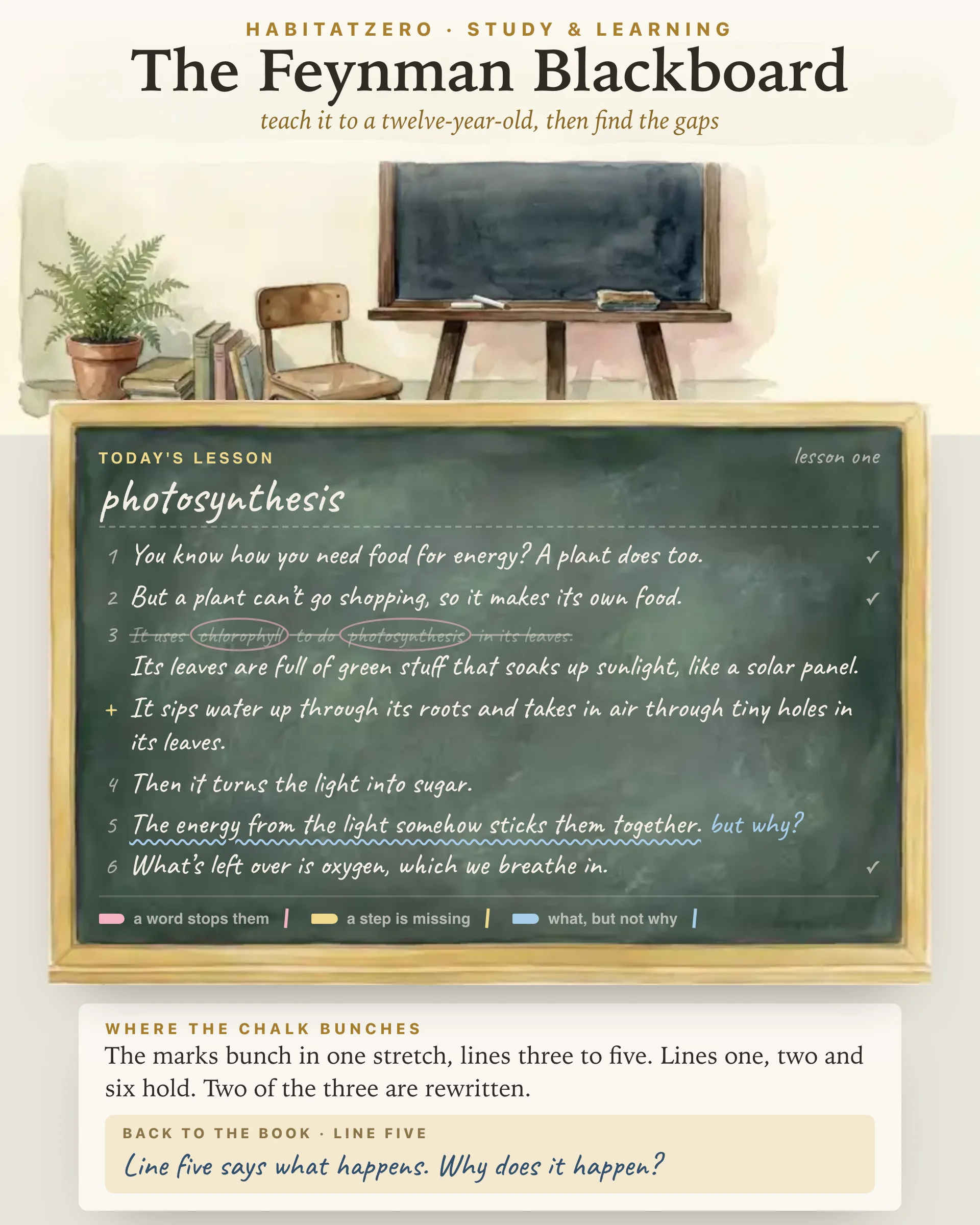
Richard Feynman, the Caltech physicist who shared the 1965 Nobel Prize in Physics, was known for explaining hard ideas in plain words, and the study method named after him borrows that habit. The history is worth getting right: Feynman never wrote down a four-step technique. The version on study sites (choose a concept, explain it to a child, find where you get stuck, simplify) is a modern framing inspired by his teaching. This blackboard is our own take on that framing, and nobody connected to Feynman, Caltech or the Nobel Foundation made or endorsed it.
A chapter you have read three times feels known, because it looks familiar. In a series of Yale studies, people rated how well they understood everyday devices such as zippers and flush toilets, wrote out a step-by-step explanation, then rated themselves again. Nearly everyone's ratings fell. The researchers called this the illusion of explanatory depth, and they found it strongest for knowing how things work, as opposed to facts or stories.
The imaginary twelve-year-old does the same job. A kid has no jargon to hide behind and won't nod past a skipped step, so writing for one drags every link into the open.
Pick one idea small enough for eight short lines, or tap a sample such as photosynthesis. Write the explanation line by line, the way you would say it out loud, with your notes shut. Starters like You know how nudge you to begin from something the kid already knows.
Then press read it back. The page walks down the lines and asks whether a twelve-year-old would follow each one. There are four answers:
The ledge tallies each color, and the page reads the pattern back: whether the marks bunch at the top, where you started too far in, in one stretch in the middle, or near the end, and which kind of break comes up most. That pattern is the part worth your attention. A cluster of circled words suggests the idea may be yours while the words still belong to the book. A run of missing steps can mean you know that stretch too well to notice the jumps, or that the steps were never there.
Every mark then turns into a question under Back to the book: what a circled word means, how you get from line three to line four, why line five happens. Look each one up, close the book, and write the line again. The old version stays on the board crossed out, so you can see what changed. When every question has an answer, wipe the board and teach the whole idea again from the top. Lines that held keep their check, and only the new ones need reading.
The pieces of the method stand on reasonable evidence. In a classic study, eighth graders prompted to explain each line of a passage on the circulatory system gained more than classmates who simply read it twice, and the students who explained the most all ended up with a correct picture of how the system works. Teaching helps too, possibly for a plainer reason than you'd expect. When learners taught the material without notes, they and a group who only practiced recalling it both understood it better a week later than learners who taught from their notes. That is why the board asks you to write with your notes shut, and to close the book again before each rewrite.
The limits matter too. The four-step package has barely been studied under its own name, so its case is borrowed from those parts. Judging your own lines as a twelve-year-old is only as honest as you are, and reading the board aloud to a real listener is a sharper test whenever you can find one. Explaining is also slow. For lists of facts, dates or vocabulary, The Active Recall Deck will do more for you in the same half hour.
Reach for the blackboard after a first pass through a chapter or lecture, once the material feels familiar but you couldn't yet teach it. It suits the two or three ideas a unit hangs on, a week or so before a test, while there is still time to reopen the book. To see how much you remember before you explain anything, a round on The Blurting Pad lays out the raw material first. If you are unsure explaining is the right move for your subject, The Study Techniques Cabinet sorts the options by what you study and how much time you have.
A first board covered in chalk marks is a good result. Each mark points at a page worth opening again.
It is a way to check your own understanding by explaining an idea in simple words, as if to a child, and treating every spot where the explanation stalls as a gap to study. It takes its name from the physicist Richard Feynman, who was known for making hard ideas sound plain.
Choose a concept, explain it in everyday language to an imagined twelve-year-old, go back to your source wherever the explanation breaks, then simplify and tell it again. On this blackboard those steps are the topic line, the chalked lines, the read-back with its colored marks, and the Back to the book list.
Not as a named method. Feynman never published a four-step study routine. The version passed around online is a modern study framing inspired by the way he taught, which is why this page calls it a framing rather than his own system.
The four-step package has barely been studied under its own name. Its parts have better support: students prompted to explain a text line by line understood it more deeply, and teaching material without notes helped learners about as much as practicing recall on their own.
The photosynthesis board here is a sample you can read through without an account. Writing your own lesson, circling its words and carrying it into a second round happens in HabitatZero, where personalizing the board costs nothing.
By the team behind Fabulous, the science-based self-care app used by over 30 million people.