
The Overwhelm Recovery ProtocolWellness & Routines · ~5 min
About this template · Updated September 2026
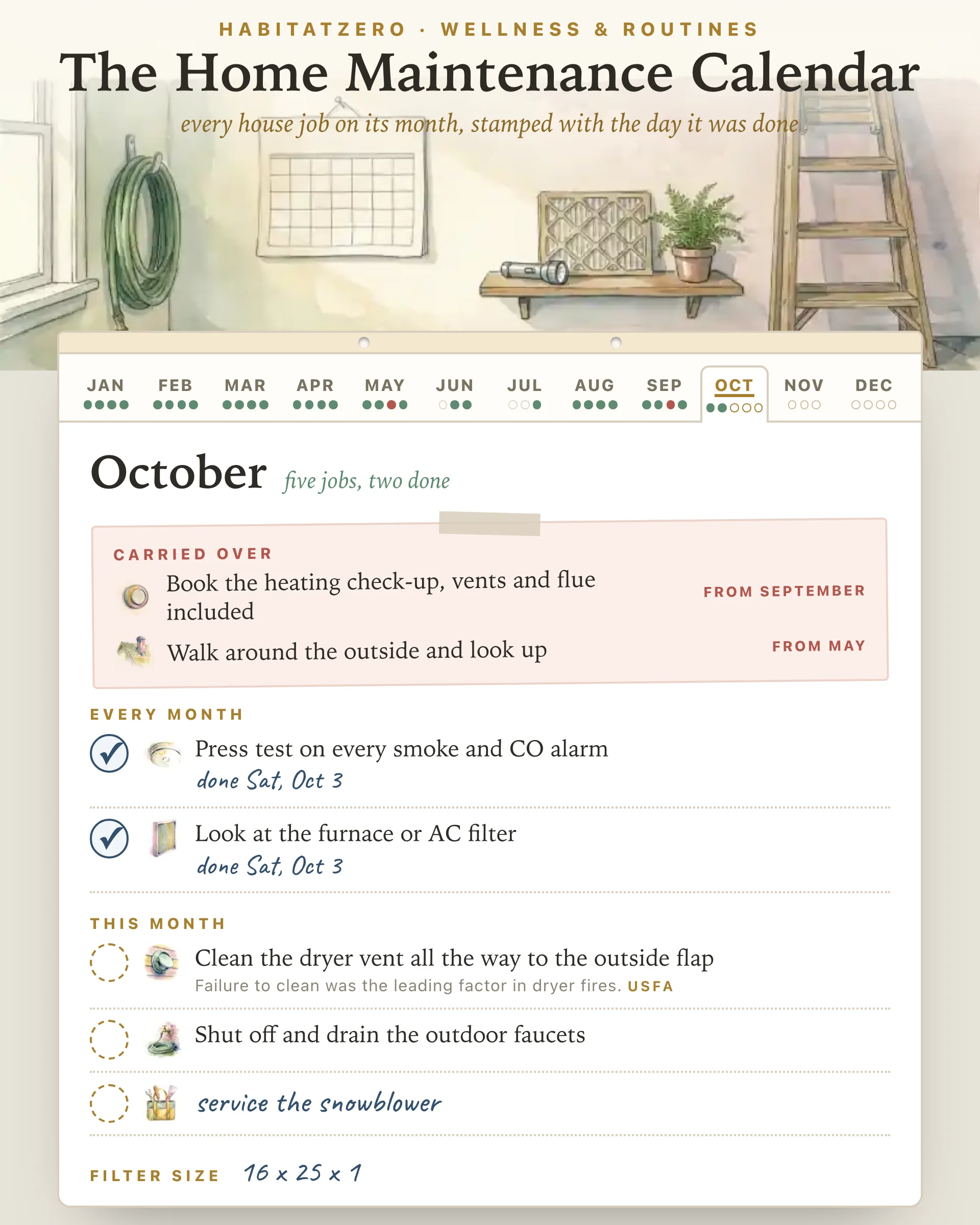
Most house jobs are not hard. They are just rare. You drain a water heater, clean a dryer vent and book a furnace check-up once a year, and nothing that happens once a year turns into a habit. The reminder tends to arrive as a symptom: a cold radiator on the first frosty night, a damp patch under the sink. By then the job is late and often bigger.
A home maintenance checklist by month fixes the timing by giving every job a place on the calendar. When a month starts, you open its page and the work is already chosen. This one also keeps the date you did each job, and tells you what slipped.
Two jobs belong to every month. Press the test button on each smoke and carbon monoxide alarm, and look at the furnace or AC filter. Everything else comes around once or twice a year, spread out so that no single month asks for more than a few.
The alarm test is monthly because the US Fire Administration asks for exactly that, along with new 9-volt batteries at least once a year and new smoke alarms every ten years. The NFPA gives the same monthly rhythm for carbon monoxide alarms, which get replaced on the maker's schedule, and adds a winter job this calendar keeps: during and after a snowstorm, the dryer, furnace and fireplace vents need to stay clear.
The heating and cooling visits follow ENERGY STAR, whose maintenance checklist puts the cooling check-up in spring and the heating one in fall, before contractors get busy, and suggests pairing them with the clock changes. The same page asks you to inspect the filter monthly and warns that a plugged condensate drain can cause water damage. The Consumer Product Safety Commission goes further on heat: a trained technician should inspect and service the heating system, chimney and vents every year.
The dryer vent sits in October for a reason. When the US Fire Administration studied clothes dryer fires in homes reported from 2008 to 2010, failure to clean was the leading factor behind them, at 34 percent, and the fires ran higher through fall and winter, peaking in January. Cleaning in October gets ahead of those months.
Start by telling it about your home. A condo drops the outside jobs and adds a January question for the association about which shared systems it maintains. Mild winters drop the freeze jobs and move the check-ups by a month.
Then stamp what you do. Tapping the circle beside a job on the current month writes today's date in pen. For something you did in April, open April's tab and stamp it there, and it reads done in April. Yearly jobs count up to two months early, so an early start is never wasted.
The calendar begins the day you save your first stamp or setting. A job whose month passes after that without a date moves to a slip at the top of the current page as carried over, fire and carbon monoxide jobs first. Jobs from before you started only read not logged yet, since the page cannot know what happened before it existed. Each month also takes three jobs of your own, and the whole year prints on one sheet.
The months here are sensible placements, not rules for your house. Your water heater's manual decides how its tank is drained, your installer may want a different filter schedule, and an older house can need more than any general list covers. Gas lines, flues and wiring belong to licensed professionals. The calendar keeps the dates; it does not replace an inspection.
Any month works, even the week you move in, once the New Home Essentials Checklist has the first night covered. Stamp what you remember doing this year and let the rest read not logged yet. After that, the first weekend of each month is enough: clear the page, then the slip. If a hard freeze is weeks away, the Winterize Your Home Checklist covers that season in more depth, and for the weekly jobs this calendar leaves out, like vacuuming and taking out the trash, the Household Chore List is the better tool.
Two jobs belong on every month: pressing the test button on each smoke and carbon monoxide alarm, and looking at the furnace or AC filter. The rest arrive once or twice a year, such as the gutters in spring and after the leaves drop, the heating check-up in early fall, the dryer vent in October and a water heater drain in February.
ENERGY STAR says to check it every month, most of all in the heavy heating and cooling months, to swap it whenever it looks dirty, and to change it at least every three months either way. Writing the filter size on the calendar saves a second trip to the store.
The lint screen gets cleaned before and after each load. The duct behind the machine needs a periodic cleaning too, sooner if clothes start taking longer to dry, because the US Fire Administration found failure to clean was the leading factor in dryer fires. This calendar schedules it every October, ahead of the fall and winter months, when the report found those fires ran highest.
Mostly the outside of the building. Switch the calendar to condo and the gutters, the roof walk, the sump pump, the chimney and the outdoor faucets drop off, while the alarms, filter, water heater, dryer vent and washer hoses stay. A January job asks the association which of the shared systems it looks after, since that varies from one building to the next.
The page shows a sample year you can read through. Setting it for your own home, stamping real dates and keeping the calendar from one month to the next happens in HabitatZero, free of charge.
By the team behind Fabulous, the science-based self-care app used by over 30 million people.


