Reading JournalStudy & Learning · ~4 min
About this template · Updated September 2026
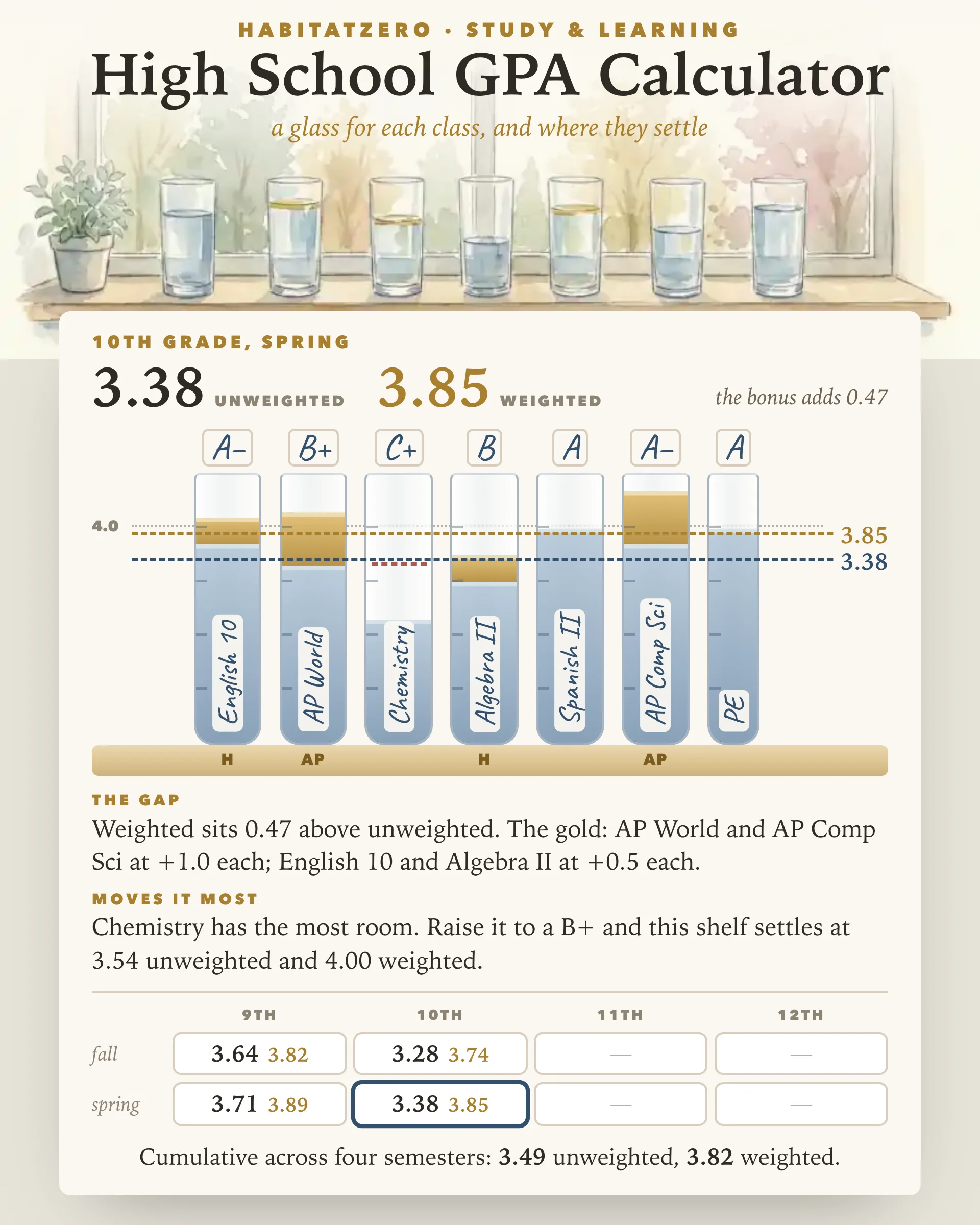
A high school GPA looks like one number, but plenty of transcripts carry two. The unweighted GPA puts every class on the same 4.0 scale. The weighted GPA gives harder classes a bonus, which is how a junior whose best grade is an A can still show a 4.2. This calculator works out both, shows the arithmetic behind each one, and keeps a shelf for every semester from 9th grade fall to 12th grade spring.
Start with grade points. On the most common scale an A is worth 4, a B 3, a C 2, a D 1 and an F nothing. College Board's guide to calculating GPA on a 4.0 scale presents that scale as one common system rather than a law, and points out that some schools skip plus and minus grades entirely.
Multiply each class's points by its credits, add the results, and divide by the credits you attempted. The sample shelf on this page is a sophomore's spring semester: seven classes, one of them a half-credit PE class, for 6.5 credits and 22.0 grade points. Divide, and the unweighted GPA comes to 3.38.
A weighted GPA adds a bonus to each qualifying class before you divide. North Carolina's State Board of Education, for one, writes its bonus into state policy: half a quality point for honors, a full point for AP, IB, Cambridge and college courses, and every student receives both GPAs. The same policy shows how local these numbers are, because students who started high school before fall 2015 earned a full point for honors and two for AP. On the sample shelf, two AP classes and two honors classes add 3.0 bonus points, and 25.0 over 6.5 credits gives a weighted 3.85.
Plus and minus grades vary too: some schools count an A– as 3.7, some as 3.67, and some ignore the minus altogether. This page rounds every GPA to the nearest hundredth; your school may carry more decimals.
Every class is a glass. Its grade sets how full it is, its credits set how wide it stands, and an honors, AP, IB or dual enrollment level pours a gold layer on top. Two dashed lines cross the shelf where the glasses would settle if you poured them all together: ink for unweighted, gold for weighted. Pouring is exactly what a credit-weighted average does, and it shows how a GPA can pass 4.0: an unweighted glass fills no higher than 4.0, so only the gold rises past that mark.
Two readings sit under the shelf. The gap names the classes that put the gold there and what each one adds. Moves it most finds the glass with the most room below an A, then shows where the whole shelf would settle if that one grade came up a step. Change a grade, a level or a credit, and both readings follow.
The strip below the shelf holds all eight semesters. Your cumulative GPA pours every graded glass from every shelf together, dividing total grade points by total credits, which differs from averaging the semester GPAs whenever semesters carry different credits. When spring repeats fall's schedule, one tap carries the classes over, each waiting for its new grade.
Your school's rules sit at the bottom. Choose tenths, thirds or no plus and minus, and type your own bonus for each level. The defaults are common values, not a promise about your school, so check them against your student handbook.
A study of how well grades and test scores forecast college completion found that high school GPA predicts graduation strongly and consistently across high schools, while ACT scores predicted it weakly and less evenly from school to school.
The usual bonus values have some evidence behind them as well. Sadler and Tai modeled the introductory college science grades of 7,613 students at 55 colleges and found support for adding one point for AP and half a point for honors in high school science. That covers one subject area and one outcome, so it is a reason the defaults are sensible rather than proof that they fit every class.
What no study settles is how a particular college will read your number. College Board notes that admissions offices may drop electives, keep only core subjects, and strip out or replace a school's weighting, which is why applications ask for the grades themselves. Treat the weighted figure as your school's own yardstick and the unweighted one as the number that travels better between schools.
Fill the current semester when report cards post or midterm grades land, then add earlier shelves once your transcript is within reach. Come back before course registration: put a class you are considering on next semester's shelf, give it the grade you honestly expect, and see what it does to both lines. A class worth taking should earn its place for more than its bonus.
The Semester Goal Worksheet turns the glass with the most room into a plan for the weeks ahead, and the Exam Planner spaces your studying out before finals. When applications come around, The Brag Sheet gathers the rest of the story a GPA leaves out.
Turn each letter grade into points, where an A is 4, a B 3, a C 2, a D 1 and an F 0. Multiply each class's points by its credits, add those up and divide by your total credits. On the sample shelf, 22.0 grade points over 6.5 credits give an unweighted 3.38.
Add each class's bonus to its grade points before you divide. With half a point for honors and a full point for AP, an A in an AP class counts 5 and a B in honors counts 3.5. The sample shelf adds 3.0 bonus points to 22.0 grade points, and 25.0 over 6.5 credits makes a weighted 3.85.
An unweighted GPA puts every class on the same 4.0 scale, so an A in regular English and an A in AP Biology both count 4. A weighted GPA gives honors, AP, IB or dual enrollment classes a bonus, which is how it can climb above 4.0. Schools pick their own bonus values, so two weighted GPAs from different schools rarely compare cleanly.
Only if your school counts them. Some schools count an A– as 3.7 and a B+ as 3.3, others work in thirds and use 3.67 and 3.33, and some drop the plus and minus so every B counts 3.0. The University of California leaves them out when it works out its own GPA for admission.
You can look through the filled sample shelf here without signing up. To shelve your own classes and keep every semester for the next report card, open the calculator in HabitatZero, which costs nothing.
By the team behind Fabulous, the science-based self-care app used by over 30 million people.