Reading JournalStudy & Learning · ~4 min
About this template · Updated September 2026
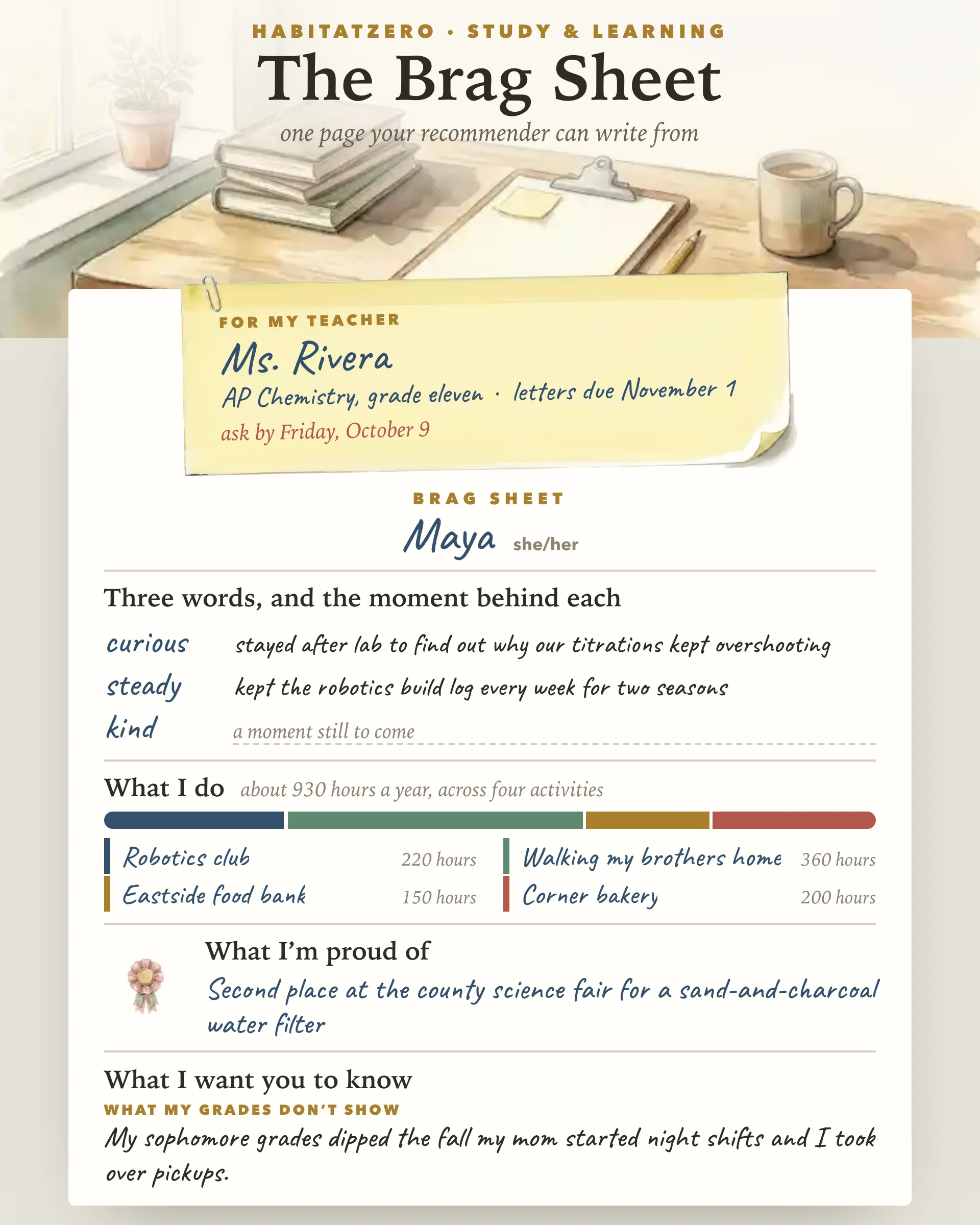
A recommendation letter can only be as specific as what its writer remembers. Your chemistry teacher knows you from one class period a day, shared with everyone else in the room. Your counselor may know you mostly from a transcript: the American School Counselor Association estimates that a high school counselor carries roughly two hundred students, and the national average across all grades is 372 students per counselor. A brag sheet closes that gap: one page, written by you, that hands the writer the facts and stories they would otherwise have to guess.
Getting that page to them is your part of the process. NACAC's guide to the parts of a college application is plain about it: the teacher submits the letter, but asking and giving that teacher the information they need falls to you. Colleges, it adds, want to hear from teachers who can share examples of your work ethic and curiosity. Examples are exactly what a brag sheet supplies.
Common App keeps teacher, counselor and family brag sheets in its first-year toolkit, and their questions make a good map of what recommenders want. The teacher version asks for three adjectives, then asks you to choose one or two qualities colleges weigh, such as intellectual promise, reaction to setbacks or concern for others, and describe a time you showed them in class. The counselor version asks for activities in and out of school, including work and family responsibilities, the grades you did them in, and something your counselor probably doesn't know about you. Both forms make the same point: the more specific your details, the more personal the letter.
This page has no connection to Common App; it covers the same ground and does some of the arithmetic and nagging for you.
Start with the sticky note. Choose who is writing (a counselor, teacher, coach, boss or mentor), add their name, where they know you from, and the date letters are due. Common App's guide to the recommendation process says to ask at least three weeks before a deadline, so the note counts back three weeks and names the day, sliding to the Friday before if that lands on a weekend.
Next come three words. Tap the ones that sound like you or write your own, and the sheet stops you at three. Each word asks for the moment behind it: when, where, what you did. A word earns its seal only once a moment backs it, and the line at the top of the page names the word still waiting for one.
Then list what you do, up to six: clubs, sports, jobs, volunteering, a project of your own, or duties at home. For each, set your role, the hours a week and the weeks a year, the same two numbers the Common App activities section asks for. The sheet multiplies them, rounds to the nearest ten, adds up the year, and draws a bar of where the hours go. An afternoon job or ten hours a week of getting younger siblings home shows up at full size, right next to the clubs.
Last, list what you are proud of and star the one that matters most; it moves to the top with a ribbon and asks why. Answer a prompt or two about what your grades don't show, print the page, and hand it over when you ask. For your next recommender, change the name on the note and print again.
Letters carry less predictive weight than their reputation suggests. A meta-analysis by Kuncel, Kochevar and Ones found that letters, in the form they are usually written, relate only weakly to how students perform after high school, although they add some information about who goes on to finish a degree. We found no study showing that a brag sheet changes an admission decision, and this page won't pretend otherwise. The case for it is more modest: a writer holding concrete moments can write about you, rather than about a pleasant, hardworking student in general.
Fill it in during the spring of junior year or the first weeks of senior year, before you ask anyone, and keep it for scholarship letters too. If the "what I want to study" prompt stumps you, the Career Quiz for Teens can give it something to say. The Semester Goal Worksheet is a good place to plan the fall your sheet will describe, and a Study Planner keeps application season from swallowing your classes.
It is a one-page summary a student hands to the teacher, counselor or coach writing a recommendation letter. It lists activities, achievements and the stories behind them, so the letter can describe you instead of a generic good student.
Start with three words that describe you and one real moment that shows each. Then add your activities with role, hours and grades, the achievements you are proudest of, and any context a transcript misses, such as a job, a family duty or a hard year.
The filled sample on this page is one: a note naming the teacher and the deadline, three words with moments, four activities adding up to about 930 hours a year, a starred science fair result, and two lines of context. Notice that none of it is grand, only specific.
Hand it over when you ask for the letter. Common App suggests asking at least three weeks before a deadline, and this page works out that day from the date letters are due, moving it to the Friday before when it falls on a weekend.
They are cousins. A brag sheet is written so someone else can write a letter about you, usually for college or scholarships. A brag document is the running list of wins adults keep for reviews and promotions. Both work for the same reason: details fade unless you write them down.
By the team behind Fabulous, the science-based self-care app used by over 30 million people.