
The Overwhelm Recovery ProtocolWellness & Routines · ~5 min
About this template · Updated November 2026
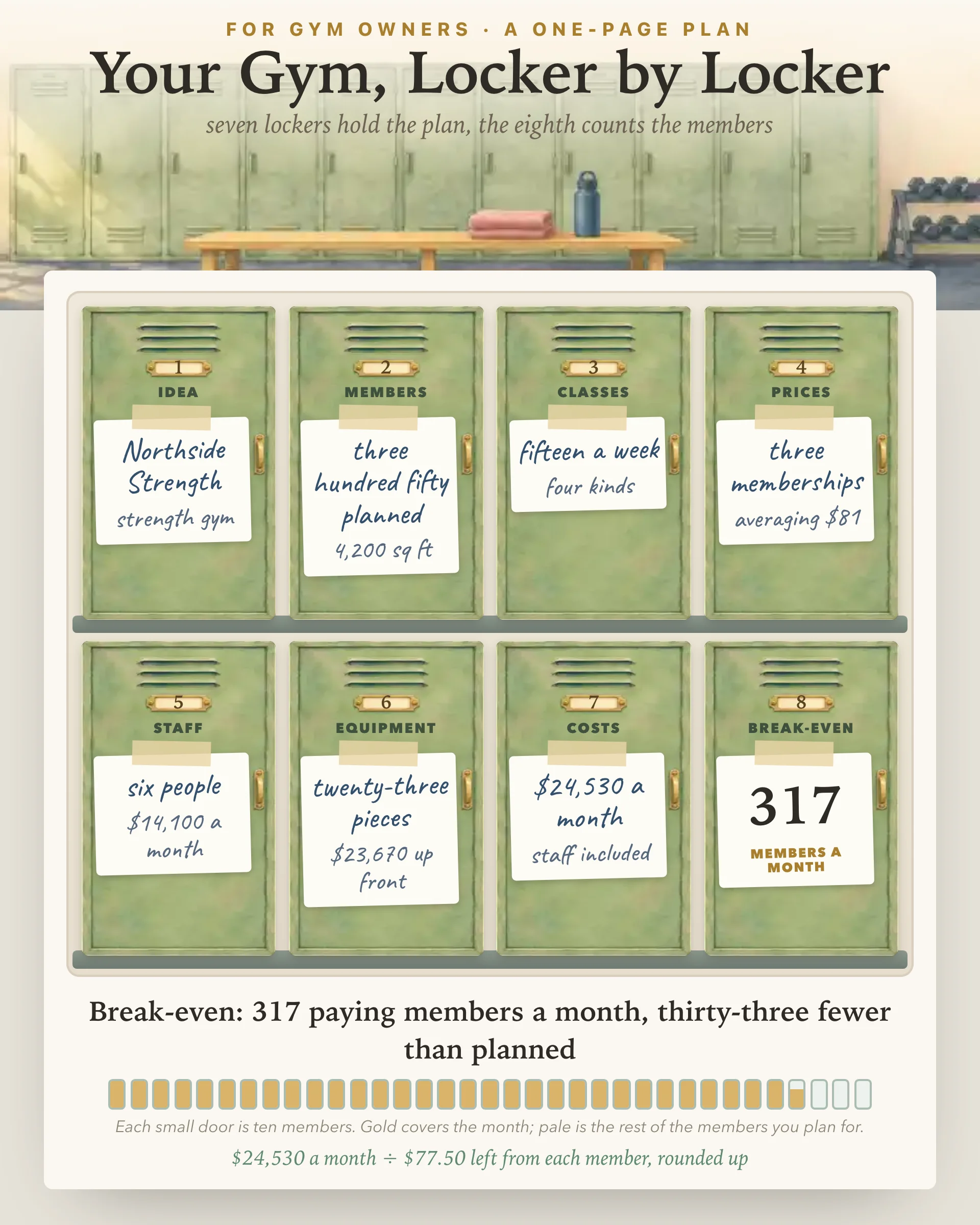
Before a landlord, a lender or your own savings says yes to a gym, one question needs a straight answer: how many paying members keep the doors open for a month? This gym business plan is built around it. Seven painted lockers hold the plan, and the eighth works out the answer from the numbers in the other seven, and nothing else.
It is a planning worksheet, not financial, tax or legal advice. Every figure on it is one you entered or a sum of those, and it makes no guess about what the gym will earn.
Each door's handwritten label sums up what's inside, so the closed bank reads as the plan at a glance.
The U.S. Small Business Administration's guide to planning a business gives the standard formula: fixed costs divided by the selling price of one unit minus the variable cost of one unit. For a gym, the unit is one member for one month, so the page:
With round numbers, purely to show the arithmetic: if a month costs 12,000 and each member leaves 48 after their own costs, 12,000 divided by 48 is exactly 250. Raise the month to 12,010 and the division gives a little over 250.2, which becomes 251.
Amounts add up in whole cents, so a price like 49.99 never drifts. A line with no amount yet is left out of its total, and the sum says so rather than counting the blank as zero. If the average membership is no more than what a member costs you, the page says plainly that no number of members covers the month.
If most members choose your cheapest membership, the average falls and the count rises. That's why the memberships locker waits until all ten shares have a place. Move one share from the cheapest membership to the priciest and watch the break-even door change.
Put your own pay on the list. A plan that only breaks even because you work for nothing hasn't really broken even, which is why the staff locker suggests that line first.
For anyone you hire, enter what they cost you, not only what they're paid. The IRS explains why it matters whether someone is an employee or an independent contractor: for employees you generally withhold income tax, pay the employer's share of Social Security and Medicare, and pay unemployment tax. How each coach should be classified is a question for an accountant, and the answer changes that role's line.
There's no income forecast. The page never multiplies a price by the members you plan for, because that would be a guess dressed up as a sum; your planned count simply sits beside the break-even count. No field asks for a member's name or details either. Members are counted here, never listed.
Equipment stays out of the monthly count because you pay for it once; if you'll finance it, add the loan payment as a monthly bill. The SBA's resource partners, including Small Business Development Centers and SCORE mentors, offer free or low-cost counseling that can review a plan like this one. Leases, permits, licenses and insurance follow your state and city, so take those questions to the people who answer them there.
Fill it in before you sign a lease or ask anyone for money, and again whenever a price, a bill or a role changes. As a fitness business plan it suits a studio as well as a gym. If you coach on your own without a space to rent, the smaller plan for a first paying group fits better; if you're still deciding what each membership includes, Three Coaching Packages lays the options side by side; and if the first thing you'll sell is a short challenge, The 14-Day Group Challenge plans it day by day.
The concept and who it serves, where it opens and how big the space is, the weekly class schedule, every membership with its price, the people on the payroll, the equipment bought before opening and the bills that come monthly. Lenders and investors usually ask for projections and a funding request on top, which you can build with an accountant from these numbers.
Total everything the gym pays in a month, staff included. Average the membership prices by how many of every ten members choose each one, then subtract what a single member costs you, such as card fees. Divide the monthly total by what remains and round up, since a member can't be split.
No. It counts the members who cover one month and stops there. It never multiplies a price by the members you plan for, quotes no going rates and shows no income figure. It is a planning worksheet rather than financial, tax or legal advice, so walk an accountant or adviser through the finished plan before committing to anything.
Yes. Choose a yoga or pilates studio, a class studio, a boxing or martial arts gym, a personal training studio, a strength gym or a 24-hour gym, and the class and equipment suggestions shift to match. A coach who trains clients alone, with no space to rent, will find a smaller plan fits better.
Filling in the lockers costs nothing. Tapping Personalize carries the whole plan, every locker and the break-even with it, into a free Salon account from the makers of Fabulous, where you can update it as quotes and prices come in.
By the team behind Fabulous, the science-based self-care app used by over 30 million people.


