
The Overwhelm Recovery ProtocolWellness & Routines · ~5 min
About this template · Updated November 2026
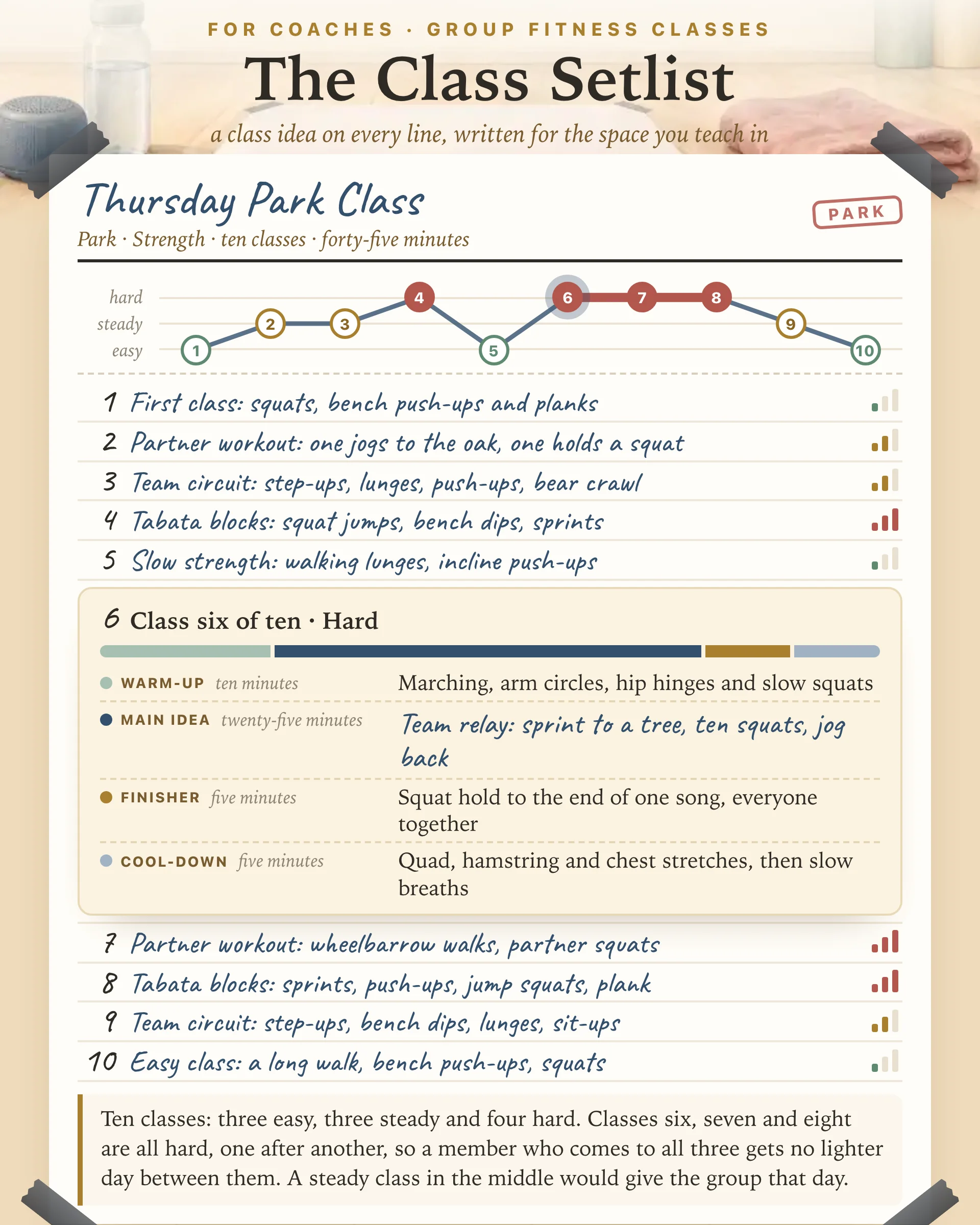
Teaching the same room every week wears out ideas faster than it wears out people. By the third Tuesday you know the squats, the playlist and who takes the back corner, and the hard part of group fitness workouts is no longer the workout. It is a fresh class that fits your space, your slot and the people who keep turning up. This sheet keeps that whole program on one taped-down page: a setlist with one class idea per line, a line above it that shows how hard the weeks run, and a plan for each session you can print.
Most class ideas fail because they were written for somewhere else: a kettlebell circuit is no use on a lawn, and a relay across a field does not fit a studio with mats in rows. So the sheet asks where you teach first.
Then choose a focus, or start from a blank outline of your own. Every line fills with an idea for that space and that focus, and you can rewrite any of them. Change the focus or the space later and the sheet asks before it replaces anything you wrote.
Each program follows one shape of effort, whether you run seven, ten or fourteen classes. The first class is easy and teaches the moves. Partner workouts and team circuits fill the steady classes, the hard ones get Tabata blocks, relays, intervals, games or the strongest flows, and an easy class comes around in every five. No two hard classes sit side by side, and the last class belongs to the group and its favorites.
Three short bars beside each line say how hard that class runs, and the line above the setlist joins them up. Open a class, mark it easy, steady or hard, and the line redraws. When two hard classes land next to each other, the join turns red and the reading below names them, because a regular who comes to both never gets a lighter day between them.
Tap a line and it opens into a cue card with four parts: the warm-up, the main idea, a finisher and the cool-down. Pick thirty, forty-five or sixty minutes a class, and the minutes split so they always add up to the slot. A hard class gets the longest warm-up and an easy one the longest cool-down. The finisher is a short game, like plank high-fives down the line or a squat hold to the end of a song, and one tap swaps it for the next. A set-out note says what to lay out before anyone arrives, and the print button puts that one class on a page you can tape by the speaker.
The sheet keeps classes and minutes, never people. There is no field for a member's name, injury or progress.
A systematic review with meta-analysis of warming up found that warm-ups improved performance in 79% of the measures examined across 32 studies, with little sign that they did harm, though the authors asked for more well-run randomized trials. That is why a hard class gets extra warm-up minutes here, as a reason rather than a promise about injuries.
The Tabata block takes its name from a 1996 cycling study by Izumi Tabata and colleagues. Seven subjects rode seven or eight bouts of twenty seconds at about 170% of their maximal oxygen uptake, with ten seconds of rest between bouts, five days a week for six weeks, and both their aerobic and anaerobic capacity rose. A mixed class doing squat jumps for twenty seconds works far below that intensity, so treat the name as a timing pattern rather than the same dose.
As for working out together, a twelve-week study of medical students found that those who took regular thirty-minute group fitness classes reported less stress and better physical, mental and emotional quality of life than when they started, while students who exercised on their own improved only on mental quality of life. It was small and the students picked their own groups, so it makes group classes worth trying without showing that they work better.
Fill it in before a new block of classes starts, then open one line the evening before each session, check the minutes against your slot and print the card. If your group wants something to do between classes, the 14-Day Group Challenge hands them a daily idea and counts who checks in. For the Tabata blocks, the Tabata Timer keeps the twenty-and-ten rhythm, and Workout Bingo makes a good game for a last class.
These ideas are written for general adult groups. Teach an easier version of every move, stop anyone who feels pain, and ask anyone with a heart condition, a recent injury or a pregnancy to get a clinician's go-ahead before they join. Treat the sheet as a way to plan classes, never as medical advice.
Formats that make people work together go further than a longer list of moves: partner workouts where one person works while the other holds, team circuits that rotate around the room, relays, Tabata blocks of twenty seconds on and ten off, and a short game to finish. Rotating those formats across the weeks keeps regulars from meeting the same class twice.
Start from what the space already gives you. A studio has mats, a wall and a speaker, a park has grass, benches and trees to run to, and a gym floor has weights, boxes and cardio machines. Write each idea around what is there, and keep a version of every move that needs no equipment at all.
Most classes run in four parts: a warm-up, a main block, a short finisher and a cool-down. Here, a steady forty-five-minute class gives eight minutes to the warm-up, twenty-seven to the main idea and five each to the finisher and the cool-down, while a hard class trades main-block minutes for a longer warm-up.
Pair people so one works while the other holds or recovers: one partner jogs to a tree and back while the other holds a squat, partners row a band toward each other, or one holds a plank while the other lunges. Swap roles every round and let each pair pick its own pace.
Yes. Building the setlist, opening each class and printing its plan cost nothing here. Tap Personalize and the setlist moves into a free Salon account, made by the team behind Fabulous, where your next block of classes can start from it.
By the team behind Fabulous, the science-based self-care app used by over 30 million people.


