
The Overwhelm Recovery ProtocolWellness & Routines · ~5 min
About this template · Updated November 2026
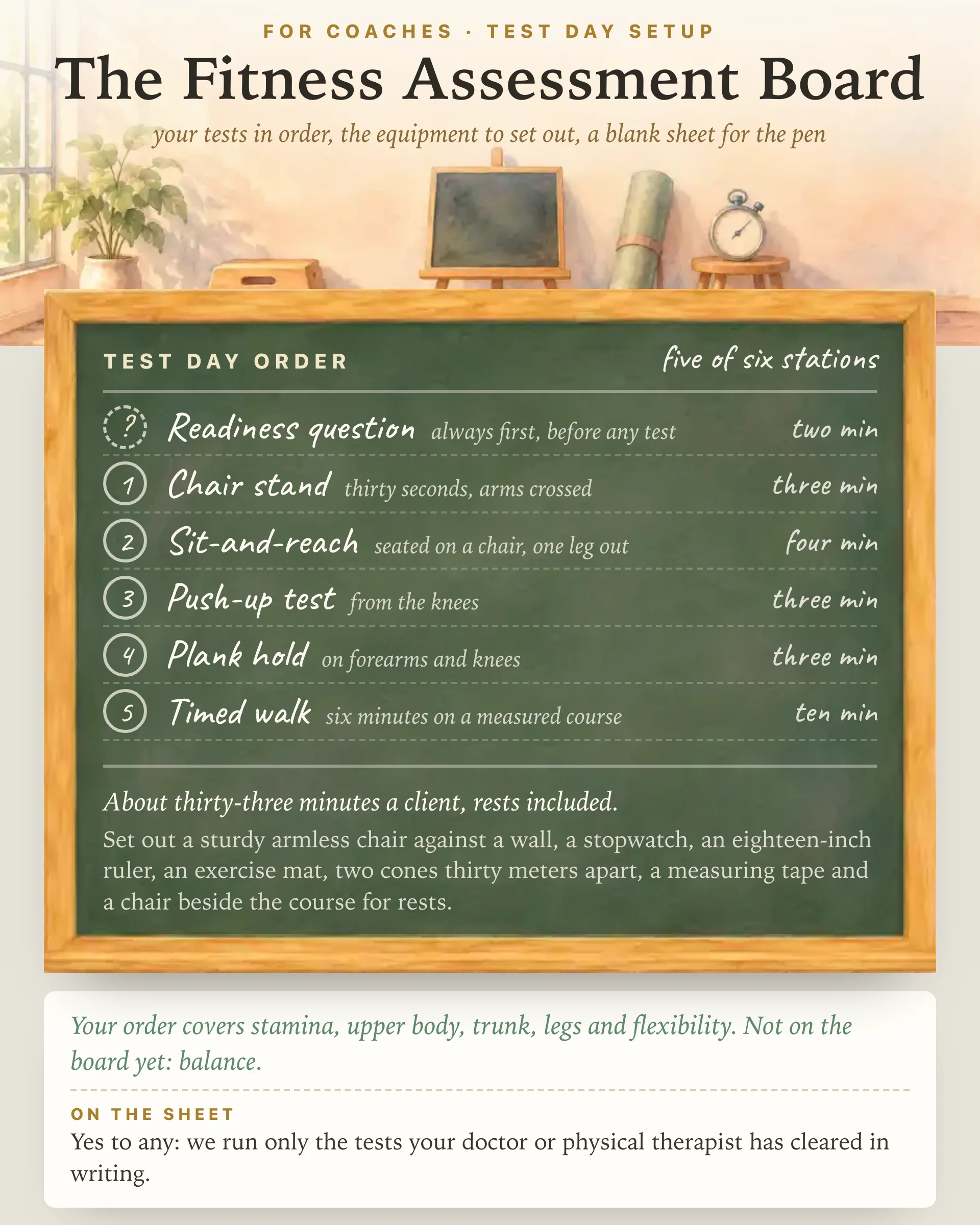
A physical fitness assessment is a short run of standard tests you put a client through at the start, and again some weeks later, so both of you can see change on paper. This board is where you set yours up: which tests, in what order, the equipment to set out, how you run each one safely, and the blank sheet you fill in with a pen.
Every sheet starts with the same question, asked before any test: pain today, dizziness or fainting, a heart or blood pressure condition, an injury or surgery in recent months, a pregnancy, or a doctor's advice to limit exercise. You choose what a yes means on your paper: testing on another day, running only the tests a doctor or physical therapist has cleared in writing, or a conversation in place of tests. None of the three lets a yes go straight to a stopwatch.
The American College of Sports Medicine's screening advice, revised by a roundtable in 2015, weighs three things before exercise: how active the person already is, whether they have signs or symptoms or known cardiovascular, metabolic or renal disease, and how hard the planned exercise will be (Riebe and colleagues, 2015). The same paper notes that cardiac events during exercise often follow warning signs. One question at the top of a sheet doesn't replace that process. It makes sure nobody reaches the first test without being asked.
The board offers a push-up test, full or from the knees; a sit-and-reach on a box, a yardstick or a chair; a three-minute step test; a plank hold on toes or knees; a timed walk over six minutes or a mile; a thirty-second chair stand; and a one-leg stand beside a counter. Each card says how to run it safely, what holds it back, what stops it at once and the equipment it needs, with one line for your own words to the client.
Six stations fill the board, and it refuses a seventh that would tire the client before it starts. As you chalk, it adds up the minutes (the readiness question and your rest between stations included), lists each piece of equipment once even when two tests share it, and names which of six areas your order covers: stamina, upper body, trunk, legs, flexibility and balance. Put the step test anywhere but first and it reminds you to start it rested, since the count comes from the pulse afterward.
Published tables help, once you know who was measured and how.
Push-up and step test tables circulate in certification manuals, with protocols that differ in depth, cadence and step height. Compare a client only against a table whose protocol you match exactly.
It shows no client's results, rating or band, and stores none. There is no name field: the sheet is filled in on paper and filed with that client's own records. The fairest comparison is a client with their own earlier sheet, run in the same order at about the same time of day, and the "run it again in" setting prints that reminder at the bottom.
These are tests a coach runs, never a diagnosis. Anyone with pain, dizziness, a heart or blood pressure condition, a recent injury or surgery, or a pregnancy checks with a doctor or physical therapist before testing. Stop the moment something hurts, and keep a counter or sturdy chair within reach for anything done standing on one leg.
Set the board up before your first assessments and print a fresh sheet for each client. Between tests, a client working on one number can follow The 30-Day Push-Up Challenge or The 30-Day Plank Challenge, and an older client can practice with The Balance Ladder.
It is a short set of standard tests, such as push-ups, a plank hold or a timed walk, run the same way on day one and again weeks later. Its job is to show a client their own change on paper, not to rate their health.
Pick one test for each thing your clients came to improve, and keep the whole session short enough that the last test is not run tired. This board offers seven, caps the order at six stations, and names the areas your order leaves out.
Ask the readiness question before anything else, warm up where the test calls for it, and stop at the first sign of pain, dizziness, chest discomfort or breathlessness that does not settle. Each card on the board spells out what holds that test back and what ends it at once.
Only with care. Every norm table comes from one group of people tested one particular way, so a client measured differently, or unlike that group, will not compare cleanly. Their own earlier sheet, from the same order at the same time of day, is the fairest yardstick.
It is free to set up here. Client results go only on the printed sheet and into your own records, since the board stores your setup and never a client. Personalize carries your setup to a free Salon account from the people who make Fabulous.
By the team behind Fabulous, the science-based self-care app used by over 30 million people.


