
The Overwhelm Recovery ProtocolWellness & Routines · ~5 min
About this template · Updated September 2026
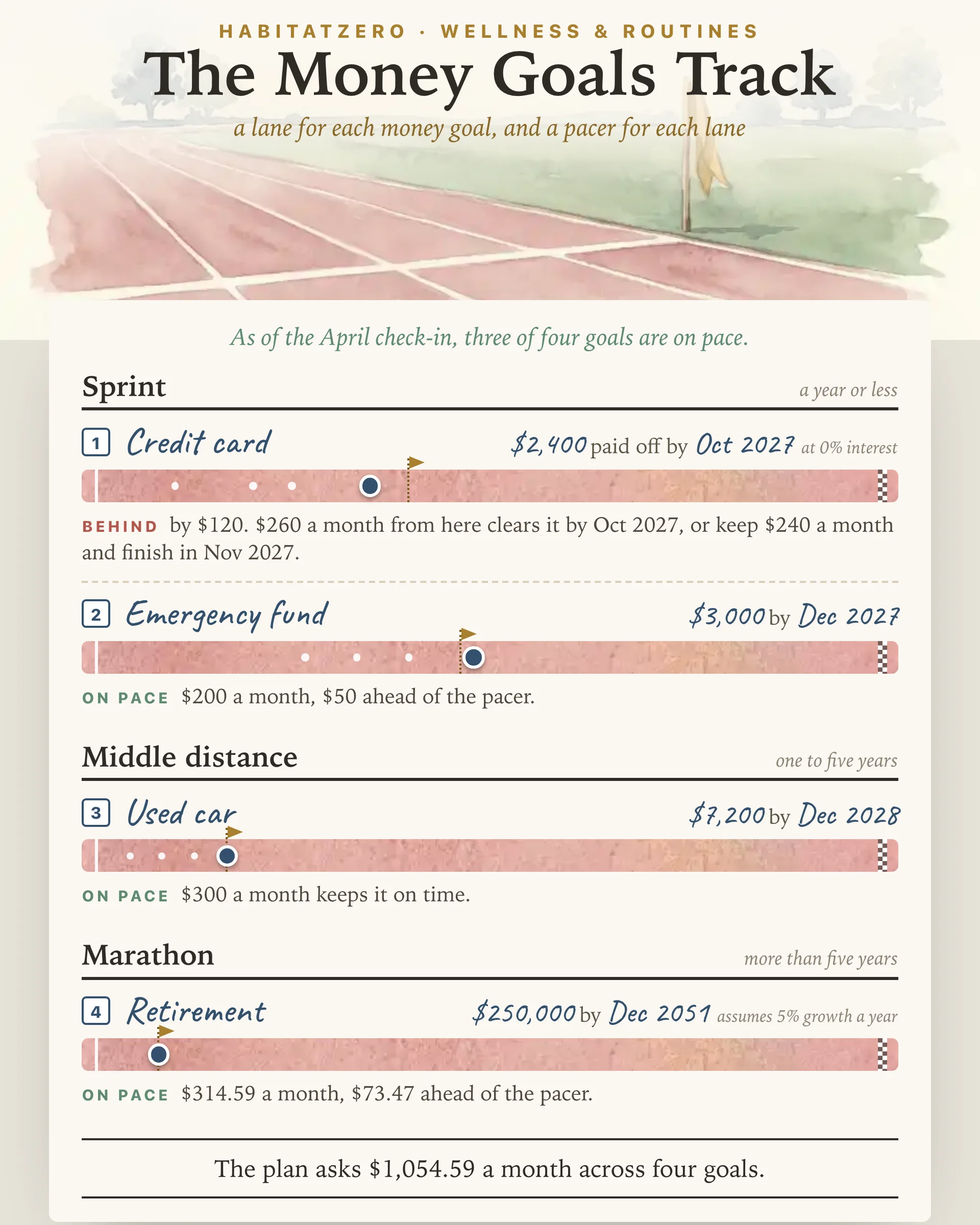
Most money goals arrive in the same week of the year and sound alike: save more, clear the card, get serious about retirement. A financial goals worksheet turns each one into three numbers you can act on, an amount, a finish date and the monthly figure that joins them. This one also runs a pacer beside every goal and tells you, once a month, whether the money is keeping up.
Money goals are usually sorted by how far away they are. Short term financial goals land within a year: a vacation, a new laptop, a first emergency cushion, a card balance you want gone. Goals one to five years out include a car, a wedding or a home down payment. Long term financial goals run past five years, with retirement the obvious one, alongside college savings or a student loan on a ten-year schedule.
The sheet borrows the runner's version of that split: a goal's finish date files it as a sprint, a middle distance or a marathon. The label matters. A sprint mostly needs a monthly figure you can keep up, while over a marathon, interest and growth can move the balance more than your own deposits do.
Each goal gets a painted lane with a start line and a checkered finish. Type the amount, or for a debt what you owe now, step the finish month, and the lane works out the monthly amount that reaches it. If some of a savings goal is already in the bank, enter that and the figure drops.
At the end of each month, check in: write what every account really shows, and each runner moves to where its goal stands. A small gold flag, the pacer, marks where the goal needs to be for your monthly amount to still finish on time. At or past the flag, the lane reads on pace. Short of it, the sheet says by how much and offers two ways back: pick up the pace to a bigger monthly amount from here, or move the finish to the month your current amount really reaches. Tap either one and the lane is back on pace under the new plan.
Two rules keep the reading honest. From your first check-in on, the monthly amount is the plan you are running, so if you later raise a goal or pull its date closer, the lane shows the gap that opens instead of quietly redrawing the plan. And a line under the track adds up what all your lanes ask for each month, which is the number to hold against what you can really set aside. The track holds six goals at most.
Everything on the page is arithmetic on the numbers you type. For a debt, enter the interest rate from your statement and the monthly payment the lane works out will cover it; leave the rate empty only when the balance truly charges nothing, as during a 0% promotional period. For savings you can add an assumed growth rate, and the lane labels it an assumption, because invested money can fall as well as rise. Check-ins correct for both: whatever the account actually did shows up in the balance you log, and the pace follows it. The page never connects to a bank, and nothing on it is financial advice.
Summing up decades of experiments, Edwin Locke and Gary Latham reported that specific, difficult goals consistently led to better performance than urging people to do their best, and that goals need feedback showing progress against them. People who find they are below target tend to raise their effort or change strategy, which is the same choice the two fixes put in front of you. A meta-analysis of 138 randomized studies found that monitoring progress toward a goal helps people reach it, with stronger effects when the progress was physically recorded or reported to others. And in research on saving by low-income households, money earmarked for a goal was saved at a higher rate when a visual reminder of the goal was present, and when it was split into two accounts rather than pooled, which is a fair argument for giving each goal its own lane.
The evidence does not show that this sheet gets anyone to their number. None of those studies tested it, and no plan creates income. If your lanes together ask for more than you can put aside, the honest move is to choose: move a finish date out, or let one goal wait until another crosses the line.
Set the track up in the quiet last days of December with your balances open, or whenever your pay changes. Check in on the same day each month, soon after payday. If a goal still feels fuzzy, sharpen it first with the SMART Goals Worksheet. If one savings goal matters most and you would rather color it in square by square, try the Savings Tracker. For resolutions that are not about money, New Year Goals keeps each one beside its first step. And if you help others with money as a counselor, teacher or caseworker, the CFPB's Your Money, Your Goals materials are written for exactly those conversations.
Common ones are building an emergency fund, paying off a credit card or student loans, saving for a car, a wedding or a home down payment, and putting money toward retirement. Each one becomes workable once it has a dollar amount and a month attached, because then a monthly figure can be worked out for it.
Time. Short term usually means within a year, such as a vacation fund or a first emergency cushion. Medium term covers roughly one to five years, like a car or a down payment. Long term reaches past five years, like retirement or a college fund. This worksheet files each goal by its finish date as a sprint, a middle distance or a marathon.
Subtract what you already have from the amount, divide by the months left and round up. Interest on a debt or an assumed growth rate changes that figure, and the sheet does the compounding for you. After every check-in it works the figure out again from what your account really holds.
A SMART goal is specific, measurable, achievable, relevant and time-bound. Save more is a wish, while putting $3,000 in an emergency fund by December is a goal. Every lane here asks for those same parts: a named goal, an amount, a finish month and a monthly figure you can check yourself against.
No bank is ever connected and no account is read: you type each balance yourself, and the sheet does arithmetic on those numbers rather than giving financial advice. The page shows a sample track to explore. Personalizing it in HabitatZero, free of charge, keeps your own lanes and check-ins from one month to the next.
By the team behind Fabulous, the science-based self-care app used by over 30 million people.


