Reading JournalStudy & Learning · ~4 min
About this template · Updated September 2026
Every finals week the same question fills group chats: what do I need on the final? The answer takes three numbers and one line of algebra. This page does the algebra, then shows why the answer comes out the way it does.
Your course grade is a weighted average. If the final counts for a quarter of the grade, everything so far counts for the other three quarters: your finished grade is your grade now times 0.75, plus your final score times 0.25. Turn that around and you get the score the final asks for:
final needed = (grade you want − grade now × (1 − weight)) ÷ weight
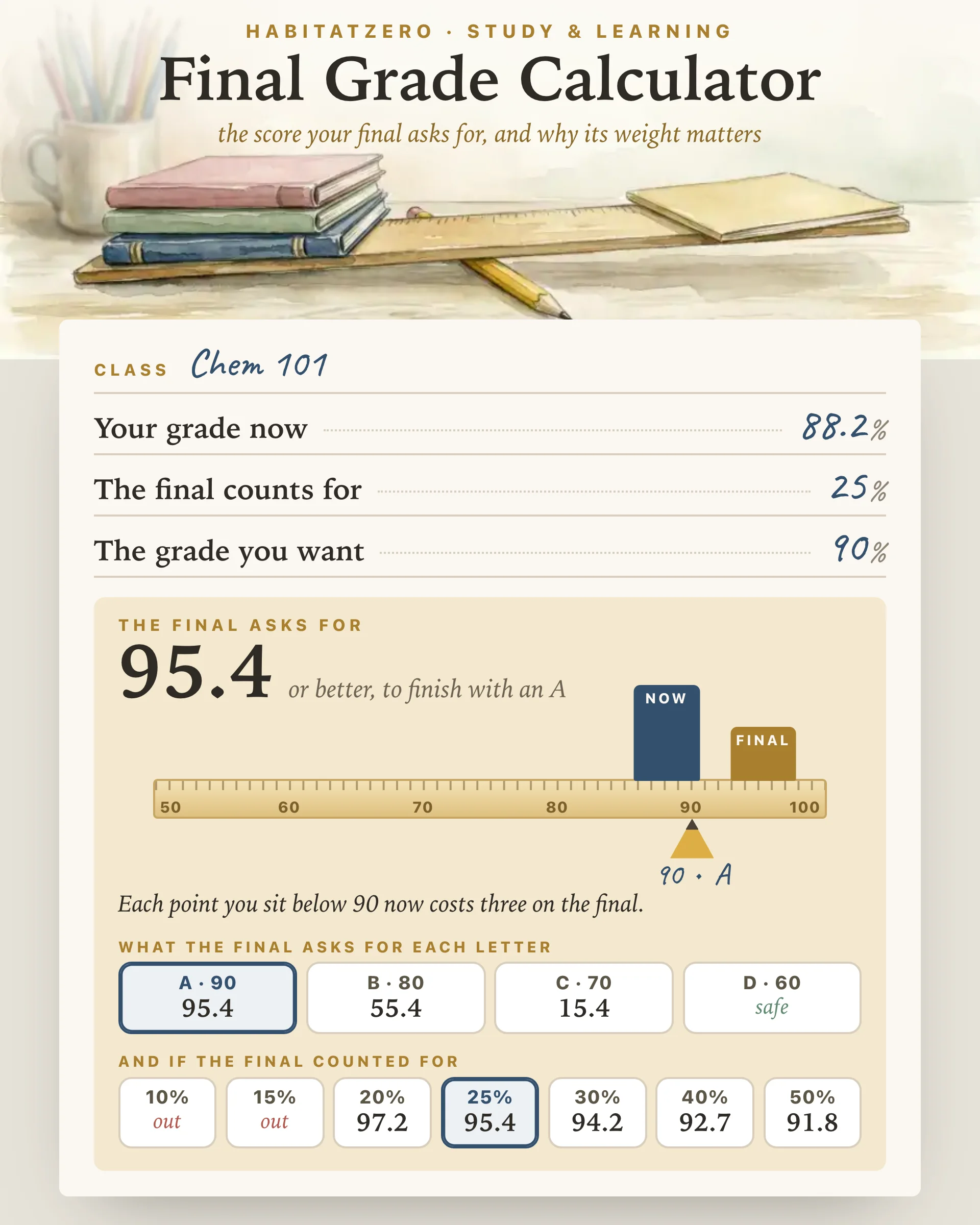
Say you have an 88.2 in chemistry, the final counts for 25 percent, and you want an A, which starts at 90. Your 88.2 times 0.75 is 66.15 points already in hand. You need 23.85 more to reach 90, and the final delivers its points at a quarter strength, so it has to come in at 23.85 ÷ 0.25, which is 95.4.
A weighted average behaves like a ruler balanced on a pencil. Your grade so far is a heavy stack sitting at 88.2, and the final is a lighter piece sitting wherever you score. The ruler balances at your finished grade, and the heavier piece always sits closer to the pencil.
When the course so far outweighs the final three to one, each point you sit below your target now costs three points on the final. At a 20 percent final it costs four, and at 10 percent it costs nine. That is why a light final rarely rescues a grade, while a heavy one often can.
Type the running grade from your portal, tap how much the final counts for, then tap a letter or type your own target. The big number is the score the final asks for, rounded up so it never flatters you. Each letter and each common weight shows what the final would ask in that case instead.
The small ruler redraws with every change. It tips when your target is out of reach, because even a perfect 100 cannot pull it level, and the page names the highest letter still open. It tips the other way when your grade holds even with a zero.
If your class starts the A at 93, switch the letters to the seven-point scale. The ten-point version, with 90 for an A, 80 for a B and 70 for a C, is one common system, as the College Board's own grade chart puts it, and plenty of schools draw their lines somewhere else.
Schools weight finals differently, and the calculator only knows what you tell it:
When the page says a letter holds even with a zero, read that as arithmetic, not permission. Many classes require the final to pass, and skipping it can sink a grade in ways no formula sees coming.
The score the final asks for is a target, not a forecast. It measures how much room you have and says nothing about how the exam will go. Its best use is deciding where your hours go: a class that needs a 55 can get a steady review, while one that needs a 95 deserves your sharpest days.
Then spend those hours on methods that hold up. A large review of study techniques rated practice testing and spaced practice the most useful, with rereading and highlighting among the least. A meta-analysis of 317 experiments on spacing found that the best gap between study sessions grows as the test moves further away, so the earlier you run these numbers, the more room you have to spread the work out.
The Exam Planner turns the days you have left into a daily pace, and the Active Recall Deck supplies the practice testing. If the number itself sets your heart racing, the Test Anxiety Answer Sheet is a calmer place to begin.
Open it in the last week or two of classes, once everything but the final has been graded, and run it for each class. Come back whenever a late assignment posts, because at a 25 percent final every point you gain now takes three off what the exam asks.
Multiply your grade now by the share of the course already done, subtract that from the grade you want, and divide what is left by the final's weight. With an 88.2, a final worth 25 percent and a target of 90, that is 90 minus 66.15, divided by 0.25, which comes to 95.4.
That comes down to its weight. When the final counts for a quarter of the grade, every point you sit below your target now costs three points on the exam, and at 10 percent it costs nine. A heavy final can swing a grade a long way, while a light one mostly confirms the grade you already have.
Convert before you type. The final's weight is its points divided by all the points in the course, and your grade now is the points you have earned divided by the points possible so far. Enter both as percentages and the answer is the same.
Then that target is out of reach on the final alone at its current weight. The calculator shows where a perfect score would leave you and the highest letter you can still reach. Before you let the target go, ask your teacher about extra credit, retakes or a dropped score.
To run your own numbers, personalize the calculator in HabitatZero. It costs nothing, and it holds on to the class, grade and weight you entered, so you can come back when a late assignment posts.
By the team behind Fabulous, the science-based self-care app used by over 30 million people.