Leaves on a StreamEmotional Fitness · ~3 min
About this template · Updated September 2026
A feelings check-in is the smallest conversation you can have with a child about what is going on inside: one question, asked at the same moments each day, answered by pointing. How do you feel right now? The answer is a face, not a paragraph, which is why young children can give it.
One check-in tells you about a moment. A week of them can tell you that mornings are the hard part. A poster of faces cannot show that; a chart that keeps each answer can.
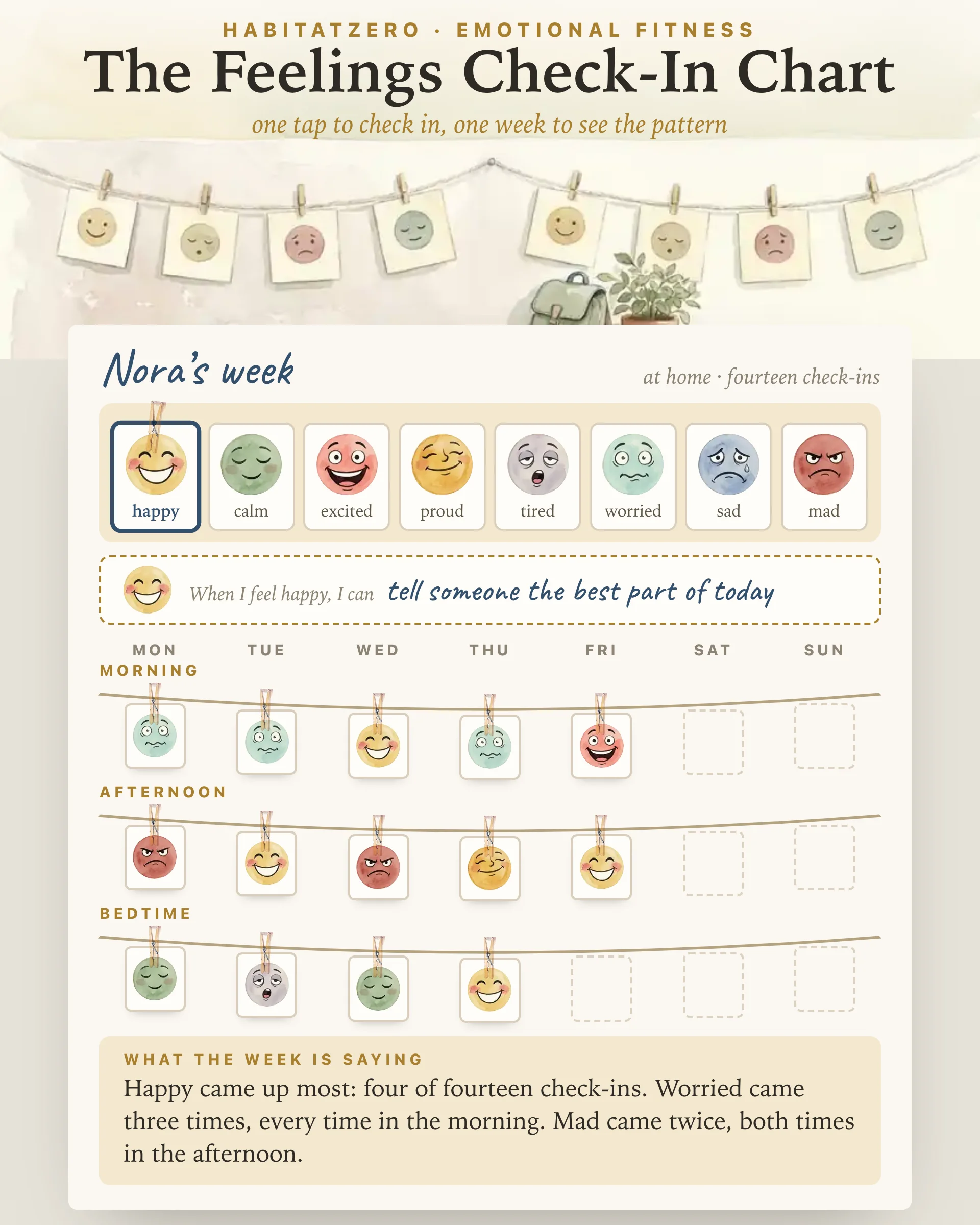
Eight painted faces sit on the board: happy, calm, excited, proud, tired, worried, sad and mad. When your child taps one, a wooden clothespin clips onto it, and the same face hangs on the week's clothesline for that day and time of day. The chart picks today's spot from the clock; tap another spot to fill in a check-in you missed, or a different face to change an answer. A spot holds one feeling, so nothing is counted twice.
At home the week has seven days and three lines: morning, afternoon and bedtime. A classroom week has five days, with morning, after lunch and end of day. You choose at the start of a week, so every check-in keeps the time it was made.
Every face comes with a helper line in your child's voice, such as "When I feel worried, I can take three slow balloon breaths." Each feeling has three kid-sized ideas to cycle through, from a high five to stomping it out, and room for one in your family's own words.
After three check-ins, the box below the lines starts reading the week. It names the feeling that came up most and any feeling that keeps landing at one time of day, like worried turning up three times, every time in the morning. A small table beneath the sentences draws every check-in as a dot under its time of day, so you can check the reading against the marks.
Tie the question to moments that already happen: breakfast, the walk home, lights out. A check-in that needs its own slot in the schedule rarely survives a busy week.
Ask, listen, and say thank you. The chart works best when no answer is wrong, so hold off on fixing the feeling right then. Mad on the afternoon line is information, not misbehavior, and a chart that quietly rewards happy faces teaches children to choose happy faces.
Go first now and then: saying you feel a little tired this afternoon shows that grown-ups name feelings too.
If your child cannot find the word, pointing is enough, and a wrong guess can be changed with one tap.
The time of day is where the chart earns its place on the fridge. Worried on three school mornings points to something before school: the bus, a spelling test, a hard goodbye at the door. Mad on the afternoon line often has more to do with a long day of holding it together, or an empty stomach, than with whatever set it off. The chart cannot tell which; you and your child can. Bring a pattern up on the weekend as a question, such as what makes mornings hard, not as a conclusion.
In a study of seventy-two children from low-income families, the ability to recognize and label emotion expressions at age five predicted social behavior and academic competence at age nine, even after accounting for verbal ability and temperament. That is a prediction, not proof that practice with feeling words causes those gains.
In a randomized trial across twenty Head Start classrooms, preschoolers who had a school year of weekly social-emotional lessons showed more emotion knowledge and were rated more socially competent than their peers. At home, a randomized trial of the Tuning in to Kids program found that parents who learned emotion coaching used more feeling words and talked more about what causes feelings, and their children's emotion knowledge improved.
No study has tested a check-in chart on its own. This one borrows the daily habit those programs build on, naming a feeling and wondering aloud where it came from. It is not a screening tool and cannot tell you whether a child needs help.
The National Institute of Mental Health suggests seeking help when a child's emotions or behavior last for weeks, cause real distress, or get in the way of school, home life or friendships. If the same hard feeling fills the lines week after week, bring the chart to your pediatrician or the school counselor; a week of marked check-ins is easier to describe than a vague worry. If your child ever talks about wanting to hurt themselves, do not wait for a pattern: call or text 988 in the US, or your local emergency number.
When a feeling is big and you need to know how big, The Feelings Thermometer measures it in levels. For a child who feels it in the stomach before finding the word, The Emotions Body Map helps them point to where. When the week shows afternoons boiling over, The Calm Down Jar gives the feeling somewhere to settle.
It is a small set of feeling faces a child points to when an adult asks how they feel, used at the same moments every day. Kept for a week, the answers show which feelings are common for your child and when they tend to arrive.
Attach it to moments that already happen, like breakfast, pickup and lights out. Ask how they feel right now, let them point to a face, and thank them for telling you. Keep the why questions for a calmer time, and name your own feeling now and then.
Young children do better with a short list than a long one. This chart uses eight faces: happy, calm, excited, proud, tired, worried, sad and mad, which gives comfortable and uncomfortable choices plus one for a worn-out body.
Look first at when it lands. Worry that only shows up on school mornings points to something you can ask about. If a hard feeling lasts for weeks, or gets in the way of sleep, school or friendships, bring the chart to your pediatrician or the school counselor.
This page shows a sample week you can look through. To clip real check-ins onto the lines, keep the week and write your own helper lines, open the chart in HabitatZero, where it costs nothing.
By the team behind Fabulous, the science-based self-care app used by over 30 million people.