
The Overwhelm Recovery ProtocolWellness & Routines · ~5 min
About this template · Updated September 2026
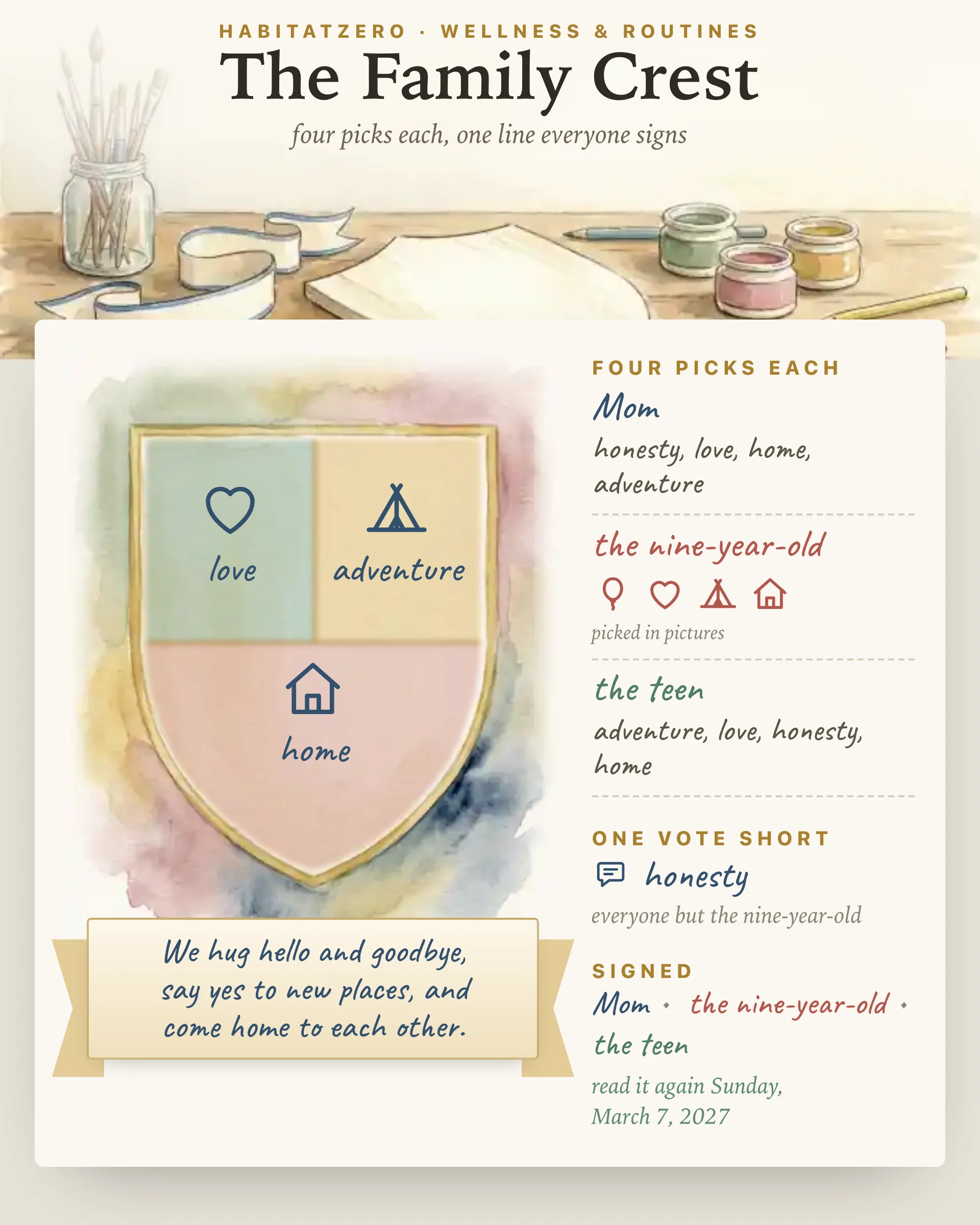
Credit first. The family mission statement is best known from Stephen R. Covey's The 7 Habits of Highly Effective Families (1997), where the habit he calls begin with the end in mind turns into a family sitting down to write its purpose together; FranklinCovey still lists the book on its site. This crest is an independent take on that exercise. It has no connection to Covey's estate or to FranklinCovey, and neither one has reviewed or endorsed it.
Every family already lives by values it rarely says out loud: who gets the last pancake, whether an argument ends in an apology or a slammed door, whether Saturday belongs to soccer or to Grandma. A family mission statement turns a few of those unwritten rules into one sentence everybody chose, one the kids can quote back to you on a long evening.
Start by putting everyone on the roster: tap Mom, Dad, Grandma or the teen, or type a name. Then pass the phone or laptop along. Each person picks the four that matter most from sixteen values, love, honesty, adventure, faith and hard work among them, and the family can add up to four of its own. Young children can switch to pictures, so a six-year-old tapping a heart, a tent and a house casts a vote that counts exactly as much as a parent's.
Anyone can also mark up to three phrases that say a value their way, such as hug hello and goodbye or tell the truth even when it's hard.
The shield paints only what is on every list. One shared value fills the whole field, two split it down the middle, and three or four divide it into quarters, the same shape as the crest projects kids bring home from school. Anything one vote short shows beside the roster with the name of whoever left it off, and that line usually starts the best conversation of the evening.
From the shared values and the phrases your family picked, the page drafts a line for the ribbon. Keep it, ask for another wording, or write your own. Choose a Sunday three months, six months or a year away to read it again, and then everyone signs. If the line or the shield changes afterward, the signatures clear, because a statement only the adults agreed to is a house rule, not a family mission.
The limit of four is deliberate. A family that lists twelve values ends up with a statement nobody can remember, and four picks per person forces the trade-offs that make the list mean something.
A real vote for children matters as much. A sentence the grown-ups announce at dinner gets treated like any other rule; one built from what the nine-year-old picked, with her signature under it, is one she has a stake in keeping.
No study has tested writing a family mission statement directly, so treat any promise of results with suspicion. The nearest evidence comes from research on family routines, rituals and shared stories. Barbara Fiese and colleagues reviewed fifty years of research on family routines and rituals, separating routines, the practical things a family does, from rituals, the symbolic moments that say who the family is. Across the studies they found both linked with parenting competence, children's adjustment and marital satisfaction. The same review is candid that the studies measured routines inconsistently, leaned on convenience samples and could not tell direct effects from indirect ones.
In a brief report, Marshall Duke, Amber Lazarus and Robyn Fivush found that children and teens who knew more of their family's history also showed higher self-esteem, a stronger sense of control, better family functioning, lower anxiety and fewer behavior problems. That is a correlation. It does not show that learning family stories causes any of those things.
Read together, the evidence supports a modest claim: families that share rituals and a sense of who they are tend to fare better, and a crest you make together, sign and come back to is one small ritual of that kind. It is not a cure for serious conflict at home, and it does not replace a family therapist when things are hard.
Print the crest and hang it where the family eats, since that is where the line will get quoted. Use it as a filter when decisions come up: does this weekend plan fit say yes to new places, or does it only fill the calendar? On the review date, read the ribbon out loud and ask whether it still sounds like your family. New babies, moves, new partners and teenagers all change a household, and the crest should change with it.
January works, and so do the first week of summer vacation, a move to a new home, or the first months of a blended family. If one person wants to work out their own purpose before bringing it to the table, the Personal Mission Statement Template is built for a single writer. The Core Values Worksheet helps a parent sort out what they value first, and when the shared line turns into chores and follow-through, the Family Responsibility Chart gives everyone a visible part.
It is a short statement of what your family stands for and how you mean to treat each other, often just one sentence. It works best when every person in the house helps write it, children included, so it sounds like your family instead of a slogan from a store.
Ask each person what matters most to them, find the values that show up on everyone's list, and turn those into one plain line. This crest does the finding for you: shared values are painted on the shield, and a draft line is assembled from the phrases your family picked.
Short lines tend to get used. Three that families might build here: We hug hello and goodbye, say yes to new places, and come home to each other. We tell the truth even when it is hard and help without being asked. We do hard things, laugh a lot, and give every idea a turn.
A motto is a few words you can say at the door on the way out, while a mission statement spells out what the family is for and how it behaves. The ribbon here holds one line that sits between them: short enough to remember, concrete enough to act on this week.
The sample family on this page can be explored without an account. To paint your own crest, keep every signature, and find the ribbon waiting on the review date, open it in HabitatZero, which is free.
By the team behind Fabulous, the science-based self-care app used by over 30 million people.


