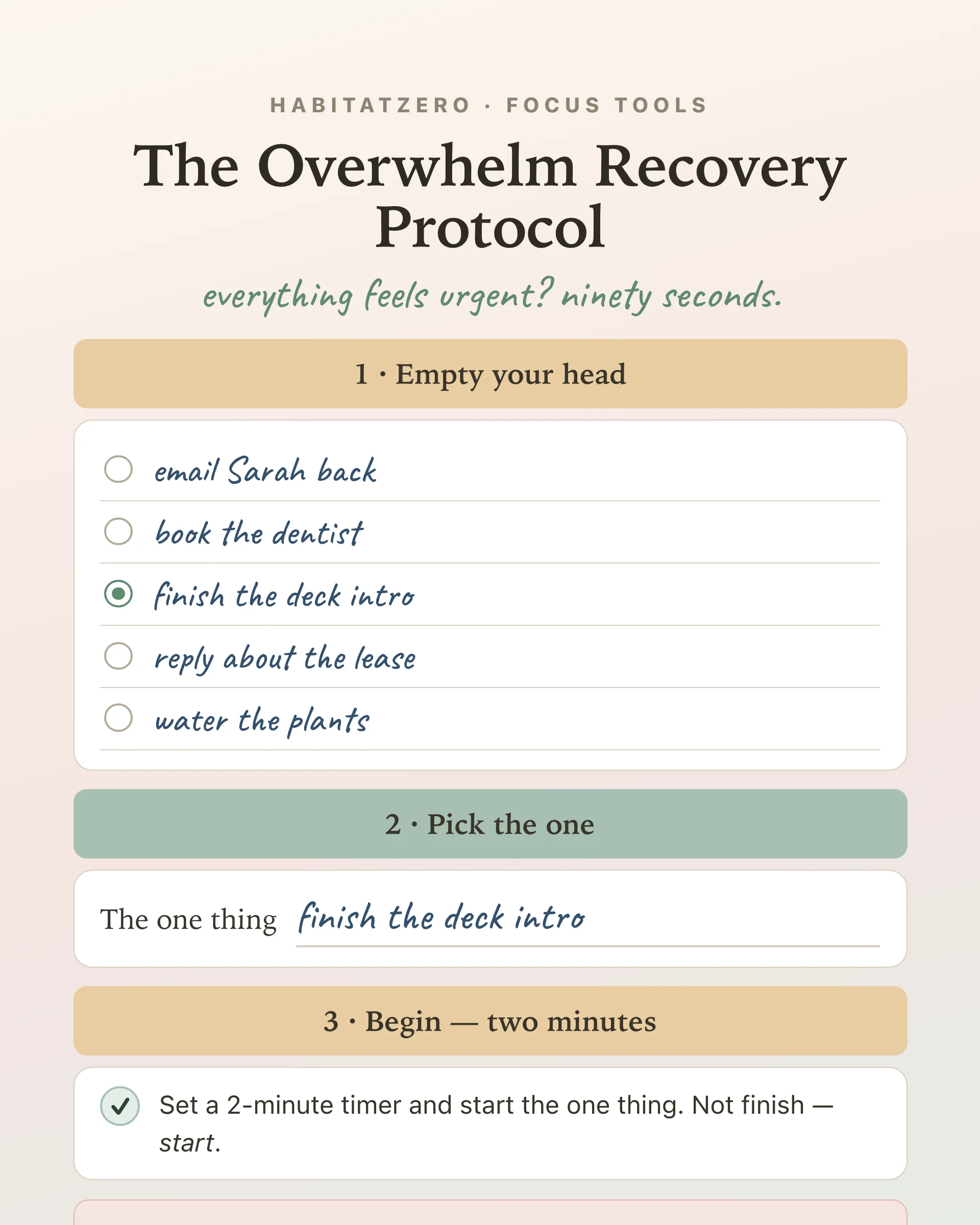
The Overwhelm Recovery ProtocolWellness & Routines · ~5 min
About this template · Updated September 2026
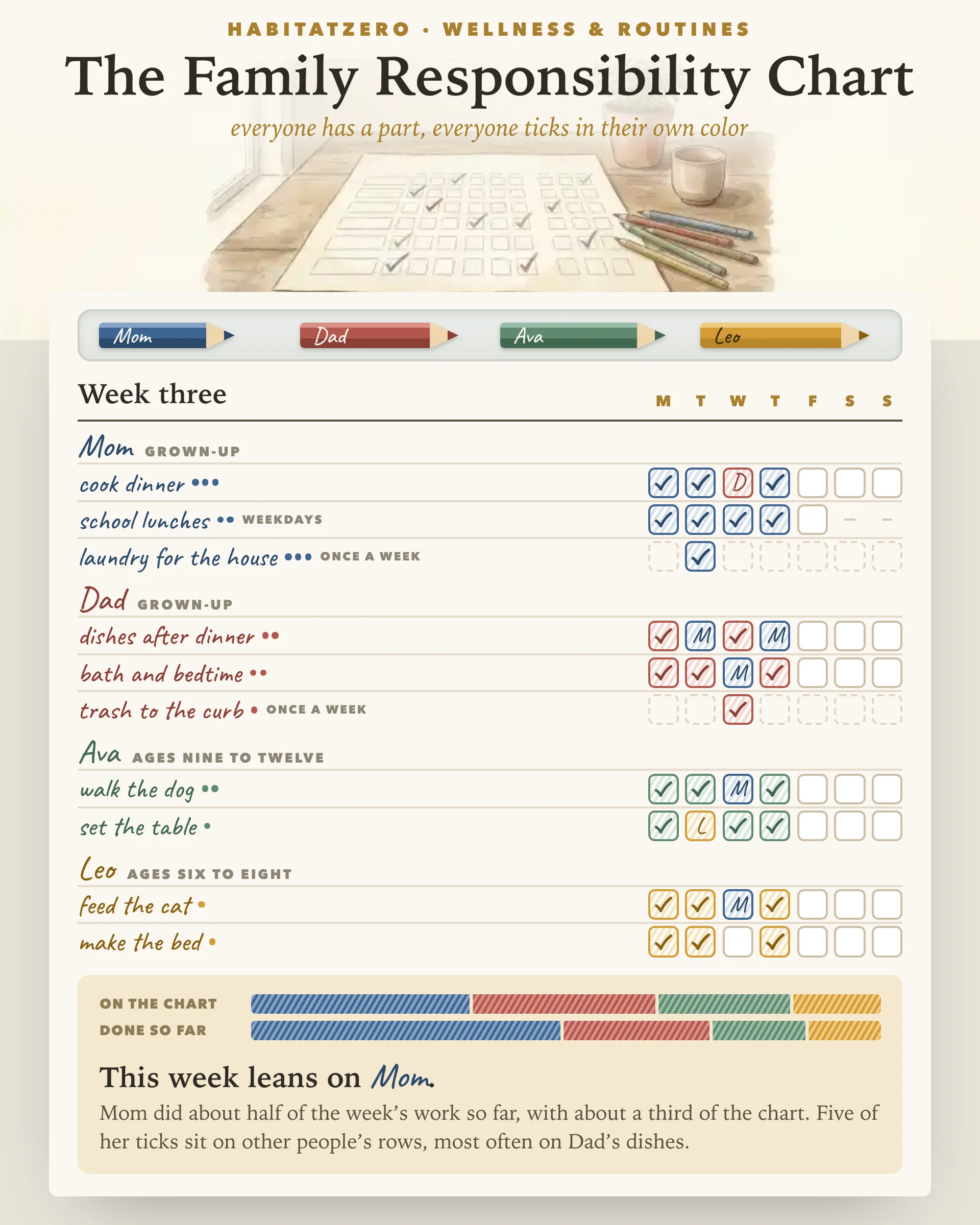
Most family charts on the fridge are really children's chore charts. The kids get rows and checkboxes, while the adults' work (dinner, laundry, the school forms, the grocery run) never reaches the paper. So it cannot answer what families actually argue about: is the work shared, or quietly piling up on one person?
This chart puts everyone on it, from a preschooler with a single job to the parent with five, and it records who actually did each job, in that person's own color.
The page opens with a tin of six colored pencils. Tap Mom or Dad to hand out the first two, or write a name on any pencil and tap that person's age. Each age brings its own suggestions, from toys back in the bin for a five-year-old to cooking dinner one night for a teenager.
Every job carries a size, from one dot for a quick one to three for a big one, and a rhythm: every day, weekdays, or once a week. Each person holds six rows at most, so no one's list outgrows a glance.
Before you tick a box, pick up the pencil of the person who did the job. When Leo feeds the cat, the tick lands on his row in his color. When Mom feeds the cat because Leo forgot, the tick still lands on Leo's row, but in her color and with her initial. That is a cover.
Covers are normal, because families step in for each other all the time. What matters is where they pile up. The pencils in the tin also wear down with every tick, so whoever is doing the most ends the week holding the shortest one.
Two strips sit under the chart. The top one shows each person's part of the chart, weighted by the size of their jobs and how often they come around. The bottom one fills in after the sixth tick and shows the work each pencil actually did.
When one pencil runs well ahead of its owner's part and is also doing most of the covering, the page says the week leans on that person. It names the job covered most often, which is usually the one to talk about first. If the week leaned the same way last time, the reading says so. It also speaks up before anyone ticks a box when one grown-up's rows already hold about twice another's.
When you close the week, it goes on file with its strip and its reading, and everyone gets a fresh pencil.
The American Academy of Pediatrics offers a list of age-appropriate chores. Children of five to seven can make their beds, set and clear the table, and fill a pet's food dish. By eight to ten they can vacuum and help make dinner. At eleven or twelve they can clean a bathroom, do and fold laundry, and cook a simple meal with supervision. The same page recommends a chart as a visual reminder and suggests praising the effort rather than the result.
Start a notch easier than you think, because a job you end up redoing yourself only turns into a cover.
In a national sample of nearly ten thousand American children, kindergartners who did chores more often reported feeling more capable by third grade, socially, academically and in life satisfaction, even after the researchers accounted for family income and parents' education. That is an association from survey data, not proof that chores build confidence. Families who hand out chores may differ in other ways too.
A study of thirty dual-earner families in Los Angeles found that most children spent surprisingly little time helping and did fewer tasks than they said they did in interviews. Allowance did little to motivate them, and the authors suggest that in some families, unclear and inconsistent expectations from parents were part of the problem. A chart with a named row for each person, ticked by whoever really did the work, speaks to both findings.
In an Indigenous-heritage community in Guadalajara, many six- to eight-year-olds were reported to pitch in on their own initiative to work for the whole family, such as tending younger siblings, cooking or running errands. In a cosmopolitan community with long experience of Western schooling, few children did, and seldom on their own. The authors tie the difference to children being expected and allowed to join in the family's shared work. One chart for everyone, with the adults on it, leans in that direction.
None of these studies tested a chart. What a chart can do is make the week visible to the whole family at once.
Set the chart up together at a family meeting, tick it through the week, and read it back on the weekend before you close it. Print it for the fridge if paper works better in your house. A cup of colored pencils beside it, one color per person, keeps the same record by hand.
If your youngest needs a sheet of their own with a reward line at the bottom, give them a Chore Chart. If the grown-ups want to split housework by minutes, the Household Chore List does that arithmetic.
It is one weekly chart for the whole household that lists each person's regular jobs with a box for every day. A four-year-old might have toys back in the bin while a parent has dinner and the grocery run. With everyone on the same page, nobody's share stays out of sight, the grown-ups' included.
Yes, if you want the chart to show how the house really runs. Children see that everyone pitches in, and the adults get an honest picture of their own split. A chart that lists only the kids leaves off the biggest jobs, which are usually the ones a parent carries without anyone noticing.
Pick jobs a child can finish without you. From three to five, toys in the bin and clothes in the hamper. From six to eight, making the bed, setting the table or feeding a pet. From nine to twelve, loading the dishwasher, walking the dog or vacuuming a room. Teens can cook a simple dinner or run their own laundry from start to finish.
Keep each person's list short enough to finish, hang the chart where everyone walks past it, and read it together once a week. A study of dual-earner families in Los Angeles suggested that vague expectations were part of why children helped so little, and it found that allowance did little to change that. Clear rows everyone can see are a better place to start than prizes.
The chart on this page is a sample family's week, and reading it needs no account. To hand out your own pencils, tick your own family's week and keep earlier weeks on file, open the chart in HabitatZero, which costs nothing.
By the team behind Fabulous, the science-based self-care app used by over 30 million people.