
The Overwhelm Recovery ProtocolWellness & Routines · ~5 min
About this template · Updated November 2026
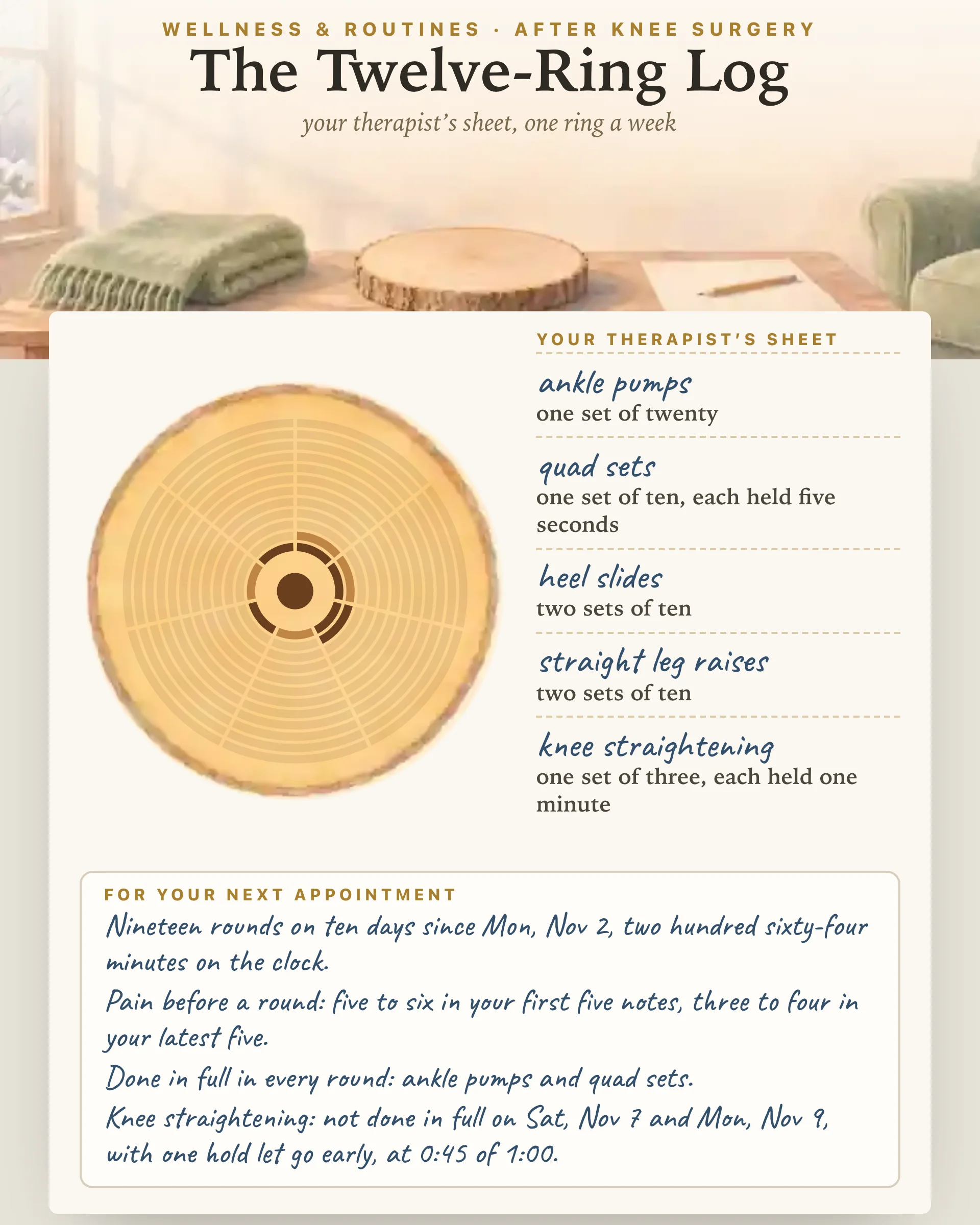
The exercises you do at home after a knee replacement belong to one person's plan: the one your physical therapist wrote for you. This page is a log for that plan and nothing else. It holds no list of exercises, no bend target and no next step. You copy each exercise from your sheet, and the page counts what you do, times your holds, keeps your pain notes and fills a wooden ring for each of twelve weeks.
Some changes after surgery are not for a log. Chest pain or breathlessness that comes on suddenly can mean a clot has traveled to the lungs; the National Library of Medicine tells anyone with signs of a pulmonary embolus to call 911 or their local emergency number, or go to an emergency room.
Call your surgeon's team at once for pain, swelling or redness in your calf or leg, a wound that is red, hot or leaking, a fever, or pain that suddenly gets worse. The library's discharge guide for knee replacement lists calf pain or swelling, a temperature above 101°F, redness or swelling around the incision, yellowish drainage, and pain your medicine does not ease among the reasons to contact the surgeon.
If you have had a fall, dizzy spells, a heart or blood pressure problem, or pain that is new, ask your surgeon or therapist before your next round. Keep a sturdy chair or counter within reach for anything your sheet has you do standing.
Copy the sheet. Write each exercise the way your therapist named it, with any helper or limit the sheet gives, such as a strap to hold or how far to go. Then pick its sets, reps and any hold per rep. Until you do, the numbers stay blank and no round can start, because those numbers are your therapist's. The sheet takes up to eight exercises. When your therapist changes something, change it here too; rounds already logged keep the numbers they were done with.
Note your pain, then start. Tap a number from zero to ten, then start the round's clock. The clock keeps real time, even on a phone that locks mid-round.
Count what you do. Tap one rep as you finish it, or the whole set at once. A hold is timed: it counts only when its full time has passed. Let go early and that hold does not count; its whole seconds are noted for your therapist instead. A set you stop partway keeps only its whole reps. A round ended under a minute with nothing counted saves nothing, and the clock stops itself at sixty minutes.
Note your pain again. Your notes are set only beside your own earlier ones, with no score and no verdict.
Copy what was measured. If your therapist measures how far your knee bends and how close it comes to straight, you can copy those degrees after the visit. They stay in date order with no number to reach.
Watch the ring. Twelve rings run from the center out, one a week, each cut into seven arcs. A day turns dark when the rounds your sheet asks for were all done in full, light when some sets were done, and stays dashed when no round was logged. The page sets aside half an hour a day: room on your calendar, not a prescription.
Bring the summary. A short box gathers rounds, minutes, days with the rounds your sheet asks for, your pain notes, anything not done in full, holds let go early and your last measured note.
A systematic review of exercise after knee replacement, by researchers at several British universities, pooled 18 trials with 1,739 people. Compared with minimal physical therapy, exercise after discharge improved function and pain at three to four months. Programs done at home did about as well as outpatient ones. No lasting benefit showed up, and the authors call the trials few, small and underpowered.
A multicenter trial led from the University of Sydney assigned 390 people aged 45 to 75 to either usual outpatient rehabilitation or a home exercise program that therapists monitored. Six weeks after surgery the home group was not worse on pain, function, knee range of motion or walking time.
The HIHO trial at two Sydney hospitals randomized 165 people with uncomplicated surgery: ten days of inpatient rehabilitation followed by a monitored home program, or the home program alone. At 26 weeks the two groups walked about the same distance in six minutes.
What these studies leave out matters too. Every program in them was designed and checked by therapists, and most of the people in them had surgery for osteoarthritis that went without complications. None tested a log. A log cannot stand in for your therapist; it helps you carry out what they set and tell them plainly how it went.
The Home Exercise Carousel is the hip version: it shows common early hip moves to mark, for six weeks. This page lists no exercises at all, runs for twelve weeks, times every hold, and keeps your therapist's measurements. The Three-Step Leg Routine is a general leg program with its own moves and harder steps. It is for later, and only once your therapist agrees.
The ones your physical therapist gives you, at the sets, reps and holds written on your sheet. Programs differ with the surgery, your other health conditions and how recovery is going, so this page never suggests an exercise: you copy yours in, and it keeps count.
As often as your sheet says, which in the first weeks is often more than once a day. The National Library of Medicine’s discharge advice tells people to do the exercises their therapist taught them on their own every day. This page sets aside half an hour a day and logs up to five rounds a day.
Some soreness during the early weeks is common, but how much to expect is a question for your own surgeon and therapist. Stop an exercise that hurts more than they said it would, and treat pain that comes on suddenly or keeps climbing as a reason to call them at once.
At once for pain, swelling or redness in your calf or leg, a wound that is red, hot or leaking, a fever, or pain that suddenly gets worse. For chest pain or breathlessness that starts suddenly, call 911 or your local emergency number, since either can mean a clot has reached the lungs.
Only as your therapist measures it. If they tell you how many degrees your knee bent and how close it came to straight, you can copy those numbers in after the visit. The log keeps them in date order and never sets a number for you to reach.
By the team behind Fabulous, the science-based self-care app used by over 30 million people.


