
The Overwhelm Recovery ProtocolWellness & Routines · ~5 min
About this template · Updated November 2026
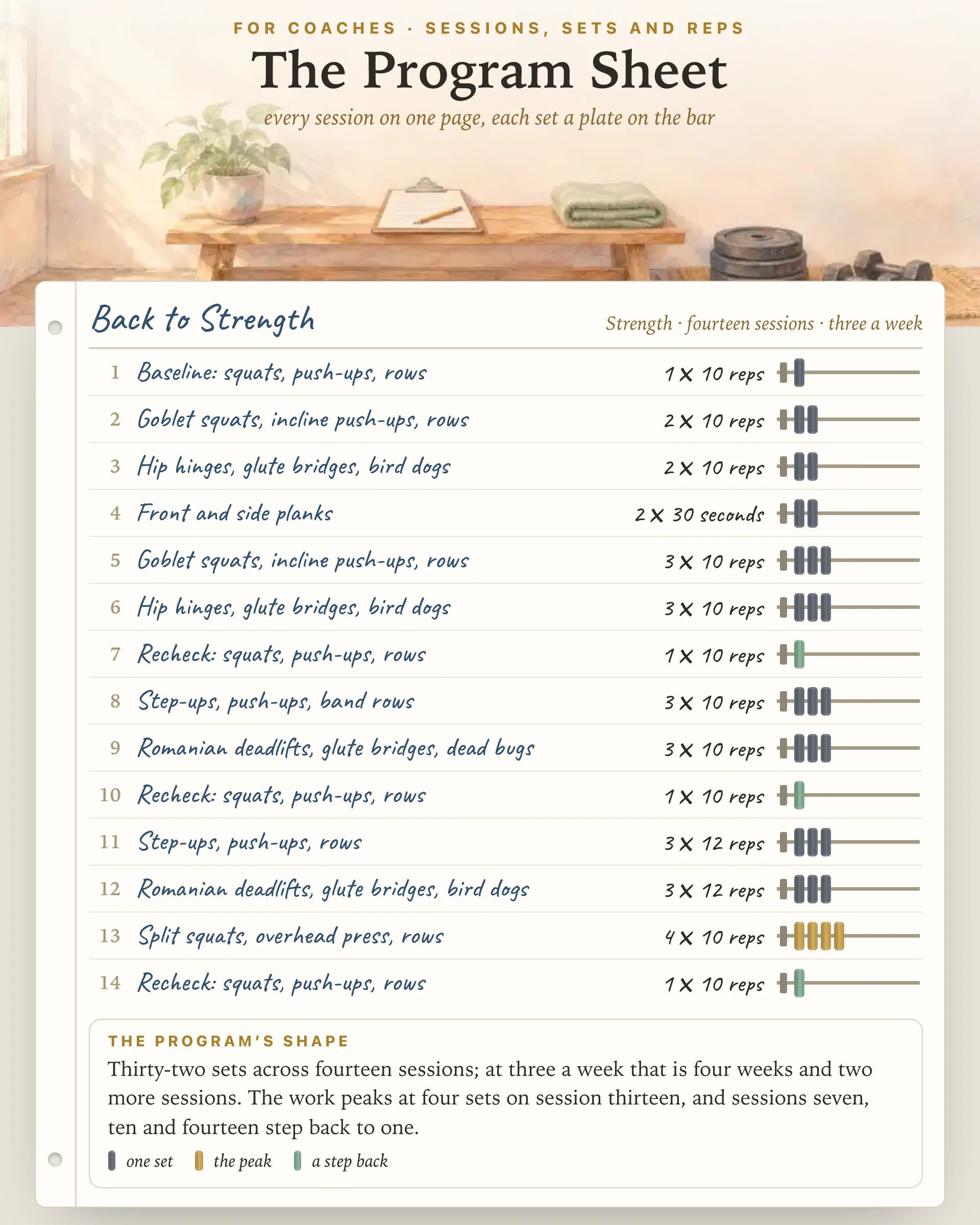
A program is the plan you write before the first session, and the page the person you coach carries out the door. Most exercise program templates are spreadsheets that make you type every cell and never tell you anything back. This sheet drafts the whole block from one tap, lets you rewrite any session, and reads the finished program back before you hand it over.
Whatever the focus, a program on paper answers the same handful of questions.
Name the program, then tap a focus. Every session fills at once from a starting plan written for a general adult group, each with its dose already set. Tap a row and a panel opens right under it. Tap a move to add it to that session's line, tap a move already in the line twice to take it out, or write over the line in your own words. A line holds sixty characters, so the sheet turns down a move that would run past that and says why. Two steppers set the sets and the count, and four small buttons say whether the count is reps, seconds, minutes or breaths.
Each set appears as a plate on a small bar at the end of its row. Read down the page and the plates draw the outline of the block: where the work builds, where it tops out and where it eases off. Gold plates mark the heaviest session or sessions, and green plates mark any session that carries fewer sets than the one before it. Under the sheet, a short reading says the same in words, for example thirty-two sets across fourteen sessions, a peak of four sets on session thirteen, and three lighter rechecks.
Switching the focus after you have written sessions brings a question before anything is replaced, and shortening the program hides later sessions without deleting them. When it looks right, print it: the buttons drop away and the page keeps the name, every session, its dose and its plates.
The sheet stores a program and nothing about a person. There is no box for a client's name, contact details or health history, which belong in your own records.
The American College of Sports Medicine's 2026 position stand on resistance training prescription, an overview of 137 systematic reviews, found that progressive resistance training improves strength, muscle size, power and several measures of physical function in healthy adults. Strength rose more with two to three sets and at least two sessions a week, and muscle size rose more at ten or more sets a week. The same overview found that periodization, the planned waves of harder and easier training, did not consistently change outcomes. So the lighter sessions on this sheet are a sensible way to space out hard work, not a proven ingredient.
For the rest of the week, the WHO 2020 guidelines on physical activity recommend that adults get 150 to 300 minutes of moderate activity, or 75 to 150 minutes of vigorous activity, each week, along with regular muscle-strengthening activity. An earlier ACSM position stand on prescribing exercise adds that a program should be shaped around each person's usual activity, health and goals, and that raising intensity and volume gradually may lower the risks of exercise.
None of this means a particular program will produce a particular result for a particular person. The plates describe your plan, not how hard anyone worked: ten reps with a light dumbbell and ten with a heavy one make the same plate.
Open it when you plan a new block for one client or a small group, and again when the rechecks tell you what the next block needs. Pair it with a SMART goal for exercise so the block aims at something specific, and suggest a workout journal to the person following it, so they can note how each session felt. If you also run group sessions, the 14-day group challenge uses the same day-by-day outline for a challenge everyone does together.
Every starting plan here assumes a general adult without injuries. Write an easier version of each move into the session line when someone needs it, stop any move that hurts, and refer anyone with pain, a heart or blood pressure condition, a recent injury or a pregnancy to a clinician before session one.
A name and one focus, how many sessions and how often, the moves in each session, and the sets with reps or time for each. A baseline at the start and a recheck at the end let you and the person following the plan compare where they began with where they finished.
Most begin with an assessment, choose one main goal and a weekly frequency the client can keep, then pick a few moves per session with a dose for each. The dose rises in small steps across the block, easier sessions sit between the harder ones, and the plan gets rechecked and rewritten when the block ends.
There is no single right number. A 2026 overview of reviews from the American College of Sports Medicine found strength rose more with two to three sets and at least two sessions a week, and muscle size with ten or more sets a week. The strength plan on this sheet opens at one or two sets and builds to four, so a general adult group can start gently.
No. It keeps the program only: its name, the focus, the sessions and their doses. There is no field for a client's name, contact details or health history, so those stay in your own records.
Yes. You can build the program and print it here in your browser at no cost. Personalize moves it into a free Salon account, made by the team behind Fabulous, where the program stays editable for the next block.
By the team behind Fabulous, the science-based self-care app used by over 30 million people.


