
The Overwhelm Recovery ProtocolWellness & Routines · ~5 min
About this template · Updated September 2026
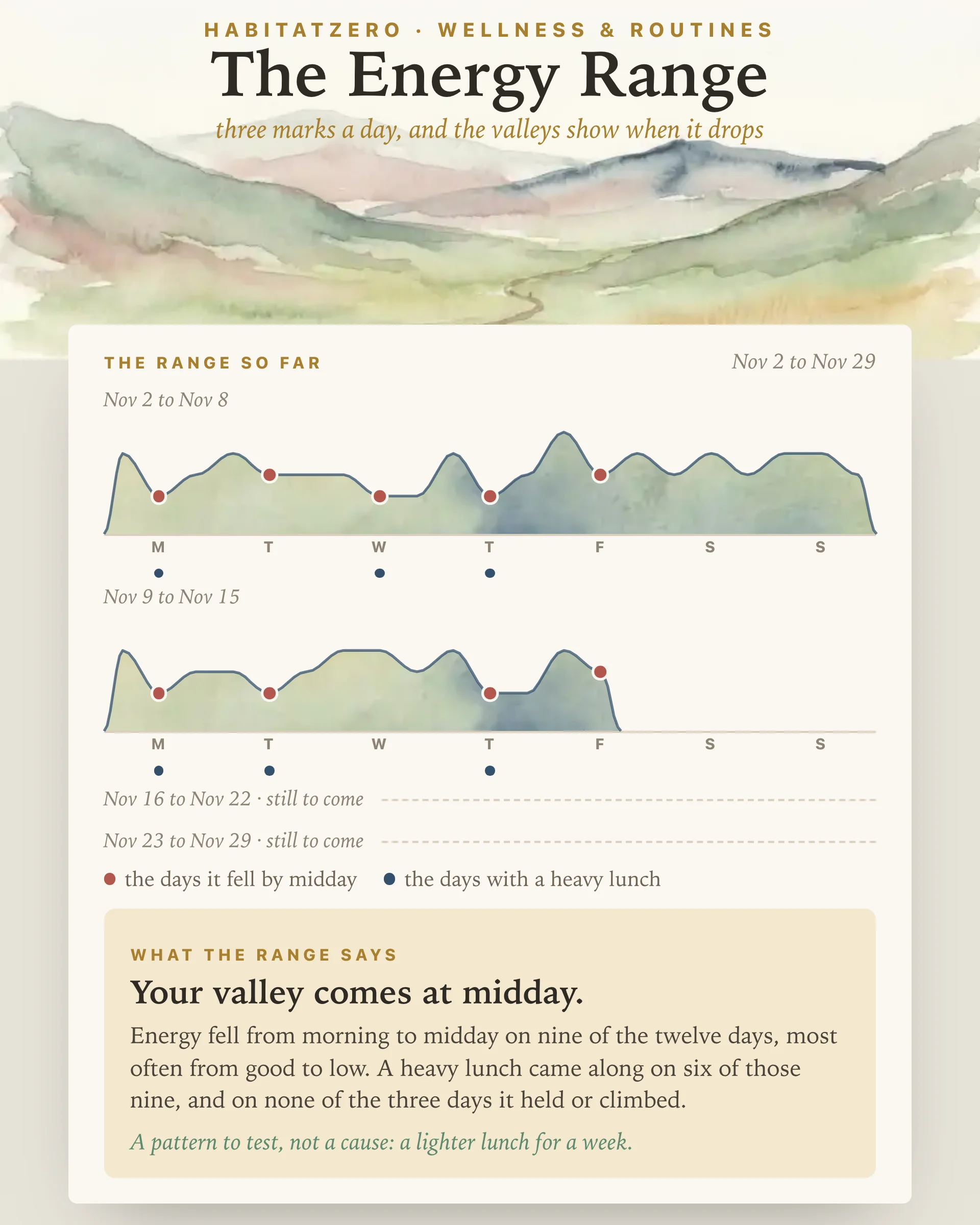
You probably know you have a bad part of the day. What you likely don't know is whether it is the same part every day, how deep it goes, and what else tends to be happening when it arrives. Memory is poor at this. It keeps the afternoon you nearly nodded off in a meeting and forgets the eight ordinary afternoons around it. An energy tracker swaps that impression for a record you can actually read.
Three times a day you tap how much energy you have: once mid-morning, once after lunch, once after dinner. There are five heights, from drained through low, steady and good up to peak. Each tap raises a painted ridge on the day's card, so a day that starts strong and sags after lunch looks like exactly that.
Under the ridge you tap what came with the day: how you slept last night, how much you moved, how you ate, when you had caffeine and how heavy your screen time was. One tap per row, and any row can stay blank. A short line catches anything else, like a deadline or a cold coming on.
Each week of marks becomes one band of the range, and up to four bands stack, oldest at the top, so the whole record reads like a landscape. Once seven days carry all three marks, the page reads it. It finds the step of the day where your energy falls most, morning to midday or midday to evening, and calls that your valley. Then it looks at what you tapped. If one of those things turns up on at least half the days your energy fell, and clearly less often on the days it held or climbed, the range says so with the counts, and it puts a small ink dot under each of those days so you can check the pairing with your own eyes.
Energy rarely runs downhill in a straight line from breakfast to bed. For some people, and on some tasks, alertness sags in the midafternoon and recovers later. Research on this post-lunch dip describes it as a real part of the body's daily rhythm: it can appear even when people skip lunch and cannot see a clock, a lunch heavy in carbohydrates makes it deeper, and strong morning types may be more prone to it. The after-lunch mark is placed to catch that dip, and the morning and evening marks give it something to be measured against.
Keep the times roughly steady. A mark at ten one day and at noon the next is measuring two different things.
The reading chooses its words carefully for a reason. If a heavy lunch shows up on six of the nine days your energy fell, that is worth knowing, but it does not prove the lunch did it. Heavy lunches might cluster on busy days, and busy days have their own ways of wearing you down. The honest next move is a small experiment: change that one thing for a week, keep marking, and see whether the valley gets shallower. The range suggests a test that fits what it finds and keeps counting, so the answer shows up where you found the question.
The caution runs the other way too. A pairing that looks strong after one week can fade by the third. Four weeks is long enough to see whether it holds.
Sleep is the clearest case for keeping a record instead of trusting how you feel. In a two-week laboratory study of chronic sleep restriction, adults allowed six hours in bed a night did steadily worse on tests of attention and thinking, until they were doing about as badly as people kept awake for up to two nights straight. Their own sleepiness ratings jumped at first and then barely moved, and the researchers concluded they were largely unaware of how far they had slipped. A tracker keeps noticing when you stop: if short nights keep lining up with your valley, the dots will show it even on weeks when you feel fine.
Some tiredness is not a question of routine. MedlinePlus advises that if you have been feeling tired for weeks, you should contact your health care provider. Its guide to fatigue adds that unexplained tiredness deserves an appointment, especially alongside a fever, weight loss you did not intend or regular sweats, and that confusion, dizziness or blurred vision call for contacting a provider right away. A low mood sitting under the tiredness belongs in that conversation too. A few weeks of marks, with their notes, is a useful thing to bring.
Start on an ordinary stretch rather than a vacation week, and mark each time of day as it comes instead of filling it in later. The page lets you catch up on yesterday, but older days close, so the record stays close to how each day actually felt.
Then follow the valley. If it keeps landing after short nights, keep the Sleep Log alongside for the bedtimes. If caffeine after noon keeps riding along, the Caffeine Calculator shows how much is still in you when you turn in. And if your mornings are always the low point, Lark or Owl may help explain why your body keeps asking for a later start.
It is a running record of how much energy you have at the same moments each day, kept long enough for a shape to appear. This one takes three marks a day, mid-morning, after lunch and after dinner, plus a tap for what the day held, so a few weeks in you can see when your energy tends to fall and what tends to be around when it does.
Part of it is built into the body clock. Alertness dips in the early afternoon for many people, and research on this post-lunch dip finds it can arrive even when lunch is skipped, although a big, carbohydrate-heavy meal tends to deepen it. Short nights, long stretches of sitting and the timing of caffeine can stack on top, which is what a few weeks of marks can help you pull apart.
Choose three moments you can repeat daily, rate your energy at each one on the same five-step scale, and note a handful of things that might matter, such as sleep, movement, meals, caffeine and screens. Give it at least a week of complete days before reading anything into it, because any single day is noisy.
If you have felt tired for weeks, talk to your doctor, and go sooner when the tiredness comes with fever, weight loss you did not plan, sweats that keep returning or a low mood that will not budge. Confusion, dizziness or blurred vision alongside it need care right away. A few weeks of marks can make that appointment more useful.
No. The range on this page is a finished sample you can look through. Opening it in HabitatZero lets you mark your own mornings, middays and evenings and keeps all four weeks for you, at no cost.
By the team behind Fabulous, the science-based self-care app used by over 30 million people.


