
The Overwhelm Recovery ProtocolWellness & Routines · ~5 min
About this template · Updated September 2026
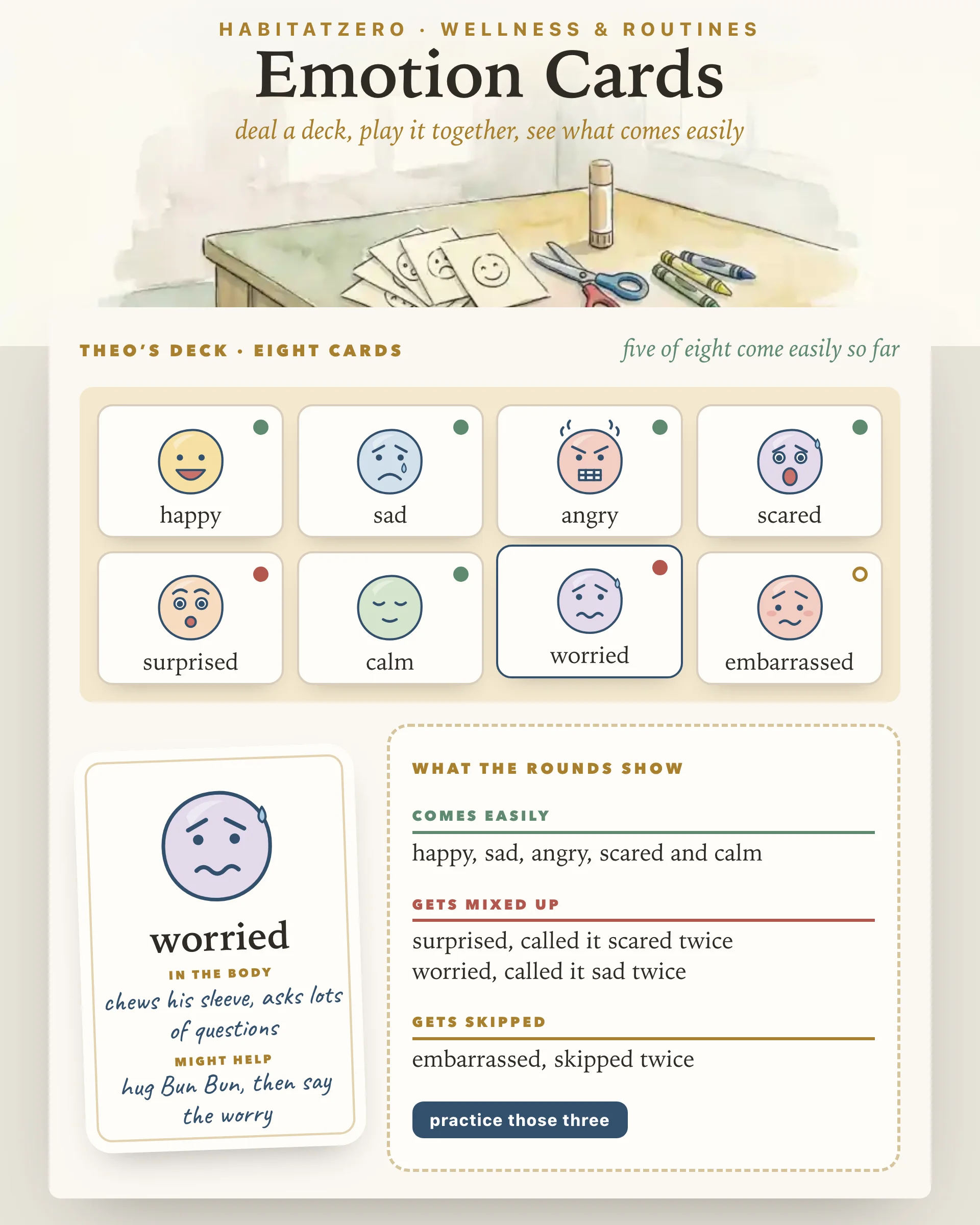
Emotion cards give a feeling a place to be pointed at. This page lets you build that deck yourself. Every card carries a drawn face, the feeling word, a body clue that says where the feeling tends to show, and one thing that might help. You choose the feelings, change the words to the ones your family uses, play three short games, and print the deck on one sheet to cut out.
A scowl or a grin seems to explain itself, but the research on how children read faces says otherwise. In a review of that work, Sherri Widen of Boston College describes children sorting expressions into two broad groups at first, feels good and feels bad, and only slowly splitting those into specific emotions, with the adult set of categories probably not settled until the teen years. The same review points out that children tend to grasp a feeling through what causes it and what people do next before they grasp it through a face.
That is why each card pairs the face with a body clue and a helper line, and why the most useful thing to say after a round is usually a question: when did you feel like that?
Deal the deck. Start with the six first feelings, happy, sad, angry, scared, surprised and calm, or tap any of the twenty feelings to deal it in. A deck holds twelve cards, exactly one printed sheet, and the page says so rather than squeezing in a thirteenth.
Make each card yours. Hold a card to change it. Switch angry to mad, write down what you really see when your child is worried, or replace the suggested helper with the one that works in your house. Anything you write shows in handwriting, on screen and on the printed card.
Play. Three games share one record.
The reading sorts the deck into feelings your child names easily, feelings that get mixed up (and with which word), and feelings that get skipped. A card counts as easy once it is named in at least two of every three tries, and each card remembers only its last ten, so an early stumble fades as the word settles in. One tap deals a practice round of just the tricky cards.
Changing a card's word starts its tries over, because the old answers were for a different word, and mix-ups with that card show its new word. Taking a card out takes its tries with it, and a card you deal back in later starts clean.
Children who understand more about emotions tend to get along better with other kids and show fewer behavior problems. A meta-analysis of those studies by Christopher Trentacosta and Sarah Fine found the links to be small to medium in size, and a link on its own cannot show that practicing feeling words causes anything. Schools take naming seriously as well: RULER, the approach from the Yale Center for Emotional Intelligence, counts labeling emotions with a nuanced vocabulary among its five skills. RULER is a whole-school program with trained staff, though, and a deck of cards is a far smaller thing.
Read the results as a note about practice, not a measurement of your child. Mixing up two feelings that sit close together, such as surprised and scared, is an ordinary step on the way to telling them apart. If something about how your child handles big feelings worries you, a pediatrician or a teacher who knows them is the right person to ask.
Print on card stock if you have it. Each card is roughly two and a half inches square, and the dashed lines are the cut lines. The second sheet is the emotions matching worksheet: every face sits above an empty glue box, and a strip of words at the bottom gets cut apart and glued into place. Teachers can hand a sheet to each child or deal the cut cards face down on a table.
Play at a calm moment, when your child is rested and curious. Mid-meltdown the words are hard for anyone to reach, and the cards will keep. Short rounds a few times a week are easier to keep going than one long session.
With a group of children, Feelings Bingo keeps everyone playing at once. Once the words come easily, The Feelings Thermometer adds how big a feeling is, and The Feelings Check-In Chart turns naming into a small daily habit.
Hold up one card with its word covered and ask what the face is feeling. Take any answer warmly, show the word, then read the body clue together and ask when they last felt that way. Five minutes and a handful of cards is plenty.
One player draws a card and acts the feeling out without words, leaning on the body clue for the face and posture, while the others guess. In this deck you do the acting and your child does the guessing, so each guess feeds the reading.
It is a sheet where a child pairs each face with the word for its feeling. Here the matching game runs on screen, one face tapped and then its word, and it also prints as a cut-and-match page with a glue box under every face.
Begin with the six first feelings on the page: happy, sad, angry, scared, surprised and calm. Once those come easily, deal in feelings that are harder to spot from a face alone, such as worried, frustrated, proud or embarrassed.
Theo’s sample deck on this page, with five of its eight cards already easy, is open to anyone. Dealing your own deck, keeping your child’s tries from one round to the next and printing the sheets happen once you personalize it in HabitatZero, and that is free.
By the team behind Fabulous, the science-based self-care app used by over 30 million people.


