
The Overwhelm Recovery ProtocolWellness & Routines · ~5 min
About this template · Updated September 2026
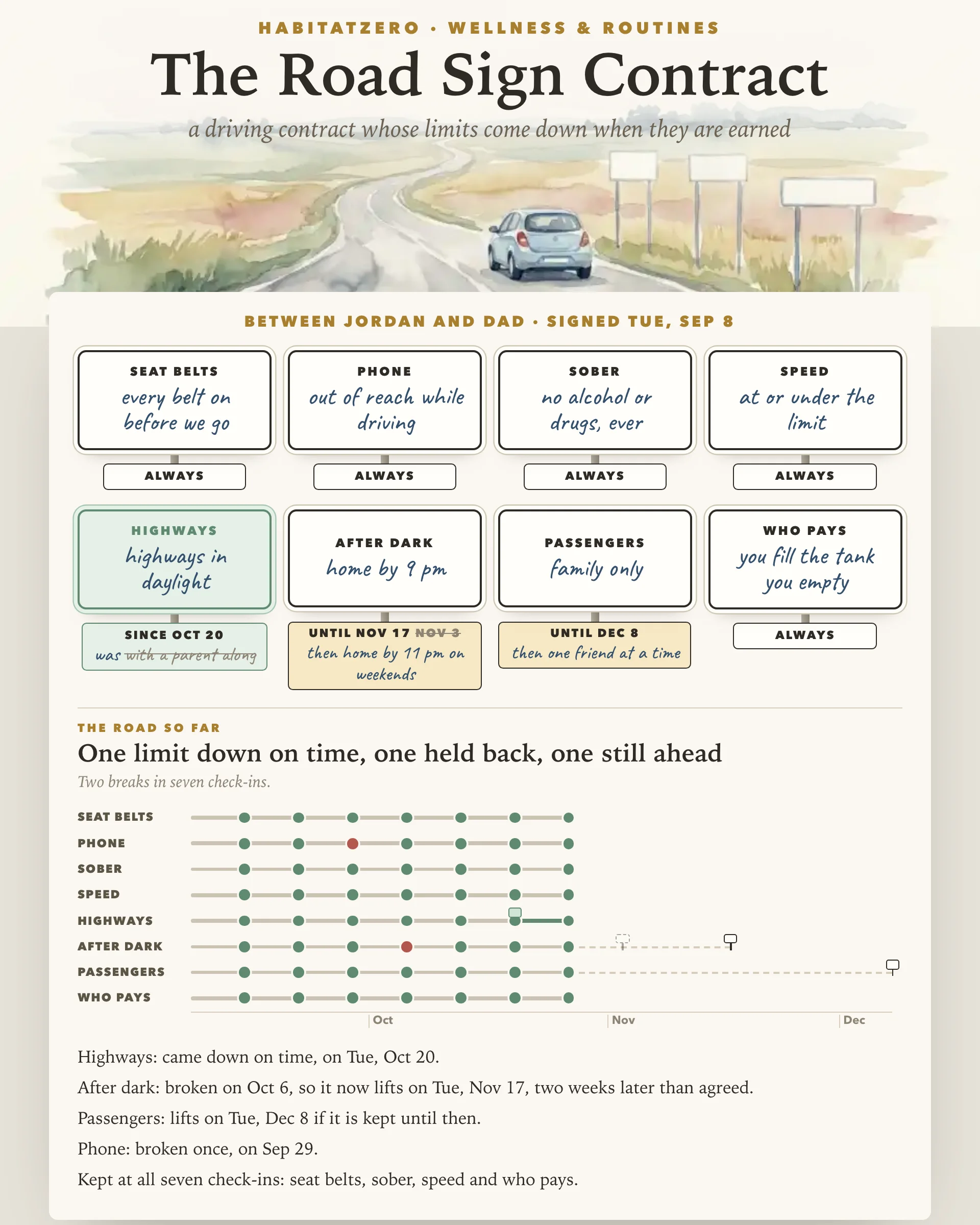
Writing your family's driving rules down is an idea you can credit to the CDC's Parents Are the Key program, whose Parent-Teen Driving Agreement asks parents and new drivers to spell out limits and the consequences for breaking them, then update the deal as the teen gains experience. This road sign contract is our own independent take on that idea. The CDC did not create it, has not reviewed it and does not endorse it.
A new license arrives at the riskiest point in a driver's life. The CDC's page on risk factors for teen drivers notes that crash risk is particularly high in the first months of licensure, and that drivers aged 16 to 19 have a fatal crash rate almost three times that of drivers 20 and older for every mile they drive. Each additional teen or young adult passenger raises the crash risk for an unsupervised teen driver, and night is harder still: in 2020, 44 percent of crash deaths among teens aged 13 to 19 happened between 9 pm and 6 am.
That is why a good driving contract for teens does two jobs. Some rules stay for good: seat belts, no phone at the wheel, no alcohol or drugs, the speed limit. Others are early limits, tight for the first stretch and loosened on a schedule once they have been kept. A contract that treats both kinds the same either smothers an experienced driver or lets a brand-new one off too easily.
Each rule is posted as a road sign. The first draft holds seven: seat belts, phone, sober, speed, passengers, after dark, and who pays for gas and damage. Tap a sign to change its rule, pick a consequence, and decide whether it stays for keeps or lifts on a date. A sign that lifts gets a yellow plaque underneath, like the ones below real road signs, showing its date and what it becomes: "family only" turns into "one friend at a time." You can post highways, bad weather or rested, or write a sign of your own, up to ten in all.
No one can sign until every sign carries a consequence and every early limit has a date. Then each of you signs under a first name. If only one of you has signed and anything changes, that signature comes off, and renaming a signer takes their signature off too. Once you have both signed, the terms lock; changing a sign means reopening the contract together, which takes both signatures off until you sign again.
Once a week, mark any sign that was broken since the last check-in. A kept limit comes down at the first check-in on or after its date, and its sign turns green. A broken one costs its consequence and pushes its date back by the agreed setback of one, two or four weeks.
Below the signs, the page draws the road so far: one lane per sign, a dot for every check-in, and a marker where each limit comes down. Then it reads the record back: which limits came down on time, which ones a break held back and by how much, which rules were broken and when, and which were kept at every check-in. That reading is the part a printed form cannot give you.
Graduated driver licensing, which phases in privileges such as night driving and passengers, exists in every state and Washington, D.C., but the CDC's guide to reducing risk for teen drivers notes that its strength varies by state. It also notes that parents can set extra restrictions when their state's law falls short of best practice. Check your state's rules first: your contract can be stricter than the law, never looser.
In a statewide trial with 3,743 new drivers in Connecticut, families who received persuasive messages and a parent-teen driving agreement set stricter limits on teen driving at licensure, three months and six months, yet the trial found no difference in reported risky driving, violations or crashes. An agreement is a way to set limits and hold them for the riskiest months. It is not a guarantee, and it does not replace practice drives together.
Set those dates a month or a few months out, and loosen one limit at a time so each change can settle. Keep consequences close to the rule they belong to: a passenger slip costs passenger privileges, a late night costs night driving. The CDC's version ends with the parent's own promise to drive safely and set an example; say yours out loud when you sign.
Use it in the week before the license arrives, or when the first months need clearer limits than you have now. If phone use is also a daily argument, The Lock Screen Contract handles the phone itself, and if gas money comes from chores, The House Time Card keeps that side of the deal in writing. For rules that reach beyond the car, try The Behavior Contract.
Start with the rules behind the worst crashes: a seat belt on every ride, no phone at the wheel, no alcohol or drugs, and the speed limit. Add early limits on teen passengers and night driving, say who pays for gas, tickets and damage, and agree on a consequence for each rule before anyone signs.
Give the tightest limits a few months, because crash risk peaks right after a new license, and loosen them one at a time as each one is kept. Seat belts, sober driving and phone rules never expire. Your state sets its own graduated licensing minimums, and those always come first.
In a statewide trial in Connecticut, families mailed safety messages and a written agreement kept stricter limits on early driving through the first six months, yet the study found no difference in reported risky driving, tickets or crashes. An agreement helps you set limits and keep them; it cannot promise safer driving by itself.
No. The CDC's Parents Are the Key program publishes its own printable two-page Parent-Teen Driving Agreement. This road sign contract is an independent page built on the same idea, a written deal you update as your teen earns privileges, and the CDC did not make, review or endorse it.
Seeing the filled-in example on this page takes no account. To post your own signs, sign together and keep the record of your weekly check-ins, open the contract in HabitatZero, where it is free.
By the team behind Fabulous, the science-based self-care app used by over 30 million people.


