The Overwhelm Recovery ProtocolWellness & Routines · ~5 min
About this template · Updated September 2026
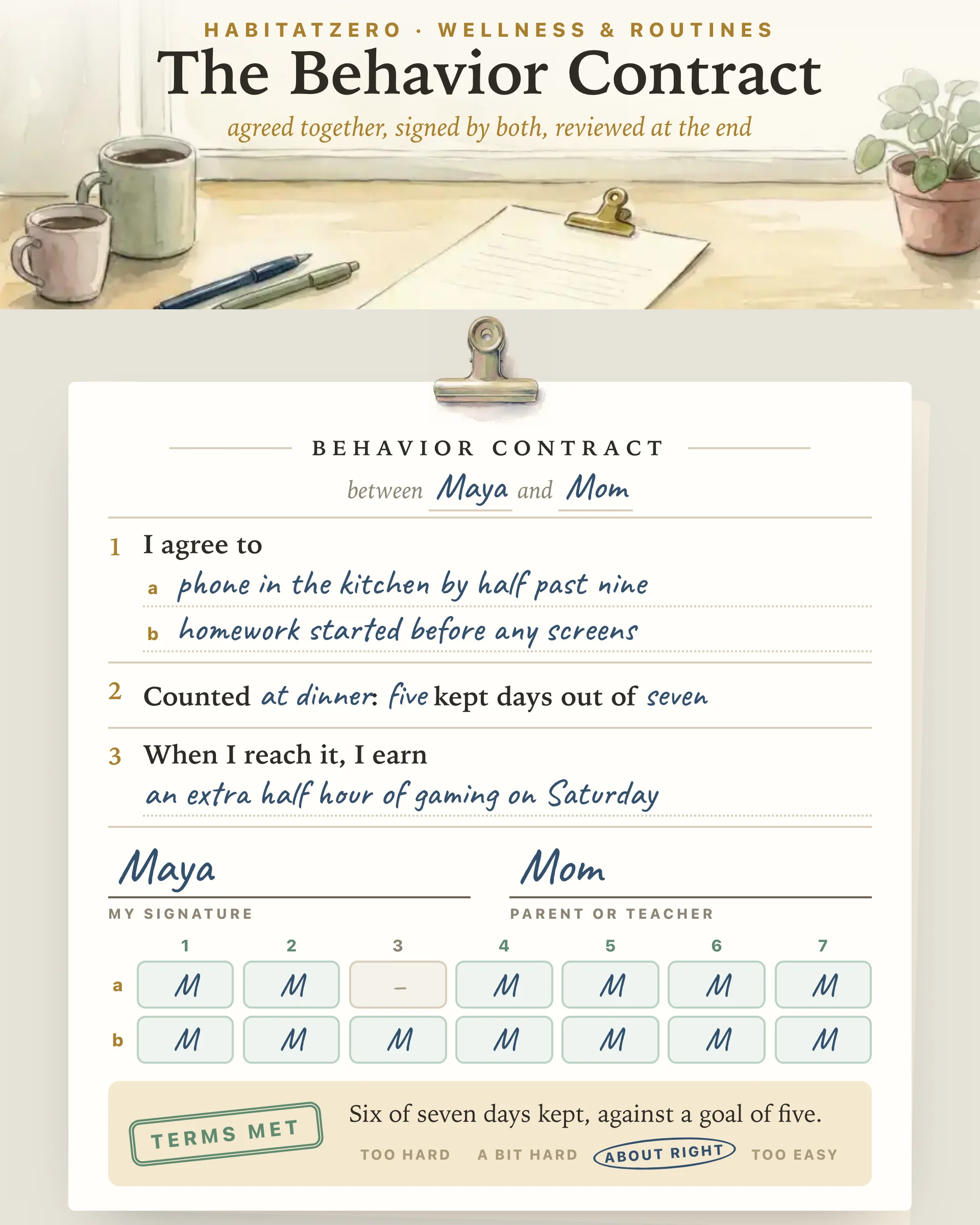
A behavior contract is a short written agreement between an adult and a child or teenager about one or two specific behaviors, signed by both of you. The signing is the real difference between a contract and a house rule: a rule is announced, a contract is agreed.
It suits older children and teens because it treats them as a party to the deal: they help word the behavior, choose the reward, and hold you to your side of it.
One or two behaviors you could both watch happen. "Be good" cannot be checked on a Tuesday night. "Phone in the kitchen by half past nine" can. Say what to do, not what to stop: "ask for a break when I start to get angry" gives a teenager something to aim at, where "no shouting" only names the failure.
How it is counted. Pick one moment each day, such as dinner or the end of the school day, and mark the day kept or not kept. Set the goal as a number of kept days with room for a rough one. Five out of seven is a fair first deal; seven out of seven means one bad Monday sinks the week.
What it earns, and when. Small and soon beats big and distant: an extra half hour of gaming on Saturday, choosing Friday's takeout. Let the young person pick it, since the reward they chose is the one they will work for.
What happens if the goal is missed. Keep this clause mild. The reward waits and you try again, or you make the next round easier together. Nothing already earned gets taken back.
What the adult agrees to. An agreement where only one person has obligations is a list of demands with a signature line. Put yourself on it too: notice it out loud when it goes well, remind once instead of five times.
Each clause opens with wordings you can tap in, plus a line for your own. Clause one turns down vague phrases and wordings that start with don't or stop, and says why. Under the goal, the sheet flags a deal with no room for a bad day.
When the clauses are filled, you both sign by typing your names, and the terms lock. Edit a clause after the first signature and the signatures come off, because a changed deal needs fresh agreement.
Once the contract is in force, the record sits at the top. Tap a box once for kept and twice for not kept; kept boxes carry the young person's initials, and the line above keeps the count in plain words. When the goal is met, the reward clause is stamped earned, and you can mark it handed over, so your side of the bargain is on the record too.
When every box is marked, the review says plainly whether the terms were met, circles a verdict from too hard to too easy, and points to the clause that lagged if one clearly did. Then it offers the next round one day easier, one day harder, or unchanged, and keeps earlier rounds listed underneath.
The research on contracts is real but small. A meta-analysis of single-case research on behavior contracts pooled eighteen studies with fifty-eight children and young people aged five to twenty-one. It found a moderate overall effect that held regardless of grade level, gender or disability status, with larger gains in reducing problem behavior than in building new behavior. Academic outcomes improved as well.
At home, a study of goal setting and contingency contracting for homework worked with four parent and child pairs; homework accuracy rose under the contracts, and two of the four children also stayed on task noticeably more. With older students, contracts whose goals were set by mutual agreement between a teacher and thirteen adolescents in a vocational program more than doubled their academic productivity.
Those are encouraging results from small groups, not promises. The National Center on Intensive Intervention's guide to behavior contracts supplies the practical rules this page builds in: write the agreement positively, keep it short and achievable, let the student choose the reward, start with frequent reinforcement and fade it, adjust the goal as you go, and never take points away once they are earned.
A contract is a teaching and motivation tool. It does not assess or diagnose anything, and if a school team or behavior specialist already has a plan for your child, theirs comes first.
Draft it on a calm evening, not in the aftermath of an argument, and start with one behavior and one week. Say it out loud on the kept days; praise is the part of a contract that is easiest to forget and cheapest to give. If the terms were too hard, shrink the step without turning the review into a verdict on the child.
Reach for a contract when an older child or teen has one sticking point you keep arguing about. For a younger child who needs to see progress within minutes, The Token Board fits better, and for a week of household jobs with a fixed list, use the Chore Chart.
It is a short written agreement between an adult and a child or teenager. It names one or two specific behaviors, how they will be counted, what meeting the goal earns, what happens if it is missed, and when the two of you will look at it again. Both people sign, which turns a rule handed down into a deal made together.
Terms the teenager helped write: a behavior they agree is fair, a reward they actually want, such as gaming time or a later curfew, and a goal with room for one bad day. Add a clause for the adult as well, so the agreement binds both people who put their names on it.
Contingency contract is the name behavior analysts use for the same tool. The reward is contingent on the behavior, and the written terms spell out exactly how it is earned. Behavior contract, behavioral contract and contingency contract all describe one basic idea.
The research is encouraging but small. A meta-analysis of eighteen single-case studies, covering fifty-eight students aged five to twenty-one, found a moderate overall effect on behavior and on academic outcomes. Treat a contract as something to run and review honestly, not as a guarantee.
Anyone can read the finished example on this page. Drafting your own clauses, collecting both signatures and keeping the daily record happen once you personalize the contract in HabitatZero, at no cost, and from there it prints as one clean page for the fridge or the classroom wall.
By the team behind Fabulous, the science-based self-care app used by over 30 million people.