
The Overwhelm Recovery ProtocolWellness & Routines · ~5 min
About this template · Updated November 2026
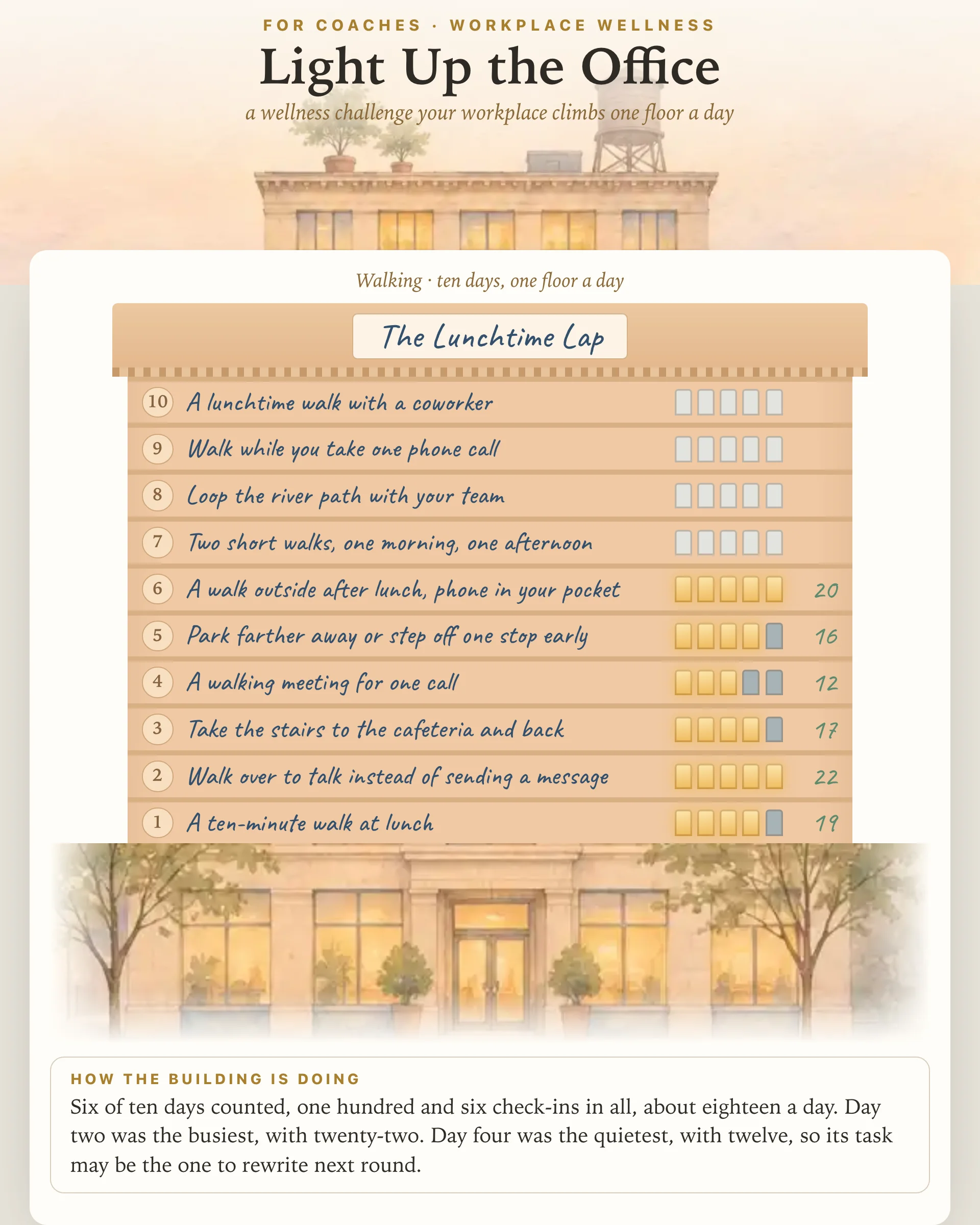
Many corporate wellness ideas ask too much of a workday that is already full. A two-week challenge with one small task a day asks very little, and that is the point. This planner gives you, the coach running it, a building to fill: one floor per day, one task per floor, and windows that light up as people join in.
You pick a theme first. Walking, movement breaks, hydration, sleep and stress each come with fourteen ready tasks, written to fit around meetings: a ten-minute walk at lunch, a stretch at the top of each hour, a glass of water before the first coffee, a set time to close the laptop. Choose your own theme and you start from a blank outline instead.
Then choose how tall the building is. Seven floors make a one-week sprint. Ten floors cover two work weeks and leave weekends alone, which suits most offices. Fourteen floors run through two full calendar weeks for teams that want a weekend task too. Shortening the building only hides the upper floors, and their tasks are still there when you make it taller again.
Tap any floor to write over its task in your own words, and it saves as you type. If you switch themes later, the page asks before it replaces the floors you have written, and it tells you plainly that any counts you entered go with the old tasks, since they no longer describe the same day.
The planner never asks who took part. After each day, you tap that floor and enter a single number: how many people did the task. The printed office poster collects it: every floor has an empty box beside it, and anyone who did the day's task adds a mark. No names, no sign-up sheet, and skipping a day needs no explanation.
As you enter counts, each floor's windows light up in proportion to your busiest day, so the building shows at a glance where energy rose and dipped. A short reading below adds it up in words and names the busiest and quietest days. The quietest is the useful one: its task is the first to rewrite before your next workplace wellness challenge.
Be honest with yourself, and with whoever is paying for the challenge, about what a program like this can do. The largest randomized trial of a workplace wellness program, run across 160 worksites of a US retail company, found that employees at the program sites were more likely to report exercising regularly after eighteen months, but saw no clear change in clinical measures such as blood pressure, in health care spending, or in absenteeism (Song and Baicker, 2019).
A second randomized study, at a large US employer, found something every coach should keep in mind. The people who chose to take part were already healthier and spent less on medical care than those who stayed out, and the program showed no significant effect on spending, productivity or self-reported health after more than two years (Jones, Molitor and Reif, 2019). An employee wellness challenge can easily end up rewarding the people who needed it least. That is a good reason to keep tasks small and welcoming, and to count the whole group rather than celebrate the keenest few.
On movement breaks in particular, a Cochrane review of workplace efforts to reduce sitting found one small trial in which one- to two-minute breaks every half hour cut sitting at work by about forty minutes a day compared with two long breaks. The reviewers rated that evidence low in quality, and they found no studies at all of walking meetings (Shrestha and colleagues, 2018). So treat this planner as a way to make healthy habits visible and shared for a couple of weeks, not as a cure for anything.
A few rules make a corporate wellness challenge feel like an invitation rather than a duty. Never tie prizes, rankings or contests to weight, steps per person or any body measure. Never ask anyone to report health details. Say clearly, out loud and on the poster, that joining is optional and that any task can be swapped for one that suits a person's body and day. If a task does not work for a coworker who uses a wheelchair or is recovering from an injury, rewrite the task rather than leave that person out.
Fill the planner in a week or two before day one, while there is still time to adjust the wording with a manager or a few early volunteers. Print the poster for a break room, a kitchen or a hallway people pass on the way to meetings. Then open the planner each evening and enter the day's count. Each round, the darkest floor shows where your list of wellness challenge ideas needs work.
If you also coach fitness classes or clubs, The 14-Day Group Challenge plans the same kind of daily program for a group that trains together. For people who want a goal of their own alongside the office round, the Walking Challenge and the Hydration Calculator give each person something to follow at home.
The ones that fit around meetings tend to last: a ten-minute walk at lunch, a stretch at the top of each hour, a refilled water bottle on every desk, a set time to close the laptop. Choose one theme, give each day a single task, and keep every task short enough that nobody has to change clothes for it.
Pick a theme and a length, then share the day list about a week before day one. Hang the printed poster where people pass, invite anyone who did a task to add a mark beside it, and enter the number of marks each evening. Talk about what the whole group managed, never about any one person.
Seven to fourteen days suits a first round. Ten days covers two work weeks and leaves weekends free, which fits most offices, while fourteen days runs through two full calendar weeks for teams that want a weekend task as well.
This planner does neither. Contests built on weight, steps per person or other body measures can embarrass people and push them to share health details they would rather keep private. A daily count of how many joined in, with no names attached, shows whether a task landed without putting anyone on the spot.
Yes. You can pick a theme, rewrite the floors, print the poster and count check-ins right here in your browser. Tap Personalize to keep the planner in a free account and pick up where you left off.
By the team behind Fabulous, the science-based self-care app used by over 30 million people.


