The Overwhelm Recovery ProtocolWellness & Routines · ~5 min
About this template · Updated September 2026
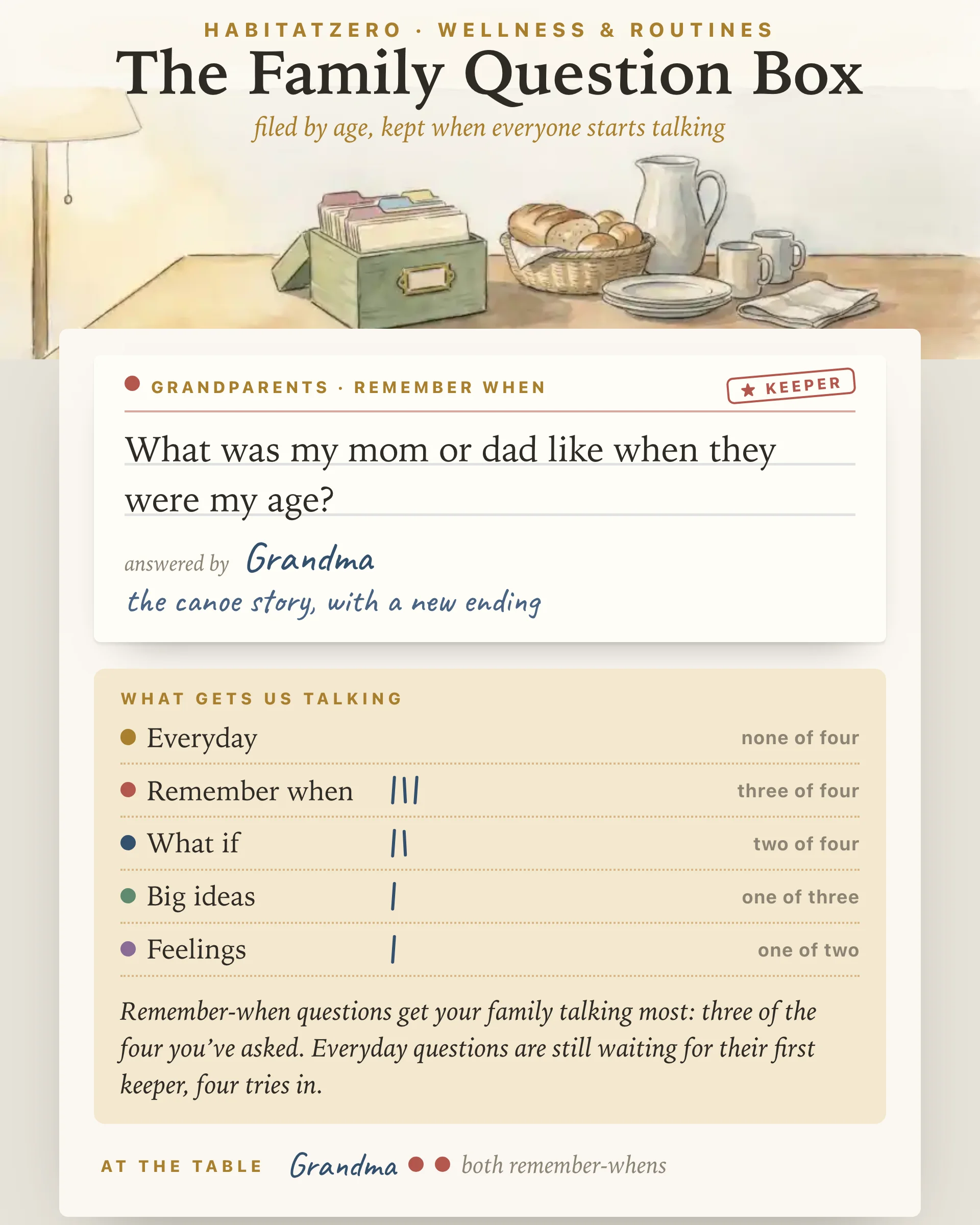
"How was school?" "Fine." You could set a clock by that exchange. The trouble isn't your child; it's the question, which is both too big and too familiar to answer. A narrower one gives a kid somewhere to begin. Which part of today would you do over, just for fun? What was the loudest sound you heard? Now there is a story.
This page is a recipe box of a hundred conversation starters for family dinner, all of that narrower kind, and they work just as well in the car. It is meant for the moment when everyone is finally sitting down, nobody is talking, and you would rather not reach for the same three questions again.
The family dinner questions sit behind four tabs. Little kids is for roughly three to six: short, concrete questions about toys, dreams and where the moon goes in the daytime. Big kids covers about seven to twelve, with recess, fairness and secret rooms. Teens asks for opinions and plans without prying into anything. Grandparents is for the kids to ask the oldest people at the table, because a grandparent's first job or childhood home rarely comes up on its own.
Behind every tab, the cards come in five kinds:
Tap a tab and a card comes out. Cards come one at a time and don't repeat until you have been through that whole section. Read it aloud. If it gets a groan, skip it: a skipped card goes back in the box and isn't counted. If it turns into a real conversation, tap it got us talking, mark who answered, and add a few words about where it went if you feel like it.
Every card you ask is counted, and every keeper adds a pen stroke to a tally beside its kind. From the third keeper on, the box says which kinds get your family talking, measured against how many of each you have asked. Remember-when questions might land three times out of four while everyday ones are still waiting for their first keeper. Each person at the table gets a line of their own as well, so you may notice that your nine-year-old opens up on what-ifs and Grandma on remember-whens. That pattern is the useful part, because it tells you what to ask next week.
Family meals have a good reputation, and some of it is earned. Teenagers who eat with their parents more often score better on a range of well-being measures. But families who eat together differ from other families in plenty of ways, and a large study of American teens found that the link depended on the relationship: shared dinners went with fewer depressive symptoms and less delinquency where parents and teens were already close, and showed little benefit where the relationship was weak. That is an association, not proof that dinner causes anything. The fair reading is that the meal is an occasion, and the talking is what can make it count.
Remember-when questions have their own line of research behind them. Studies of how mothers and young children talk about the past link detailed, elaborative reminiscing with children's memory, language, and understanding of themselves and other people. And in work on family stories, children and teens who knew more of their family's history tended to show higher self-esteem and better family functioning. That too describes what goes together rather than what causes what, but it is one reason the Grandparents tab exists.
If you want recipes and ideas next to the conversation, The Family Dinner Project, a nonprofit initiative that has been at this since 2010, keeps conversation ideas sorted by age. This page is independent of that project and has no connection to it, and every question in the box was written fresh for this page.
Bring it out on a school night when every answer so far has been one word, on a long drive, or at a bigger meal when the grandparents visit. If you would like the same three prompts for everyone each evening, Rose, Bud, Thorn is built for a turn around the table. If phones keep drifting onto the table, The Screen Time Chart is a calmer place to agree on the house rules. And if dinner keeps turning into a debate about who does the dishes, The Family Responsibility Chart can take that job off the menu.
Narrow, open questions that cannot be answered with one word work best: which part of today you would do over, where the moon goes in the daytime, or what grown-ups do at work all day. Questions that ask for a story or an opinion usually go further than questions about the schedule.
Ask one question, then answer it yourself in a sentence or two so it feels like a conversation rather than an interview. Let the youngest go first, follow up once on whatever they say, and stop after a card or two while everyone is still enjoying it.
Ordinary life back then is the richest seam: the home they grew up in, their first job and what it paid, the games they played outside, and what your mom or dad was like at your age. The Grandparents tab holds twenty-five questions written for the kids to ask.
Teens who share meals with their parents tend to score better on measures of well-being, but that research is correlational. One large study found the link mostly in families where parents and teens already got along, so treat dinner as a good place to connect, not a guarantee.
The sample box on this page can be browsed without signing in. Pulling cards for your own family, marking keepers and watching your tally grow happen in HabitatZero, which is free to use.
By the team behind Fabulous, the science-based self-care app used by over 30 million people.