
The Overwhelm Recovery ProtocolWellness & Routines · ~5 min
About this template · Updated September 2026
The four-part test at the center of this chart belongs to Jane Nelsen, the author of Positive Discipline: a logical consequence should be related, respectful, reasonable and helpful, and her article on logical consequences explains how losing any one of the four slides it back into punishment. This chart is an independent HabitatZero worksheet built on that test. Nelsen and Positive Discipline did not make, review or endorse it.
Most consequences get invented at the worst moment: your child has just hit a sibling or refused the tablet for the third time, your pulse is up, and what comes out is too big, barely connected to what happened, and loud. By tomorrow it has quietly lapsed, because it was never fair enough to keep, and your child learns that the rule depends on your mood.
A consequence chart moves that decision to a calm hour. You settle, ahead of time, what follows each of a few repeated behaviors and what you would like to see in their place. When the moment arrives, the deciding is already done, and you follow through the way you agreed.
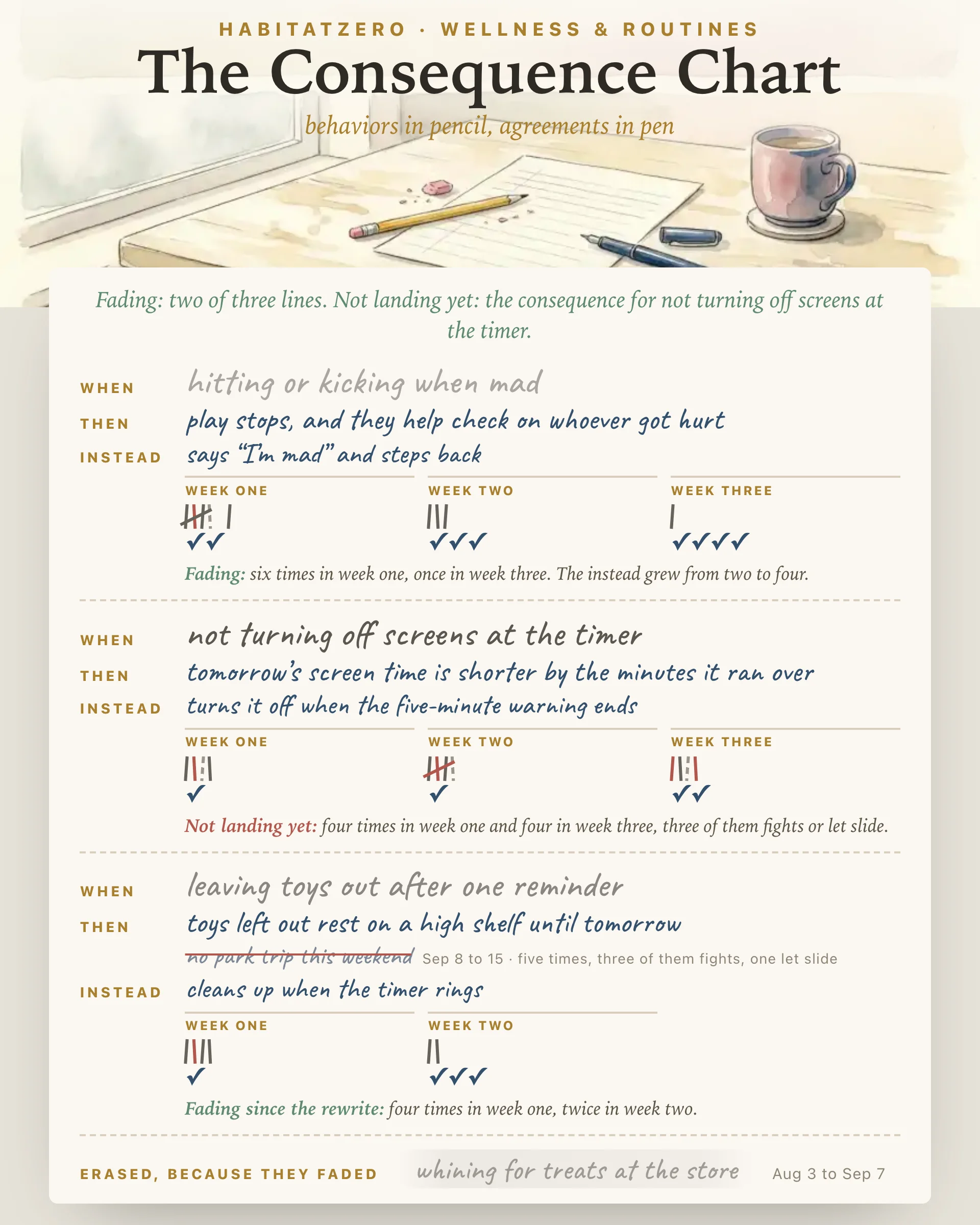
Behaviors go in pencil, because they are meant to fade and they are not who your child is. What you agree goes in pen. Before a consequence can be inked, you check it against all four of Nelsen's criteria: it grows out of what happened, it carries no shaming and nothing that hurts, it looks fair from your child's side as well as yours, and it teaches something. If one of the four will not check honestly, change the consequence. The page also turns away spanking, slapping and taking away meals.
Add the behavior you want instead and what you will do when it shows up, then ink the line. The chart holds three lines. Answering the same way every time is the whole trick, and nobody manages that for eight behaviors at once.
Then you mark. Each time the behavior happens, tap how the follow-through went: calm, as agreed; turned into a fight; or let slide. Each time the instead appears, it gets a check in pen.
After two full weeks, the chart compares week one with the latest full week. A line whose tallies have dropped by half or more reads as fading, and its pencil visibly lightens. A line that holds steady reads as not landing yet, with the likeliest reason: mostly fights or let-slides point to a consequence too big to carry out calmly, while calm follow-through points to one that isn't related enough, or an instead that needs more noticing.
You can rewrite a consequence that isn't landing. The old words stay on the chart, crossed out, with a count of the marks made under them, and the new words start again at week one, so no mark ever counts toward words it wasn't logged under. When a behavior goes quiet, the eraser takes it off the chart and onto a short list of what faded.
The American Academy of Pediatrics' guidance for parents on discipline lists consequences among its healthy strategies: explain them calmly and firmly, be ready to follow through right away, don't hand the toy back after a few minutes, and never take away something a child truly needs, such as a meal. The same page asks parents to catch children being good and to name exactly what they did well, which is the job of the instead line.
The AAP's policy statement on effective discipline is blunt about the alternatives. Spanking and other physical punishment, along with yelling at or shaming children, accomplish little in the moment and nothing over time, and physical punishment is linked to worse behavioral and emotional outcomes.
A meta-analysis of 77 parent-training evaluations for children up to age seven found larger effects in programs that taught parents to be consistent and to use time-out, and in programs that built more positive interaction between parent and child.
What the evidence does not say: no study has tested this chart, and Nelsen's four criteria are a practitioner's guideline rather than a trial result. The chart keeps your side of the agreement steady; the warmth around it still does most of the work.
Some consequences arrange themselves. Clothes that never reach the hamper don't get washed, and a child who refuses a coat feels the cold. Letting that happen, without rescuing or an I-told-you-so, can teach more than anything you add. Skip it whenever the result would be dangerous, would hurt someone else, or would harm your child's health, as skipped toothbrushing does.
If a behavior is dangerous, such as hurting people or darting toward traffic, or nothing on the chart eases after several steady weeks, bring the chart to your child's pediatrician. The AAP counts pediatricians among the people parents can ask about managing behavior, and a few weeks of dated marks make that conversation concrete.
If you can't yet tell what sets a behavior off, log a handful of episodes on The ABC Behavior Chart before choosing a consequence. The Weekly Behavior Chart gives the instead a daily place of its own, and a Calm Corner gives a short break somewhere comfortable to happen.
A consequence chart pairs each of a few repeated behaviors with the response your family settled on beforehand, plus the behavior you would like to see instead. Because the decision was made while everyone was calm, you can answer the same way each time instead of improvising a punishment mid-meltdown.
A natural consequence arrives by itself: a bike left out overnight gets rained on. A logical consequence is one a grown-up arranges that grows out of the behavior, such as toys left on the floor spending the night on a high shelf. Natural consequences only make sense when the result is safe.
Minutes of screen time that run over come off the next day. A thrown toy is put away for the rest of the day. Time spent stalling at bedtime comes out of story time. Juice spilled on purpose gets wiped up by the one who spilled it. Each follows from what happened and is small enough to carry out calmly.
No. The four-part test of related, respectful, reasonable and helpful is Jane Nelsen's, from Positive Discipline, and this page credits her for it. The chart is an independent HabitatZero worksheet, and neither Nelsen nor Positive Discipline made, reviewed or endorsed it.
You can study the filled example here without an account. Writing your own lines, marking each follow-through and getting the two-week reading happen in HabitatZero, which costs nothing.
By the team behind Fabulous, the science-based self-care app used by over 30 million people.


