The Overwhelm Recovery ProtocolWellness & Routines · ~5 min
About this template · Updated September 2026
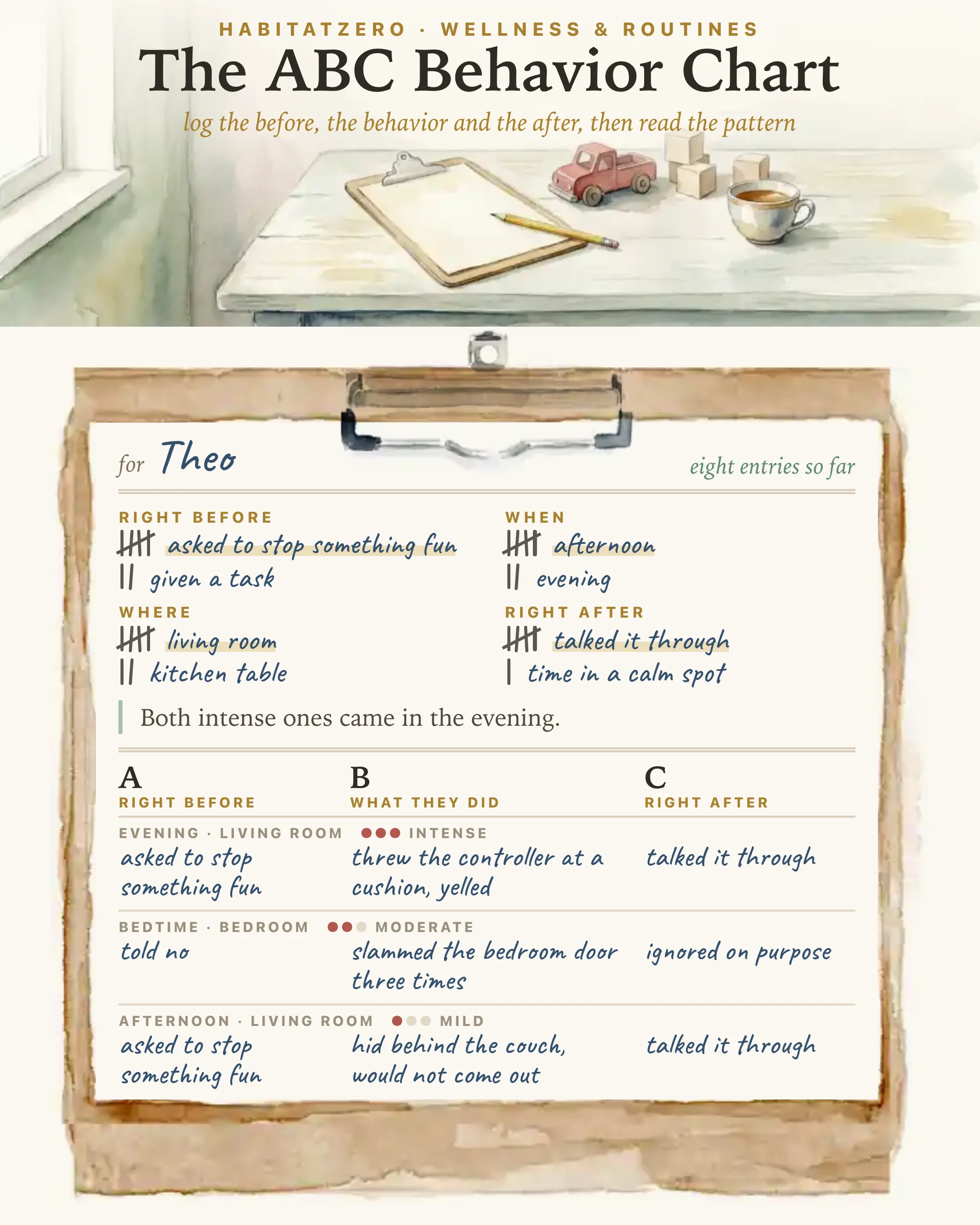
When the same kind of blowup keeps happening, memory makes a poor witness. By the third one in a week, you remember the volume and the mess, not the order things happened in. An ABC behavior chart gives you the order back. A is the antecedent, what happened just before. B is the behavior, what your child actually did. C is the consequence, what happened right after. Log enough of them and the hard moments start to look less random.
The antecedent is the moment just before things turned: a request, a no, the tablet going off, a change of plan, a long wait, a noisy room. Sometimes there is nothing you can point to, and that is worth recording as well.
The behavior is whatever a camera would have caught. "Threw the controller at a cushion and yelled" is useful. "Had a meltdown" or "was being defiant" is a label, and labels hide exactly the detail a specialist will want.
The consequence is simply what came next, from anyone in the room. You talked it through, a sibling laughed, the homework got put off, the plan went ahead anyway. It is not a verdict on your parenting or your teaching. Write down the responses you are less proud of too.
The page is a painted clipboard, and each entry takes about a minute. Tap up to two things that came right before, or write your own. Write one short line for what they did, and mark whether it was mild, moderate or intense. Tap up to two things that came right after, then add the part of the day and the place. Anything you write yourself comes back as a chip next time, and your recent behavior lines are offered again, so a repeat entry is mostly taps. The sheet holds twenty entries at a time.
From the third entry, the clipboard starts tallying in pencil marks: which lead-ups come up most, which times of day and which places cluster, and what most often follows. It then says so in a sentence or two, for example that both of the intense entries came in the evening. It never offers a reason, and that restraint is deliberate.
Writing down a behavior together with the events around it is one of the oldest habits in behavior analysis. A 1968 paper by Sidney Bijou and colleagues argued for recording behavior and its surroundings in observable terms, and it drew the same line this page keeps: a descriptive record shows what goes together, while an experiment is what shows why.
Timing is part of the picture. A 1985 study of scatter plots showed that charting when problem behavior happens, rather than averaging it over weeks, can reveal patterns that point to the parts of the environment setting it off. That is why the chart asks when and where.
The limit matters just as much. In a comparison of descriptive and functional analyses, researchers took twelve people whose behavior had already been recorded in everyday settings and then tested what was actually maintaining it. The consequence that most often followed the behavior turned out to be the maintaining one in only three of the twelve. Attention was the most frequent consequence in eight of those records, yet it was keeping the behavior going in just two. Adults respond to outbursts, so attention turns up in records like this again and again, whether or not it is what sustains the behavior. So when your tallies say that talking it through usually follows, read that as a fact about your household or classroom, not as the reason your child does it.
Bring the chart to whoever you are working with: your child's teacher, the school psychologist, your pediatrician or a board-certified behavior analyst. Schools often call the formal version a functional behavioral assessment, and direct observation of this kind is a standard part of it. Two weeks of honest rows turn that first meeting from a general worry into something specific you can look at together.
If a behavior is putting your child or anyone else in danger, do not wait for a pattern to form. Call your pediatrician or the school now.
Log soon, ideally within the hour, before the story settles into a shape. Log the small incidents as well as the big ones, or the chart will only ever describe your worst days. If two adults share the chart, agree first on what counts as the behavior, so that "hitting" means the same thing in both sets of entries.
Start when a behavior keeps coming back and you cannot see why, and keep going for a week or two. If the tallies point to transitions, a First-Then Board shows the next step before the change arrives. If a particular stretch of the day keeps turning up, a Token Board can reward the easier moments you want more of, and a Feelings Thermometer gives your child a way to show how big a feeling is before it becomes a behavior.
It is a running record in three parts: the antecedent, meaning what happened just before a behavior, the behavior itself, and the consequence, meaning what happened right after it. Filled in after each incident, the rows begin to show which situations tend to set a behavior off and what usually follows.
Give every incident its own row, written soon afterwards. Under A, put the request, refusal or change that came just before. Under B, describe only the actions you saw or heard, like pushed the plate away and cried for two minutes. Under C, write what you and anyone nearby did next, then add the time and the place, since patterns often hide there.
Anything that happened straight after the behavior, not only discipline. A hug, a warning, homework being put off, other children laughing or the plan simply carrying on all belong in the C column. Write it down plainly and without blame, because the aim is to see what follows the behavior, not to grade how anyone responded.
Not by itself. It shows what tends to happen together, and research comparing records like this with direct testing has found that the two often point to different reasons. Treat the pattern as something to bring to a teacher, school psychologist or behavior analyst, who can work out the why with you.
Anyone can look through the filled-in sample on this page. Personalizing it in HabitatZero, which costs nothing, gives you your own clipboard that keeps every entry, and printing it puts all of your rows on paper along with a few empty ones to carry on by hand.
By the team behind Fabulous, the science-based self-care app used by over 30 million people.