
The Overwhelm Recovery ProtocolWellness & Routines · ~5 min
About this template · Updated November 2026
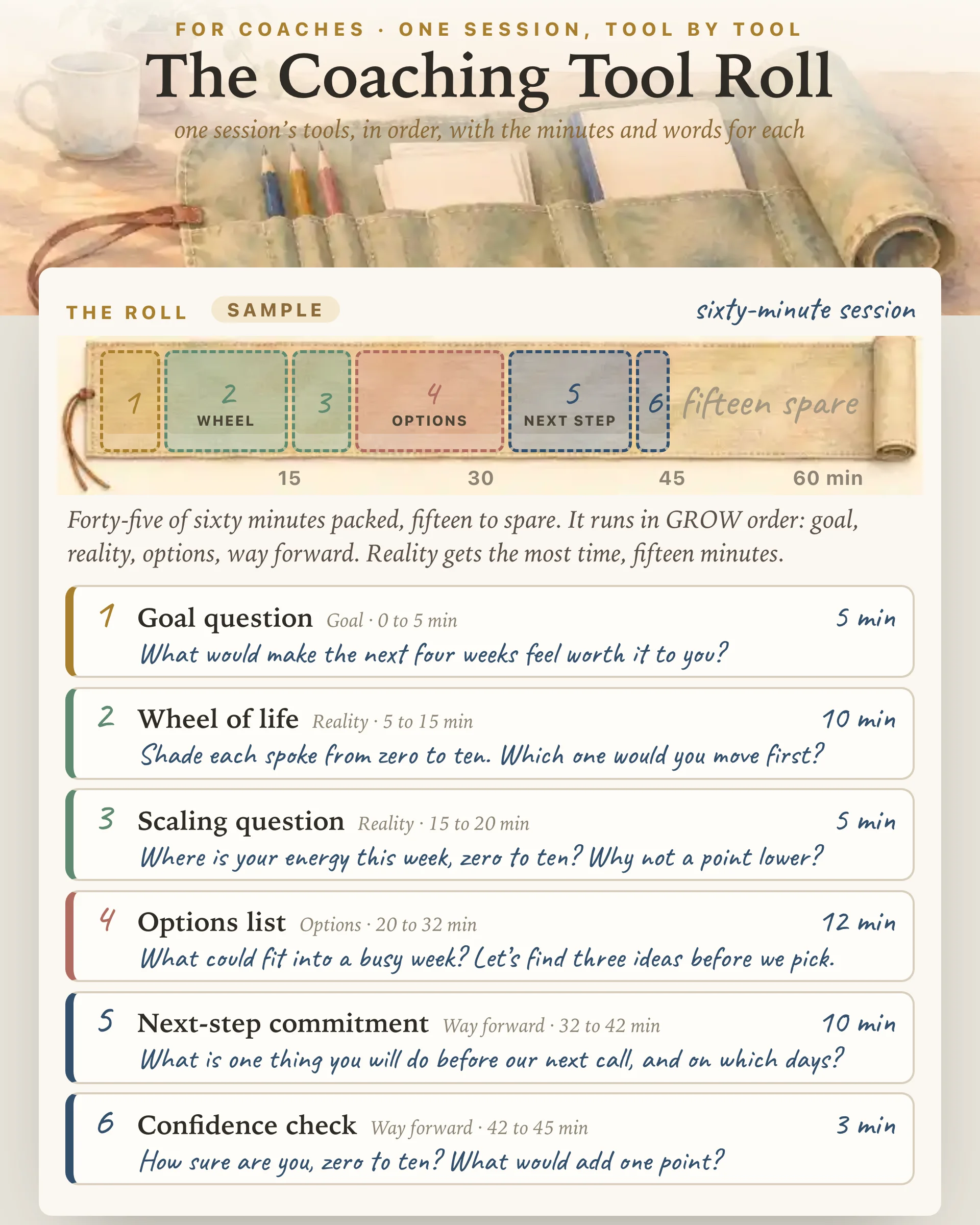
You may know the moment: minute fifty, ten minutes left, nothing settled, and a useful conversation with nowhere to land. The fix is rarely a new technique. It is deciding, before the client sits down, which few coaching tools this hour will use, in what order, and how long each one gets.
This page is built for that decision. Picture a canvas tool roll laid open on the table: one pocket per tool, left to right in the order you will reach for them, each pocket as wide as the minutes you give it. Whatever canvas is left at the end is your spare time. If the pockets run past the end of the session, the roll shows that too.
Every tool in the drawer is a classic, and most have a known origin worth naming.
The drawer is sorted by GROW: goal, reality, options and will, which many coaches call the way forward. Sir John Whitmore and colleagues developed it in the late 1980s and early 1990s, and its value is mostly in the order. Agree what the session is for, look honestly at where things stand, widen the options, then narrow to one step.
Three of the questions come from solution-focused brief therapy, which Steve de Shazer, Insoo Kim Berg and their team at the Brief Family Therapy Center set out in a 1986 paper in Family Process. The scaling question asks for a number from zero to ten, and its real work is the follow-up: what makes it that number and not one lower? The exception question hunts for the times the problem was a little smaller. The miracle question asks someone to describe the morning after the problem has gone; the Miracle Question page walks through it in full.
The SMART goal traces back to George T. Doran's 1981 article in Management Review. Doran's letters stood for specific, measurable, assignable, realistic and time-related; the version most coaches use today swaps in achievable and relevant. The values card sort was published by W. R. Miller, J. C'de Baca, D. B. Matthews and P. L. Wilbourne at the University of New Mexico in 2001, and you can run the whole deck on the Values Card Sort page. The wheel of life asks for a rating of each area of life on spokes from zero to ten; the Wheel of Life page lets a client shade one in.
The if-then plan is Peter Gollwitzer's implementation intention: name the moment that is likely to derail the step and decide the response in advance. Gollwitzer's 1999 paper in American Psychologist describes a program of studies in which plans of that shape helped people act on goals they already held. The next-step commitment, the options list, the best-friend question and the confidence check have no single author. They are the plain working parts of nearly every coaching conversation.
Pick how long the session runs, then fill the roll. A classic set does it in one tap: GROW from start to finish, a first session, or a stuck week. Or tap tools from the drawer one at a time. Each pocket starts with a standard question, which you should rewrite in the words you would actually say.
Step the minutes up or down and move pockets earlier or later. Seven pockets is the limit, which keeps an hour from turning into a string of handovers between tools. If your own favorite is missing, add a tool of your own, name it and tell the roll which GROW stage it serves.
The line under the roll is where the page earns its keep. It counts the minutes packed against the session's length and tells you what is spare or over. It names the order your stages run in, and it notices when nothing settles a next step, or when the session ends somewhere after it. Those are observations, not rules. Plenty of good sessions break the GROW order on purpose.
The roll holds your plan and your own wording, never a client's name, answers or scores. Print it and keep it beside you; whatever the client says goes on paper or in your own records.
A meta-analysis by Theeboom, Beersma and van Vianen pooled studies of coaching in organizations and found positive effects on performance, well-being, coping, work attitudes and goal-directed self-regulation. That is encouraging, but it measures coaching as a whole, mostly in workplaces. It does not show that any one tool, sequence or timing works better than another, and it says nothing specific about fitness or health coaching.
So treat the roll as a planning habit rather than a method with proof behind it. What it does give you is a session you thought through in advance, with minutes kept back for the step at the end.
Pack a roll the evening before a session, or once for a kind of session you run often, such as a first meeting, a monthly review or a week when a client feels stuck. Afterward, glance at which pockets ran long; that is worth knowing before the next one.
They are short, repeatable structures a coach brings into a conversation: a question with a known shape, a rating from zero to ten, a card sort, a wheel to shade in. Each one gives the talk a job for a few minutes. On this sheet you choose which ones a session needs and in what order.
GROW stands for goal, reality, options and will, often called the way forward. Sir John Whitmore and colleagues shaped it in the late 1980s and early 1990s, and it gives a session a simple arc from what someone wants, through where things stand and what could be done, to a step they choose.
A wide view and a clear aim tend to come first, so the first-session set opens with the wheel of life and a values card sort, shapes one SMART goal and closes on a next step and a confidence check. Swap any of them for a tool you already trust.
No, and that is deliberate. The roll stores your plan: the tools, their order, the minutes and your own wording. Whatever a client says or scores belongs on paper or in your own records, never on this sheet.
Yes. You can pack a roll on this page and print it without signing up. Personalize saves your session plan to a free Salon account, made by the team behind Fabulous, so you can come back to it.
By the team behind Fabulous, the science-based self-care app used by over 30 million people.


