
The Overwhelm Recovery ProtocolWellness & Routines · ~5 min
About this template · Updated November 2026
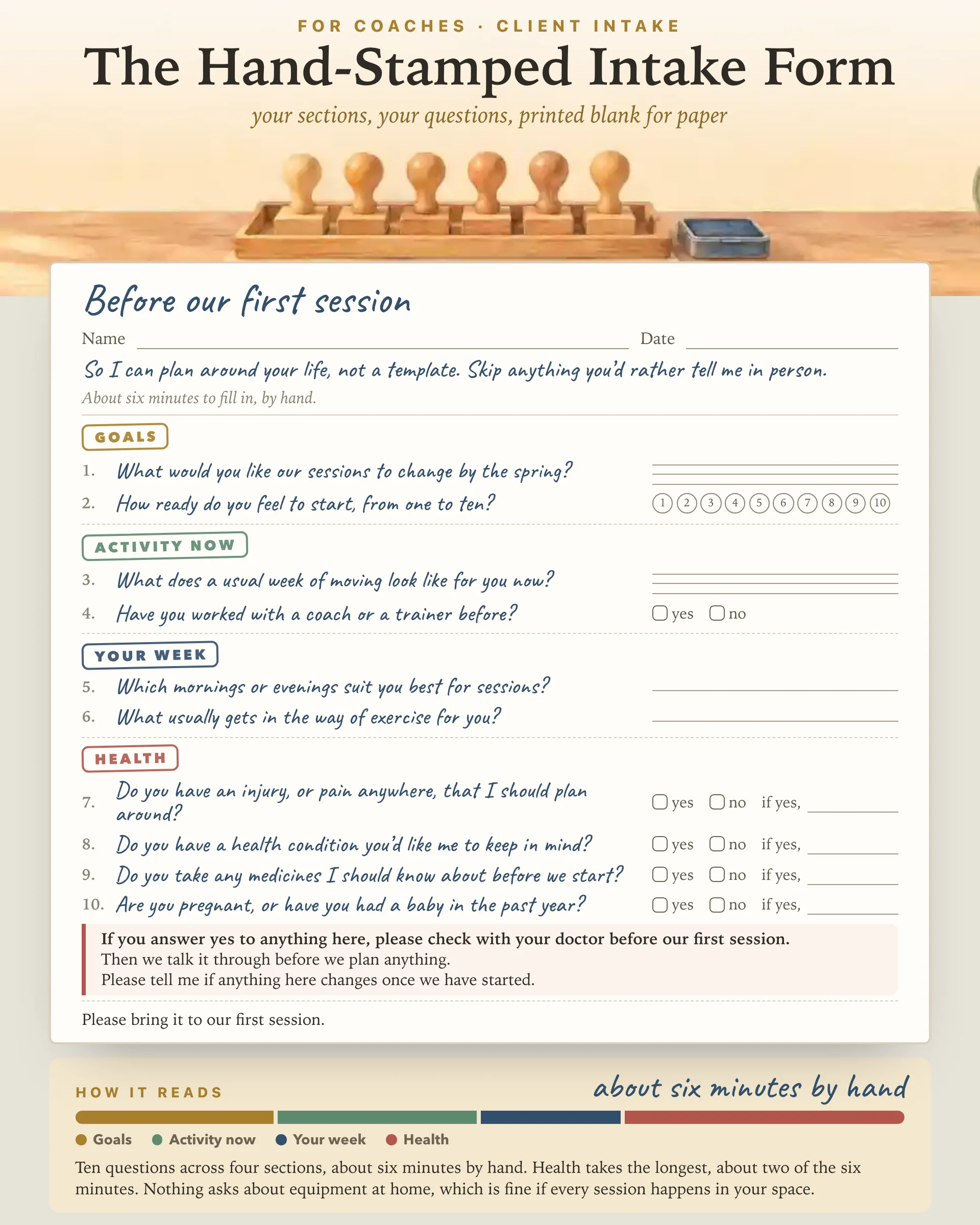
A client intake form is the page a new client fills in before you plan anything for them. Done well, it spares your first session a long round of questions. This template builds yours the way you might at a desk: a tray of six section stamps, a slip of questions under each one, and a blank sheet where you stamp on the sections you need, pick or write the questions, and give each answer the space it deserves. It holds your questions and your wording, never anything a client writes. The form prints blank and is filled in by hand, on paper.
Each stamp is one section, and each comes with questions you can reword:
Health is on the sheet from the start and cannot be lifted off; you can trim it, but it keeps at least one question. The rest is your call: a trainer who sees people only in a studio can leave Equipment out.
Under Health, each question is a yes or no with a line for detail, and one sentence you cannot remove prints beneath them: if you answer yes to anything here, please check with your doctor before our first session. You choose what follows, such as talking it through before you plan or waiting for the doctor's go-ahead.
An intake form is not a medical screen, and this one does not pretend to be. For screening, use guidance written for it. The American College of Sports Medicine updated its pre-participation screening recommendations in 2015, basing the decision on three things: how active the person is now, whether they have known heart, metabolic or kidney disease or signs and symptoms of it, and how hard they intend to exercise. The same update dropped the counting of risk factors from the screening step, partly because the older approach sent too many people to their doctor and could become a barrier to starting at all. Many coaches also hand new clients the PAR-Q+, a screening questionnaire from the PAR-Q+ Collaboration. Use its official version unchanged, and add the line on your form saying you may ask for it.
Pregnancy deserves its own question. The American College of Obstetricians and Gynecologists says that, without obstetric or medical complications, physical activity in pregnancy is safe and desirable, and that people who were already active can usually keep going with some changes. That is a conversation for the client and whoever provides their pregnancy care, so a yes routes there first. Your certification's guidance and local rules outrank this page.
The sheet adds up how long a new client needs by hand. It allows half a minute to read the top, ten seconds for a check box or a scale, half a minute for a line or a yes followed by a line, and a minute and a quarter for a few lines. These are rough working figures, not measurements, but they show which sections eat the minutes.
Length matters. In an experiment with an online questionnaire, Mirta Galešić and Michael Bošnjak told people it would take ten, twenty or thirty minutes; the longer the stated time, the fewer started and finished, and questions placed later drew faster, shorter and more uniform answers. That was a web survey, not a paper form from a coach, so treat it as a caution rather than a rule. The form holds sixteen questions at most, and its reading flags a sheet that runs past ten minutes.
No field on this page takes a client's name, contact details or answers; the only name line is the blank one on the printed sheet. You keep the questions here and your clients write on paper, which keeps their health details out of a browser. Your part is to store the filled-in sheets somewhere private and to ask only what you will use.
The same stamps make a coaching intake form for a wellness coach, who might lean on Goals and Preferences, or a personal training intake form that spends longer on Health and Equipment. Move a section earlier if you want the conversation to start there.
Build it before your next new client books a first session, and print a fresh copy whenever you reword a question. If you are still setting up how you take on clients, Your Coaching Business Plan counts an intake form among its launch steps. Once the Goals answers come back, The SMART Exercise Target turns a hope into something you can both check, and The Readiness Ruler is a good follow-up when someone circles a low number for readiness.
The few things you need before planning a first session: what the person hopes to change, how active they are now, when they can train, what they have to train with, anything about their health you should plan around, and how they like to be coached. Leave out anything you would never act on.
Plain yes or no questions about injuries or pain, health conditions, medicines, pregnancy or a recent birth, a recent operation, and symptoms such as chest pain or faintness during activity. On this form, any yes asks the client to check with their doctor before the first session. Pair it with a published screening tool such as the PAR-Q+, since an intake form is not a medical screen.
No. The PAR-Q+ is a pre-participation screening questionnaire published by the PAR-Q+ Collaboration, and it should be used in its official, unchanged version. This page builds your own intake questions around it and can add a line on the form telling clients you may hand them the PAR-Q+ as well.
Mostly in which sections carry the weight. A health or wellness coach may lean on goals, the week and preferences, while a trainer adds equipment and spends longer on health. The same stamps cover both, so you keep the sections your work needs and lift the rest off.
No. It saves your questions and wording, never a response: the form prints blank and each client fills it in by hand. Personalize copies your questions into a free Salon account from the team that makes Fabulous, so you can keep editing them there.
By the team behind Fabulous, the science-based self-care app used by over 30 million people.


