The Overwhelm Recovery ProtocolWellness & Routines · ~5 min
About this template · Updated September 2026
Most chore fights in a shared home are not about the dishes. They are about memory: who cleaned the bathroom last time, whether taking the trash out twice earns anything, why the floors always end up with the same person. A chore list settles what needs doing. A chore wheel settles whose turn it is, and it does so without anyone keeping score in their head.
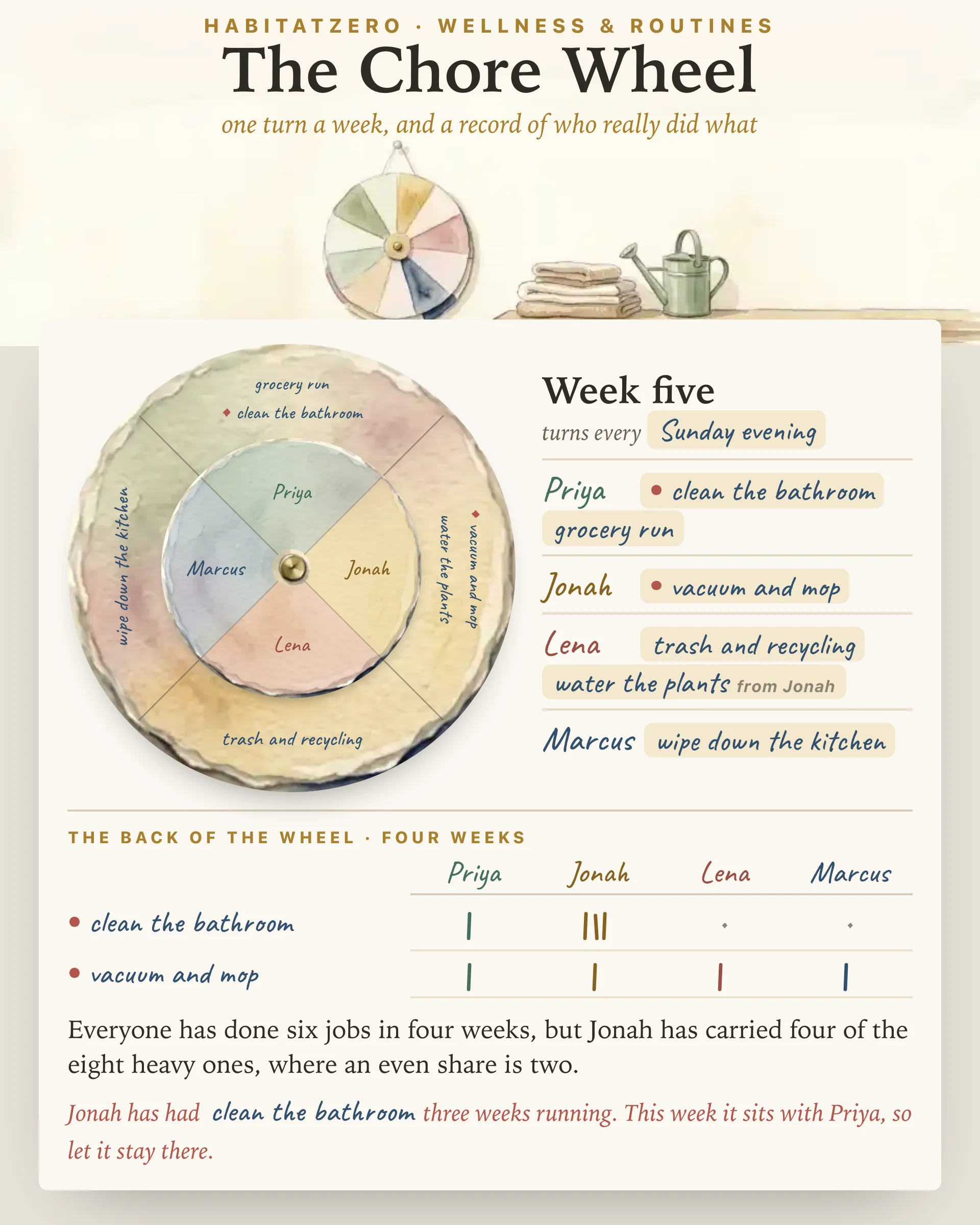
A classic chore wheel is two circles of card joined at the center by a brass paper fastener. The large circle carries the jobs around its rim. The small circle sits on top and carries the names, one wedge per person. Each week you turn the small circle one slice, and every name lands beside a new set of jobs. After a full lap, which takes as many weeks as there are people, everyone has done everything once.
Nobody chooses, so nobody haggles. The jobs nobody wants come around to everyone at the same pace, and the wheel answers the question before anyone has to ask it.
Many online chore wheels are spinners: tap a button and chance picks the job. That feels fair in the moment, but chance has no memory. Spin often enough and one roommate draws the bathroom three weeks in a row while another never sees it, which is exactly the resentment the wheel was meant to prevent. Use chance once, to decide where the first week starts, and let the rotation do the rest.
Start with the inner ring: the name of everyone who shares the work, up to six. Then fill the rim with up to eight jobs by tapping suggestions or writing your own, and mark the heavy ones, the jobs nobody volunteers for. When there are more jobs than people, each slice holds a few, and the page deals the heavy jobs into separate slices before doubling any up. When there are fewer jobs than people, someone gets a week off, and the turning shares that out too.
Under the wheel sits this week's assignment. Real weeks are messy, so trades are built in: tap a job and pick who actually did it. When the week is done, one tap turns the wheel and files the week away.
The back of the wheel is the part paper cannot do. It keeps a tally of who really did each job over the last twelve weeks, compares each person's share of the heavy jobs with an even share for the weeks they were in the house, and speaks up when one person has had the same job three weeks running. Trades are where fairness usually leaks away, one favor at a time, and the tally shows it without anyone having to accuse anyone.
To put the wheel on the fridge, print the page: the buttons drop away and the two circles come out full size, already lettered, with a small cross marking each center for the fastener.
Nobody has run a trial of chore wheels, so be wary of any promise that one will rescue a relationship. The research does show that the split of housework, and how people feel about it, is tied to how relationships go. In a study of couples in Israel, much of the link between who did the housework and marital quality ran through whether the split felt fair. A study of 487 couples found that the division of housework predicted relationship satisfaction, with the quality of communication carrying part of that link. A wheel will not make anyone talk better, but it takes a recurring decision out of the conversation.
For families there is a second reason to put children on the wheel. A US study that followed nearly ten thousand children found that kindergartners who did chores more often rated their own social and academic competence higher by third grade. That is an association, not proof, and it says nothing about wheels, but it is a fair argument for giving a six-year-old a real slice of the rim.
Tie the turn to something that already happens every week, like trash night or Sunday dinner, so it never depends on one person remembering. Name each job by what finished looks like: "wipe down the kitchen" leaves less room for argument than "kitchen". If the bathroom is the job that starts the fights, agree once on what it includes; The Bathroom Cleaning Checklist spells that out step by step.
Revisit the rim when the household changes: a new roommate, a new dog, a kid old enough for the laundry. Adding a name reshuffles the slices; the tally keeps what already happened.
A chore wheel suits two to six people who share the same set of weekly jobs: roommates, couples, and families with kids old enough to do real work. If you have not yet listed all the chores, start with The Household Chore List, which sorts them by how often they come around and adds up everyone's minutes. If your child is small and needs a box to check off each day more than a weekly rotation, a Printable Chore Chart will serve them better.
It is a pair of stacked paper circles: the chores are lettered around the rim of the large one, and the household's names sit on the small one on top. Turning the small circle one slice a week hands everybody a new set of jobs, so after a full lap each person has done each job once.
Cut two circles from card stock, the smaller about three fifths the width of the larger. Split both into one slice per person, letter the chores around the big rim and the names on the small circle, then pin them together through the centers with a brass paper fastener. This page draws both circles to size, so the only work left is cutting.
Each slice of the rim holds a small group of jobs instead of one, and the heavy jobs are spread out first so no slice carries two while another carries none. With fewer jobs than people, somebody gets a week off, and the turning shares those weeks out too.
Only to pick a starting point. Pure chance can give the same roommate the bathroom three weeks running, which is the very argument a chore wheel exists to settle. A steady one-slice turn guarantees that everyone meets every job once per lap.
The page shows a finished example household you can look over. Personalizing it in HabitatZero, which costs nothing, puts your own names and jobs on the wheel, turns it with you each week, keeps the record of trades, and sets out your own pair of circles for printing.
By the team behind Fabulous, the science-based self-care app used by over 30 million people.