The Overwhelm Recovery ProtocolWellness & Routines · ~5 min
About this template · Updated September 2026
In most houses with several children, chores settle into one of three shapes: the oldest does most of it, the youngest is quietly excused, or everyone does the same two jobs whatever their age. Lists of age-appropriate chores are easy to find. What they miss is the view across your own children that shows whether the work grows as they do.
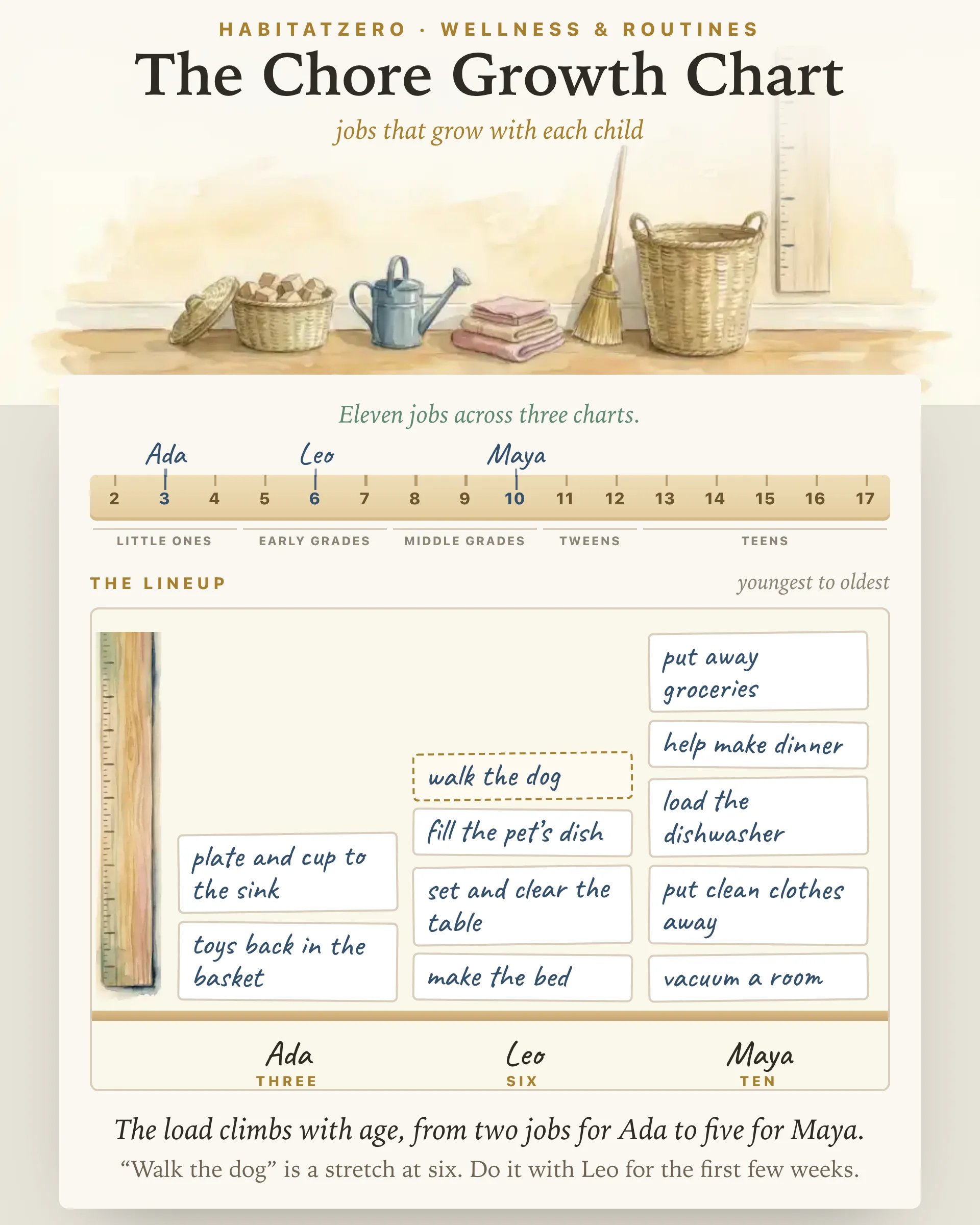
Here you mark each child on a ruler at their age and hand them jobs from the band that fits. Their charts then stand in a row from youngest to oldest, so you can see the shape of the load before anyone argues about it.
The bands follow the American Academy of Pediatrics' list of age-appropriate chores, which groups school-age children at five to seven, eight to ten, and eleven to twelve. For the youngest band the page leans on Cleveland Clinic's advice for toddlers and preschoolers, which says a child is ready to pitch in once they can follow an instruction or two.
Children keep the jobs of the younger bands, too; a ten-year-old still makes the bed. Treat each band as a starting point, not a deadline. A careful six-year-old may walk the dog happily, and a distracted eleven-year-old may need the eight-to-ten list a while longer.
Tap a child's age on the ruler and a pencil mark appears with their name; up to four children fit. Pick a child and the panel opens on the jobs for their band: tap one, borrow from a younger band, or write your own. A job from a band above their age stands dashed in the lineup as a stretch, the kind you do side by side for a few weeks. Each chart stops at six jobs.
The lineup is the point. Every chart stands on the same floor with the youngest on the left, so the tops should step up as you read across. The reading underneath names what it sees, whether that is a load climbing with age, a dip where a younger child holds more than an older one, a child with nothing yet, or an older child whose jobs all suit someone much smaller. When the shape is off, it ends with a first step toward fixing it. When the shape looks right, print it: every job gets seven day boxes, and the skyline survives on paper.
The best-known study followed nearly 10,000 American children from kindergarten. White, DeBoer and Scharf found that kids who did chores more often in kindergarten rated themselves more capable with schoolwork, friends and life in general by third grade, and that doing chores at any frequency went with better math scores. That is an association, built on parents' reports of how often chores happened. Families who hand out chores may differ in other ways, so the study cannot show that the chores made the difference.
Nothing in the research sets an ideal number of jobs for each age; the guidance only points in a direction. A University of Arkansas extension guide notes that older children can manage more complex tasks and more tasks overall, while younger ones need more guidance and fewer steps. The lineup follows that direction without pretending to measure effort. It counts jobs, not minutes, so a teenager's three big jobs can outweigh a seven-year-old's five small ones. You are the judge of that; the chart just puts the question where everyone can see it.
Add one new job at a time, especially for a child who has never had one, and praise the effort rather than the result; both come straight from the AAP's advice. Say what finished looks like: “books on the shelf and clothes in the hamper” works where “clean your room” does not.
If a teenager wants a say in their jobs and a link to pay, the chore chart for teens is built for that negotiation. To follow the week itself with the grown-ups included, use the family responsibility chart. For one child's week on the fridge, the printable chore chart is simpler.
Set it up at the start of a school year, after a birthday, or in a week when one child seems to carry the house. After each birthday, step that child's age up a year and their panel opens on the next band.
Many five-year-olds can make their bed, set and clear the table, fill a pet’s food dish, sort laundry and empty small wastebaskets. The American Academy of Pediatrics lists these for ages five to seven, so show each one a few times and stay close while it is new.
By eight to ten, the AAP list adds vacuuming, walking the dog, putting away their own laundry and the groceries, making a snack and helping with dinner. Loading the dishwasher usually fits this age as well.
Two- to four-year-olds do best with one-step jobs done beside a parent: toys back in a basket, a cup carried to the sink, books returned to a low shelf, plants watered, or the pet fed with help. Cleveland Clinic suggests starting once a child can follow a simple instruction.
Research does not give a set number. Pediatric advice is to add one new job at a time, avoid piling on too many, and expect more as children grow. This chart stops at six jobs per child so a printed column stays readable, and its lineup shows whether the older children really carry more.
The example on this page shows a filled-in family you can look through for free. Marking your own children, handing out their jobs and printing the charts happens in HabitatZero, which keeps the lineup ready for the next birthday.
By the team behind Fabulous, the science-based self-care app used by over 30 million people.