
The Overwhelm Recovery ProtocolWellness & Routines · ~5 min
About this template · Updated September 2026
Susie Faux, who opened a London boutique called Wardrobe in 1973, is the person credited with the capsule wardrobe. As she described it, well-chosen pieces should last for many seasons, and each season's shopping should add to the capsule rather than start it over. Donna Karan launched her own label in 1985 on the same logic, with a system she called seven easy pieces: a handful of interchangeable items meant to carry a wardrobe from day to evening and from weekday to weekend. This checklist is an independent tool built on their idea. Neither Faux nor Karan made it, checked it or has any connection to it.
The point of a capsule is not owning less for its own sake. It is owning pieces that combine: a skirt that works with most of your tops, a coat that goes over all of it, shoes you can wear with nearly everything on the rail. When the pieces cooperate, getting dressed stops being a daily puzzle.
Faux never fixed a size. Asked how big a capsule should be, she answered in the post linked above that it depends on the person and that there are no hard rules, only the principle that less is more. Courtney Carver's Project 333 later gave the idea a number: thirty-three items for three months, counting clothing, accessories, jewelry, outerwear and shoes, and leaving out underwear, sleepwear, loungewear and workout clothes. This page borrows that line about what stays off the count. It is not part of Project 333, and Carver has not reviewed it.
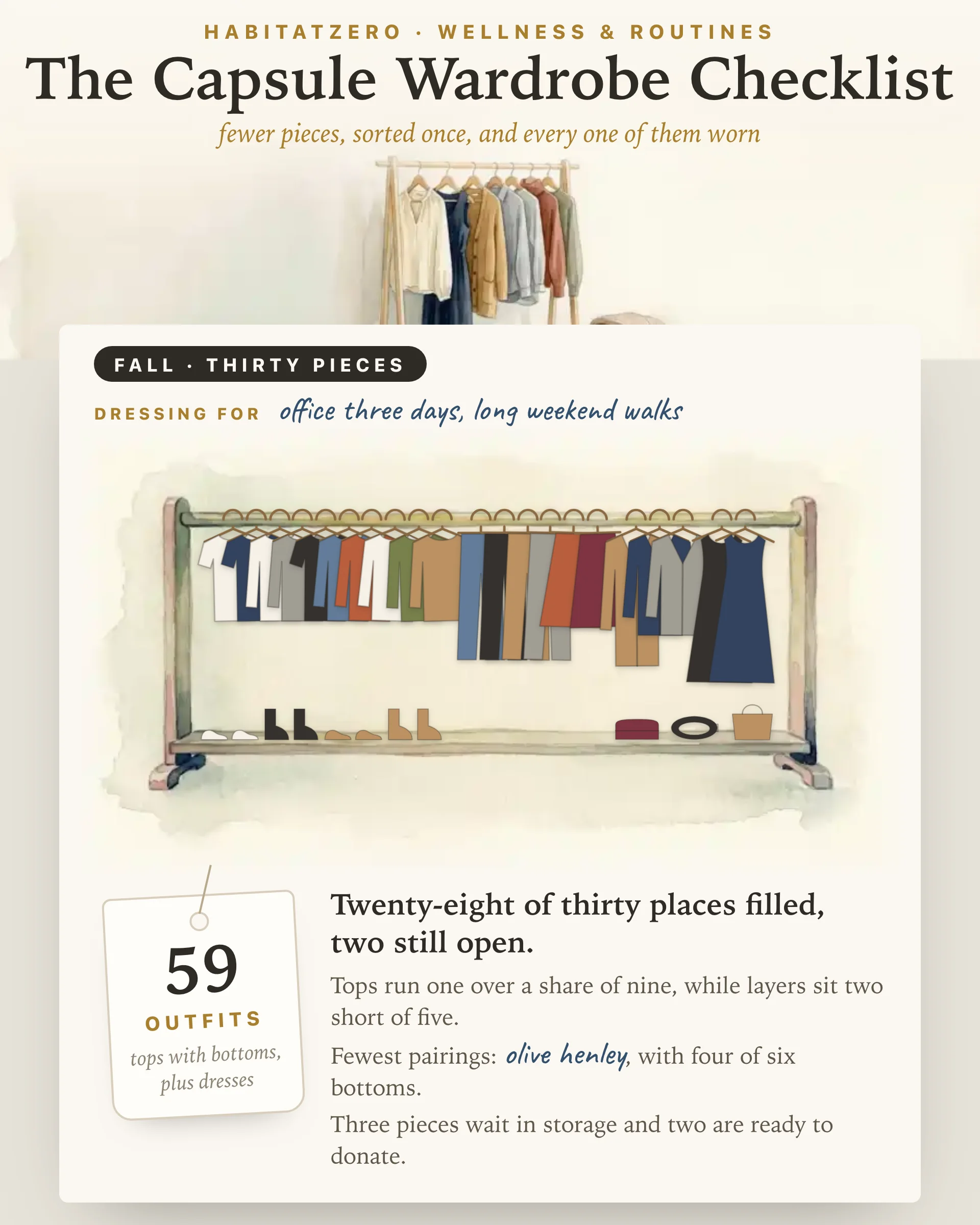
Start with the season the capsule has to carry you through, then a size between twenty-five and forty pieces. The sheet turns the size into a starting share for each category. A thirty-piece fall capsule, for example, asks for nine tops, six bottoms, five layers, two dresses, four pairs of shoes and four accessories. Treat the split as a place to begin: if you live in dresses, let them run over and let the tops run short.
Then sort one category at a time. Each one opens with that season's essentials, so you can tap what you already own and write in the rest. A color word in the name colors the piece, so an olive henley hangs olive; anything else gets a swatch from six neutrals and seven accents. Every piece is marked keep, store or donate. Kept pieces hang on the painted rail in their own colors, stored pieces wait for their season, and the donate list collects everything ready to leave the house.
The tag on the rail counts outfits: every top and bottom that go together, plus one for each dress. The rule behind it is simple. A neutral goes with anything, and two accent colors count as a pair only when they match. That makes the number a floor, not a verdict on your taste; if your rust skirt looks good with your olive sweater, trust your mirror. Under the tag, the sheet names the category running furthest over its share, the one furthest short, and the piece with the fewest pairings.
The arithmetic explains why capsule advice leans on neutrals. A black pair of trousers adds one outfit for every top you own. A wine skirt adds one only for each neutral top, plus any top in the same wine. Mark a few pieces and the pattern shows: the plain ones do the heavy lifting, and a bright one earns its place when it pairs with enough of the rest.
The count leaves shoes and layers out on purpose. Multiplying by every pair of shoes and every jacket turns a thirty-piece closet into hundreds of combinations, a figure nobody dresses by.
Research on capsule wardrobes is new and small. One study asked ten women about three weeks with a capsule, and they described feeling less stressed, caring less about trends, enjoying their style more and noticing what they bought. Another followed seven women through an eight-week capsule with journals and interviews; they built new dressing habits and got clearer about what to buy, how to care for their clothes and what to let go.
Both are small interview studies of volunteers who chose to try the idea, and neither compared them with people who kept their usual closets. They show what the experience can be like. They do not prove that a capsule makes anyone calmer, thriftier or more stylish. Treat a season on this rail as an experiment you get to judge yourself.
Use it at the turn of a season, with everything you might wear laid out on the bed. Mark each piece, box up what you are storing and put it out of sight, and take the donate pile out the same week. Come back when a piece wears out or a new one earns its place, and the counts follow.
If the closet needs a bigger clear-out first, Clothes to Keepsakes starts with clothes and moves through the rest of your things in order. For one overflowing closet, the Decluttering Checklist works a single area at a time, and The Declutter Challenge spreads small clear-outs across a month.
The clothes you would actually wear this season, sorted into tops, bottoms, layers, dresses, shoes and accessories. This one suggests seasonal essentials, such as a cream turtleneck, dark wash jeans and a camel coat for fall, and takes your own pieces too. Underwear, sleepwear, loungewear and workout clothes usually stay off the list.
No number is fixed. Susie Faux, the boutique owner credited with the idea, wrote that the right size varies from person to person. Project 333 sets thirty-three items for three months, and this checklist lets you choose anywhere from twenty-five to forty, so start with a size you could live in for one season.
Count every top and bottom that look right together, then add one for each dress. Ten tops and six bottoms make sixty outfits at most. This sheet pairs a neutral with anything and two accent colors only when they match, which is why a gray or navy piece adds more outfits than a bright one.
No. Project 333 is Courtney Carver's challenge, and its rules are published on her site, Be More with Less. This capsule sheet was built separately, borrows only her line about leaving underwear and workout clothes out of the count, and has not been reviewed or endorsed by her.
This page shows a sample rail you can look over. To sort your own closet, keep your marks from one sitting to the next and watch your outfit count move, open the checklist in HabitatZero, which is free.
By the team behind Fabulous, the science-based self-care app used by over 30 million people.


