
The Overwhelm Recovery ProtocolWellness & Routines · ~5 min
About this template · Updated November 2026
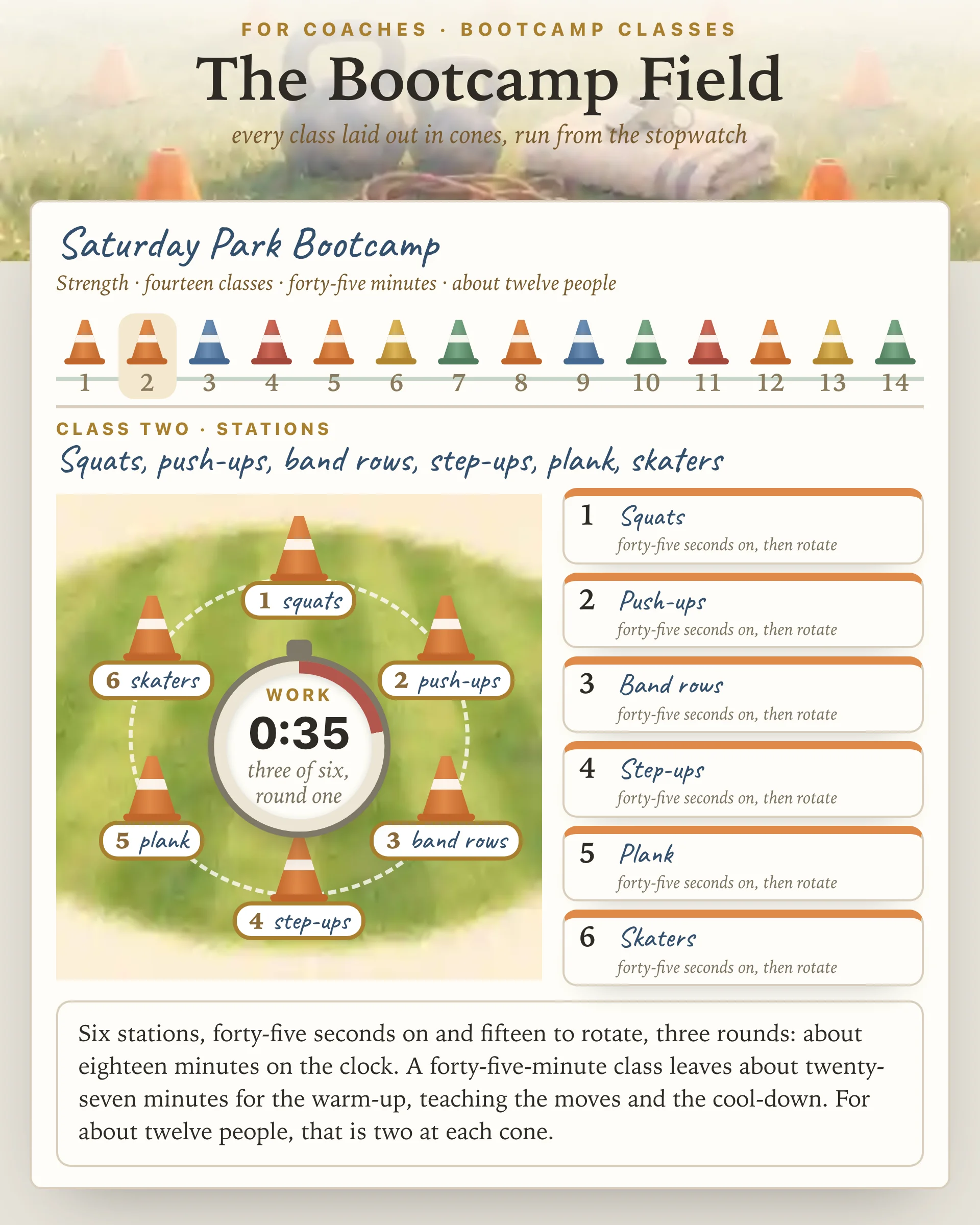
A bootcamp class is hard, simple work done together, usually on a patch of grass or an open gym floor: cones in a ring, partners trading turns, a timed block, a relay to finish. Planning a good one means knowing what goes at each cone, how long people work and rest, whether the circuit fits the hour you booked, and how to split whoever turns up. This sheet keeps those answers on one page, then runs the class for you.
A program of bootcamp workouts usually rotates a small set of formats across the weeks, so the same dozen moves never feel like the same class twice.
The bootcamp exercises themselves can stay plain: squats, lunges, push-ups, band rows, step-ups, planks, bridges and short runs.
Name your bootcamp, tap a focus, and choose seven, ten or fourteen classes. Every class fills from a starting plan: one to learn the moves, station circuits that gain a round as the weeks pass, partner days, AMRAPs and ladders in between, and a team relay that closes the program at any of the three lengths. Along the top, each class stands as a small cone in its format's color.
Tap a cone and that class opens on the field. Its moves stand as numbered cones on a chalk ring around a stopwatch, and the same moves sit below as station cards. Add a move with one tap, tap a move already in the class twice to take it out, or write over the line in your own words. A class holds eight cones and sixty characters, and when the sheet turns a move down it tells you which limit you reached. Switching the format resets the timing to suit it, and three steppers set the work, the rest and the rounds.
The reading under the cards does the arithmetic. It adds up the time on the clock, sets it against the length of your class, and says how many minutes are left for the warm-up, teaching the moves and the cool-down, or warns you when the circuit alone overruns. Set your usual group size and it also says how to split the room: two or three at each cone, six pairs, two teams of six.
When the class begins, press Start. The stopwatch counts down each work and rest interval, names what comes next and lights the cones in use. It keeps true time even when your phone locks in a pocket, and a pause never counts against the class. Print the station cards the evening before and set one beside each cone.
The sheet holds counts, never names: there is nowhere to note who came or how anyone did.
Circuit work has reasonable evidence behind it. A meta-analysis of resistance circuit-based training in healthy adults aged 18 to 65 found increases in both aerobic capacity and upper-body strength, with clear differences from control groups. It pooled small numbers, eight studies for each outcome, and most of those programs used weights rather than bodyweight moves on a lawn, so treat it as support for the format rather than a forecast for your class.
Training as a group may help too. A systematic review of group dynamics strategies in physical activity programs found that their effect on activity held up across seventeen studies, while noting that few of those studies measured why it worked.
For the week as a whole, the WHO 2020 guidelines on physical activity ask adults for 150 to 300 minutes of moderate activity, or 75 to 150 minutes of vigorous activity, plus regular muscle-strengthening work. A bootcamp class counts toward those totals, and how much depends on how hard each person works during it.
None of this predicts what any one person will gain from your program, and the sheet cannot see effort: the same forty-five seconds can be easy for one member and hard for the next.
Open it a week before a new block starts and print the first class's cards. Before each class, check the reading against the time you booked. Between blocks, the two-week group challenge gives your group a daily outline to follow at home, and for a single interval session the HIIT timer or the EMOM timer is the simpler tool.
The starting plans assume healthy adults without injuries. Teach an easier version of each move, let people stop anything that hurts, and ask anyone with pain, a heart or blood pressure condition, a recent injury or a pregnancy to talk with a clinician before their first class with you.
It is a group class built from simple, demanding moves set out at stations and done in timed rounds, often outdoors. Most programs mix circuits with partner drills, AMRAPs, ladders and relays, so the same moves feel different from one week to the next.
Moves that need little kit and suit mixed abilities: squats, lunges, push-ups, band or dumbbell rows, step-ups, planks, bridges and short runs. Give each one an easier version so everyone in the group can find a level that fits.
Start from the length of the class, keep room for a warm-up and a cool-down, then pick a format and fit the moves, intervals and rounds into the time left. This planner adds up each class and tells you how much of the hour remains around it.
Rotate the format across the weeks: a station circuit one day, partner drills the next, then an AMRAP, a ladder that adds two reps each time through, and a team relay to close the block. Repeating a circuit later with one more round gives the group a familiar class with a little more work in it.
Yes. Laying out the classes, running the clock and printing station cards all work here at no cost. Personalize keeps the whole program in a free Salon account from the makers of Fabulous, ready for your next block.
By the team behind Fabulous, the science-based self-care app used by over 30 million people.


