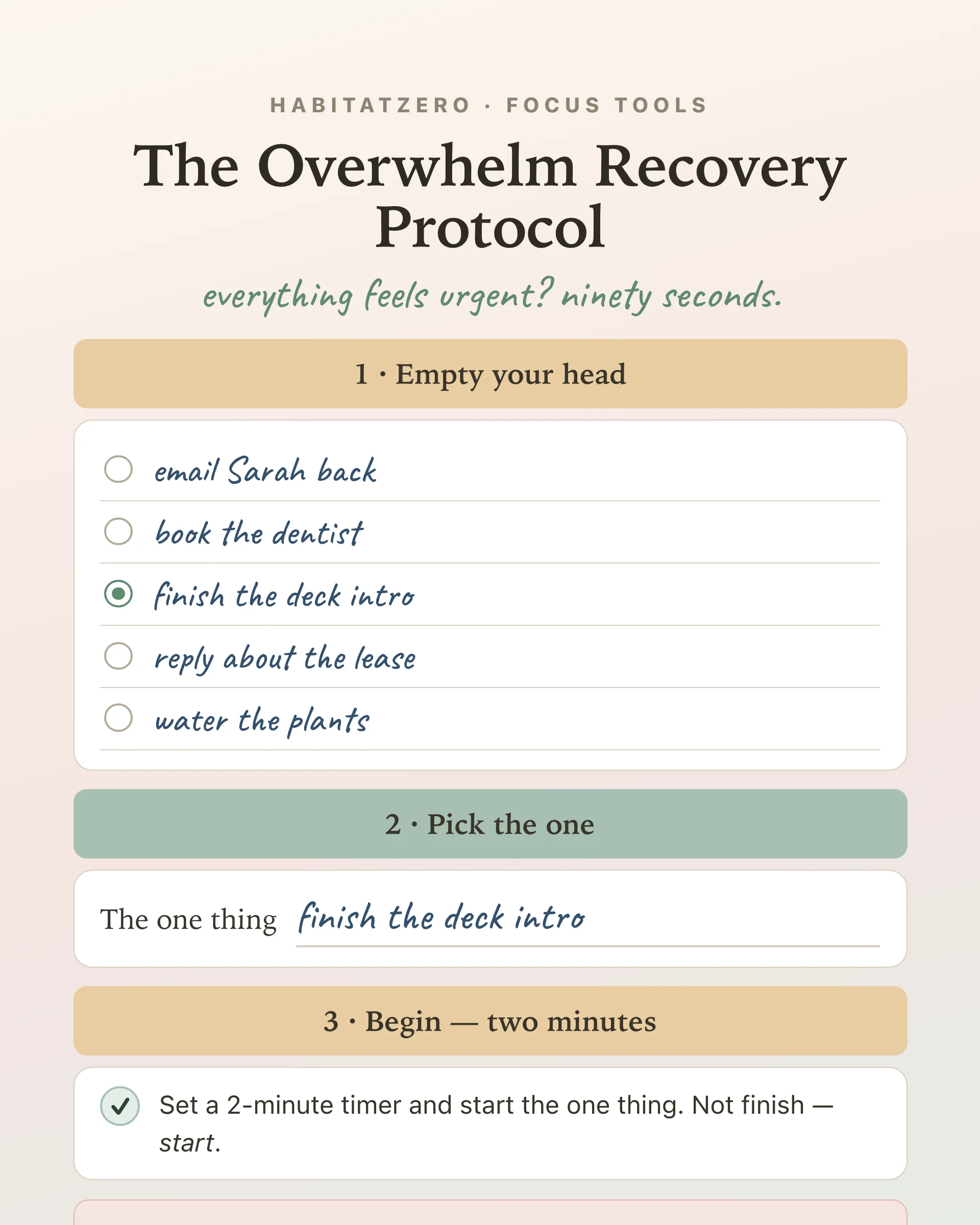
The Overwhelm Recovery ProtocolWellness & Routines · ~5 min
About this template · Updated September 2026
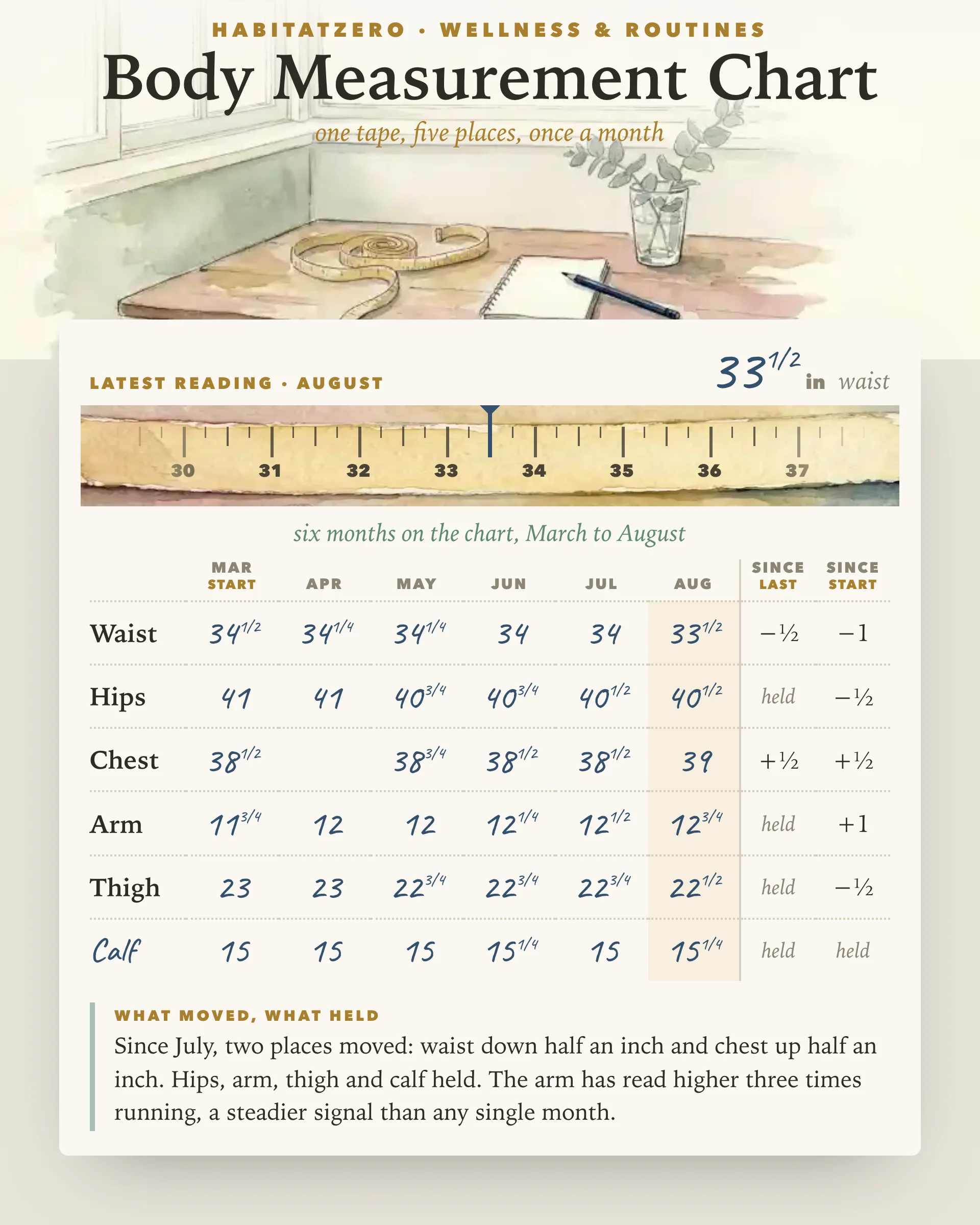
A body measurement chart is a modest, useful thing: the same five circumferences, taken the same way once a month, written in columns so each month sits beside the last. This one keeps the paper chart's shape and adds the arithmetic. You slide a painted tape to each number, the month fills in, and a change column tells you in plain words what moved since last time and what held. It records. It does not grade.
A tape answers a narrower question than a mirror or a scale. It gives the size of one place on your body, at one landmark, on one morning, and that narrowness is the point. Strength work might show up in the upper arm while the waist holds still; a new walking habit might move nothing for months, and the chart will say so without drama.
The catch is that tape readings wobble. A review of the research on waist measurement found reported errors ranging from under a centimeter to fifteen centimeters, and concluded that in a single person a real change can be hard to separate from measuring noise. The authors' advice matches this page's: one fixed method, practiced, with repeat readings. Measuring monthly rather than every few days gives any real change time to grow larger than the wobble.
Landmarks matter more than the tape.
The WHO report adds details that shift your numbers more than you might expect. The tape should sit snug without pressing into the skin. Read the waist at the end of an ordinary breath out, because pulling the belly in shrinks it. Whatever is in your stomach changes the waist too, which is why a morning before breakfast is the easiest moment to repeat. Take every reading twice, and if the pair lands more than a centimeter apart, measure again.
Pick a place, then drag the painted tape until the needle sits on your number. The minus and plus buttons nudge it by a quarter inch, or half a centimeter once you switch units, and the arrow keys work as well. Write it in and the sheet moves on to the next place, so a whole month takes a few minutes. Tap any number on the chart to rewrite or clear it, step back a month to add older readings, and add up to three places of your own, such as a calf or the neck.
Each row ends in two change figures, one since the previous reading and one since the start. A change of a centimeter or less shows as held, following the WHO repeat rule above. Under the chart, a short paragraph names which measurements moved and which held, and it notices when one place has moved the same way three or more times running, which says more than any single month.
A tape cannot tell muscle from fat from water, and it cannot say why a number changed. That is part of why this chart carries no ideal ranges, no target lines and no colors for good or bad. Health organizations do use waist size in clinical screening, with cut-offs set for whole populations; if that is your question, bring it to a clinician rather than to a chart.
If tracking your body starts to feel like a verdict instead of a record, put the tape away for a while. For some people, including anyone recovering from disordered eating, not measuring at all is the better choice, and a clinician can help decide.
Use it through a training block, when coming back to exercise after a long break, when a scale feels like the wrong instrument, or simply to keep your sizes current for sewing and fitting clothes. It pairs well with a Weekly Fitness Reflection for the story of each week and a 12-Week Fitness Planner for the season around it. Measure on the same morning each month, write it in, and let the columns do the remembering.
Stand relaxed with your feet together and wrap a soft tape around bare skin, snug but not pressing in, level with the floor. Take the waist after an ordinary breath out, the hips at their widest, the chest under the arms, the upper arm halfway to the elbow and one thigh at its widest. Read each one twice.
The World Health Organization protocol uses the point halfway between your lowest rib and the top of your hip bone. The US National Institutes of Health and the national NHANES survey measure at the top of the hip bone instead. Either spot works for tracking, as long as it stays the same spot every month.
Once a month is plenty. Two careful readings of the same waist can differ by a centimeter or more, so weekly changes are mostly measuring noise. A month gives a real change time to outgrow that wobble, and this chart points out any place that moves the same way three times running.
Stand with your feet together and find the widest part of your buttocks by sliding the tape up and down, ideally in front of a mirror, until it reads largest. Keep the tape parallel to the floor all the way round, resting on the body without squeezing, and note that same level for next month.
You can look through a filled example chart on this page without installing anything. To slide the tape to your own numbers and keep the columns growing month after month, personalize it in HabitatZero, which costs nothing.
By the team behind Fabulous, the science-based self-care app used by over 30 million people.