The Overwhelm Recovery ProtocolWellness & Routines · ~5 min
About this template · Updated September 2026
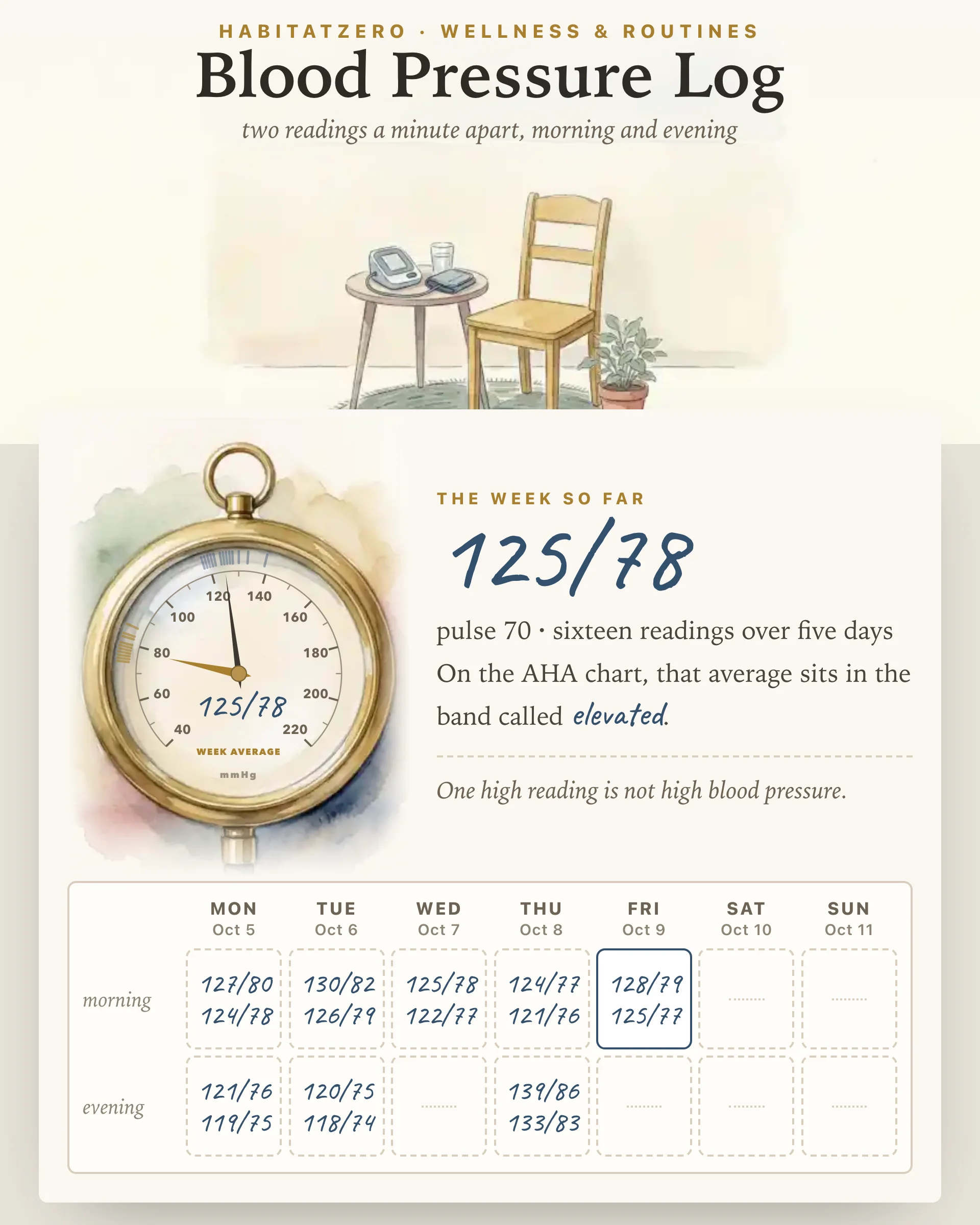
One reading tells you what your blood pressure was for about a minute, on one morning, in one chair. Your clinician needs something else: the shape of an ordinary week, mornings and evenings, busy days and quiet ones. A blood pressure log is how that week travels from your arm to their desk.
This page is that log, laid out as a week. You write each sitting in by hand, a painted dial marks every reading and settles on the average once there are enough, and the finished week prints as a single page.
Most of the wobble in home readings comes from how they are taken, so follow the American Heart Association's advice on measuring at home closely. Skip caffeine, exercise and smoking for half an hour beforehand, and empty your bladder. Sit with your back supported, both feet on the floor and your legs uncrossed, with your arm resting on a table so the cuff sits at heart height, on bare skin just above the bend of the elbow. Then give it five quiet minutes, with no talking and no phone, and take two readings a minute apart. Write both down.
The joint policy statement on home monitoring from the AHA and the American Medical Association describes the usual schedule: two readings at least a minute apart, morning and evening, ideally for seven days. That makes twenty-eight readings; the minimum is three days and twelve readings. It is specific about the arithmetic too: what counts is the average of every top and bottom number across the period, not a glance down the column. Some protocols also drop the first day's readings, an option your clinician may prefer.
The sitting slip holds one morning or one evening. Its timer counts the five quiet minutes and then the minute between readings. Each number goes in by hand: top, bottom and pulse. A pair whose bottom number comes out larger than the top is flagged and stays out of the average. Up to two short notes can ride along with each sitting, such as after coffee or poor sleep, because context often explains an odd number.
Every reading leaves a pencil mark on the dial's rim, blue for top numbers and gold for bottom ones. The hands stay at rest until the log holds twelve readings over at least three days, then swing to the average of everything written so far, and the page names the band that average falls in. The week card below keeps all seven days in view; days that have not come yet stay closed, and the arrows beside the dates slide the week earlier or later without moving any reading off the day it was taken.
The AHA's chart of blood pressure categories sorts readings into normal (below 120 over 80), elevated (120 to 129 with a bottom number under 80), stage 1 hypertension (130 to 139, or 80 to 89) and stage 2 hypertension (140 or more, or 90 or more). Its top band changed names in 2025: what the older chart called a hypertensive crisis is now severe hypertension, above 180 over 120, with hypertensive emergency kept for readings that high alongside symptoms, in line with the 2025 AHA/ACC guideline. When your two numbers land in different bands, the higher band applies.
Two caveats sit beside that chart. Its categories were drawn from readings taken in a clinic, and the guideline matches home values to them differently near the top: a home average of 135 over 85 lines up with 140 over 90 in the office. And a band is not a diagnosis; the AHA says plainly that only a doctor or other medical professional can confirm high blood pressure. One high reading is not high blood pressure. It is one moment, which is why the dial waits for a week's worth before it moves.
If you also have chest pain, shortness of breath, back pain, numbness, weakness, a change in vision or trouble speaking, call 911 right away and do not wait to see whether it comes down. If you feel fine, wait at least a minute and measure again, and if the second reading is still that high, contact your clinician immediately. The page shows this beside any reading that crosses the line.
Home readings pay off when someone acts on them. The 2025 guideline notes that home monitoring alone brings only modest drops in clinic readings, with larger gains when it is paired with support such as a care team adjusting treatment from the numbers. So keep the log in the week before an appointment, after a change in treatment, or whenever your clinician asks for a home week, and bring the printed page.
If your mornings start with coffee, take the reading first; the Caffeine Calculator shows how long each cup stays with you. If you keep glucose readings for the same appointments, the Blood Sugar Log works alongside this one, and if poor sleep keeps turning up in your notes, the Sleep Log can show the pattern.
Sit with your back supported, feet on the floor and your arm resting at heart height, then rest for five quiet minutes. Take two readings a minute apart and write down the top number, the bottom number and the pulse for each one. Repeat every morning and evening at roughly the same times, and add a short note when something was off, such as coffee beforehand or a rushed start.
The joint statement on home readings from the American Heart Association and the American Medical Association describes two readings a minute apart, morning and evening, ideally for seven days. That is twenty-eight readings, with three days and twelve readings as the minimum. The figure that counts is the average of every reading rather than a glance down the column, so this page waits for twelve readings over three days before it shows one.
On the American Heart Association chart, normal is below 120 over 80 and elevated is 120 to 129 with a bottom number under 80. Stage 1 hypertension is 130 to 139 or 80 to 89, and stage 2 starts at 140 or 90. Above 180 over 120 is severe hypertension. When the two numbers fall in different bands, the higher band applies, and only a clinician can confirm a diagnosis.
If you also have chest pain, shortness of breath, back pain, numbness, weakness, a change in vision or trouble speaking, call 911 and do not wait to see whether it comes down. If you feel fine, wait at least a minute and measure again, and if the second reading is still that high, contact your health care professional right away. That is the American Heart Association's own advice.
Yes. Once you keep the log in HabitatZero, which costs nothing, the print button lays the whole week out on one page: every reading with its pulse and notes, the average of all of them, and the band that average sits in. The version on this page is a filled example to look around before you start your own.
By the team behind Fabulous, the science-based self-care app used by over 30 million people.