
Leaves on a StreamEmotional Fitness · ~3 min
About this template · Updated September 2026
Some mornings the worry is awake before you are. Your eyes open, your chest is already tight, and the day's list starts reading itself aloud. An anxiety morning routine will not stop that first wave. What it can do is give the next hour a shape, so you are not making decisions while the wave passes, and over a few weeks show which parts of that hour go with calmer mornings.
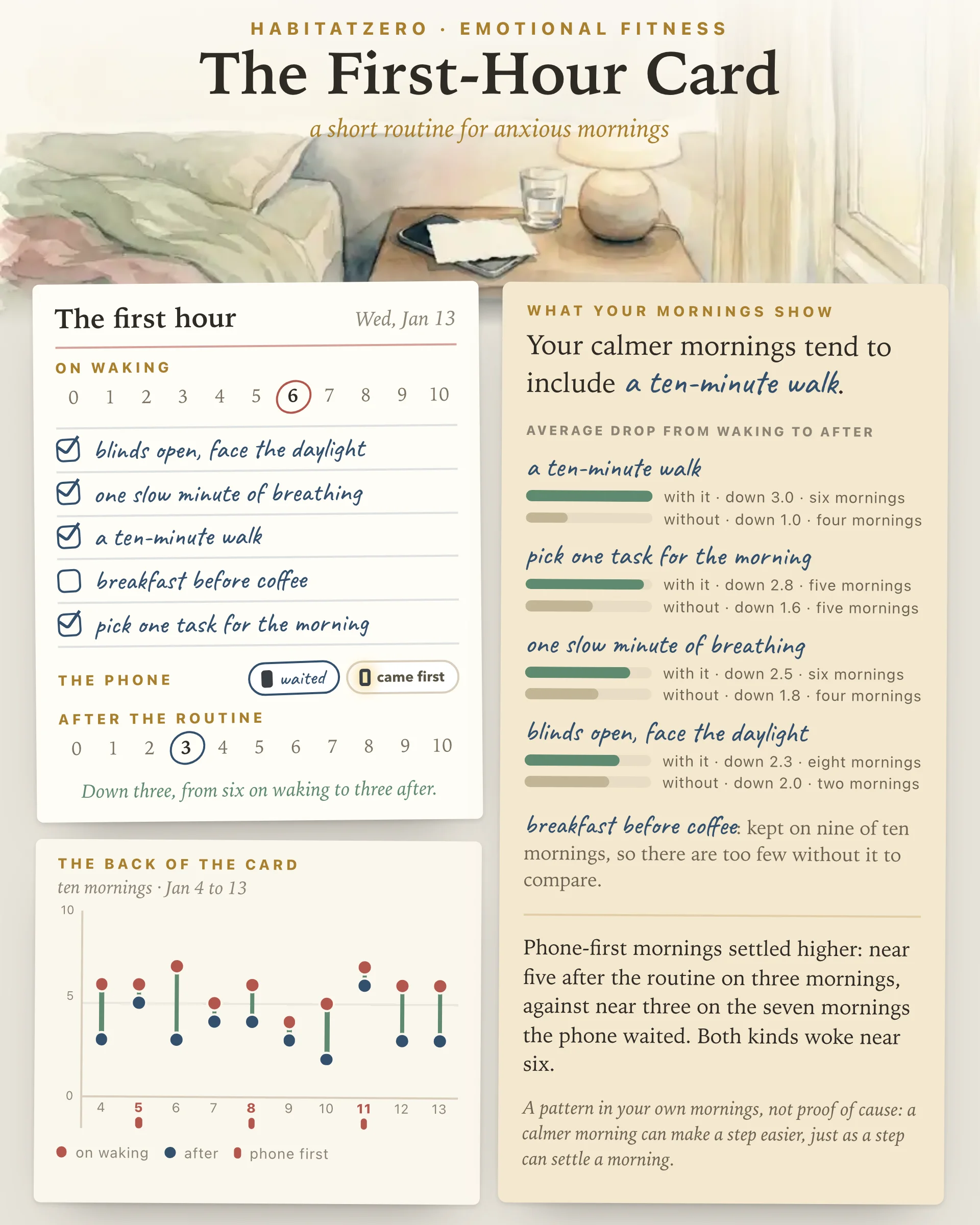
This page puts that routine on an index card. You choose a handful of steps, and each morning you circle two numbers: one when you wake, and one when the steps are done. The card keeps the arithmetic.
Cortisol rises sharply soon after you wake. This rise, the cortisol awakening response, is a well-described feature of the stress system, yet a review of what is known about it found that its exact function had not been worked out, and its authors suspected that anticipating the day ahead plays a part. It is tempting to blame morning anxiety on it, but the evidence does not support that yet: a structured review of cortisol studies in anxiety disorders turned up intriguing findings but no consistent pattern across panic disorder, generalized anxiety, phobias and social anxiety. So be wary of pages that promise to fix your cortisol.
The suggestions come in six kinds, each cheap to try. Pick three to five; the card holds six, because a short hour you keep beats a long one you drop by Thursday.
News, messages and feeds get their own line instead of a step. Each morning you mark whether the phone waited or came first.
When you wake, circle a number from zero, calm, to ten, as bad as it gets. Check off each step as it happens, mark the phone line, and circle a second number once the steps are done. The card reads the morning back (down three, from six to three) and draws it on the back of the card as a short line from how you woke to how you felt later.
After four mornings with both numbers, the reading opens. For each step, it compares the average drop on mornings you kept it with mornings you skipped it, once it has two of each. It also sets phone-first mornings beside the ones where the phone waited, and says whether they settled higher and whether they started higher too.
The card shows patterns in your own mornings, not causes. A calm morning makes a walk easier, just as a walk may settle a morning. Steps also travel together: if you mostly skip the walk on the days you grab the phone, the card cannot pull the two apart, and it says so. Ten or twenty mornings are a small sample, so let the reading choose your next experiment rather than deliver a verdict.
This is a self-help routine, not treatment for anxiety. If anxiety wakes you most mornings, or arrives with panic attacks, chest pain or breathlessness, see a doctor: those symptoms deserve a proper look, and chest pain can have causes other than anxiety. Sudden or severe chest pain is an emergency: call 911 or your local emergency number. If the dread on waking ever turns into thoughts of not wanting to wake up at all, call or text 988 in the US, or your local emergency number, today.
Set the card up the evening before, while tomorrow is still a plan. Keep it for three weeks, then read the back and change one thing at a time. Twenty-one mornings fill a card, and a fresh one keeps your steps while the count starts over.
A short one you can keep on a bad day. The steps worth trying are small: the same wake time every day, some daylight, a minute of slow breathing or grounding, a little movement, food before or with coffee, the phone held back, and one planned task. Which of them go with calmer mornings for you is what the card is built to find out.
No one knows for sure. Cortisol rises sharply soon after waking, and that rise is real, but studies of cortisol in anxiety disorders have not found a consistent pattern, so it is not a proven cause. Plainer things can play a part too, like a short night, a hard day ahead, or reading the news before your feet reach the floor.
There is rarely a single switch. What tends to help is making the first hour lighter: fewer decisions, the news and messages later, some movement, and less caffeine if you are sensitive to it. Logging two numbers a morning for a few weeks shows which changes help you. If anxiety wakes you most days, or comes with panic, chest pain or breathlessness, see a doctor.
It can. In a meta-analysis of caffeine challenge studies, a dose of about five cups of coffee brought on panic attacks in roughly half the people with panic disorder and raised anxiety in healthy adults too, while far less is known about ordinary amounts. Eating first or keeping the first cup small is an easy experiment, and the card will show whether it changes your mornings.
The page shows a filled-in card you can look over. Keeping your own, with your steps and a reading that grows each morning, means personalizing it in HabitatZero, which costs nothing.
By the team behind Fabulous, the science-based self-care app used by over 30 million people.


